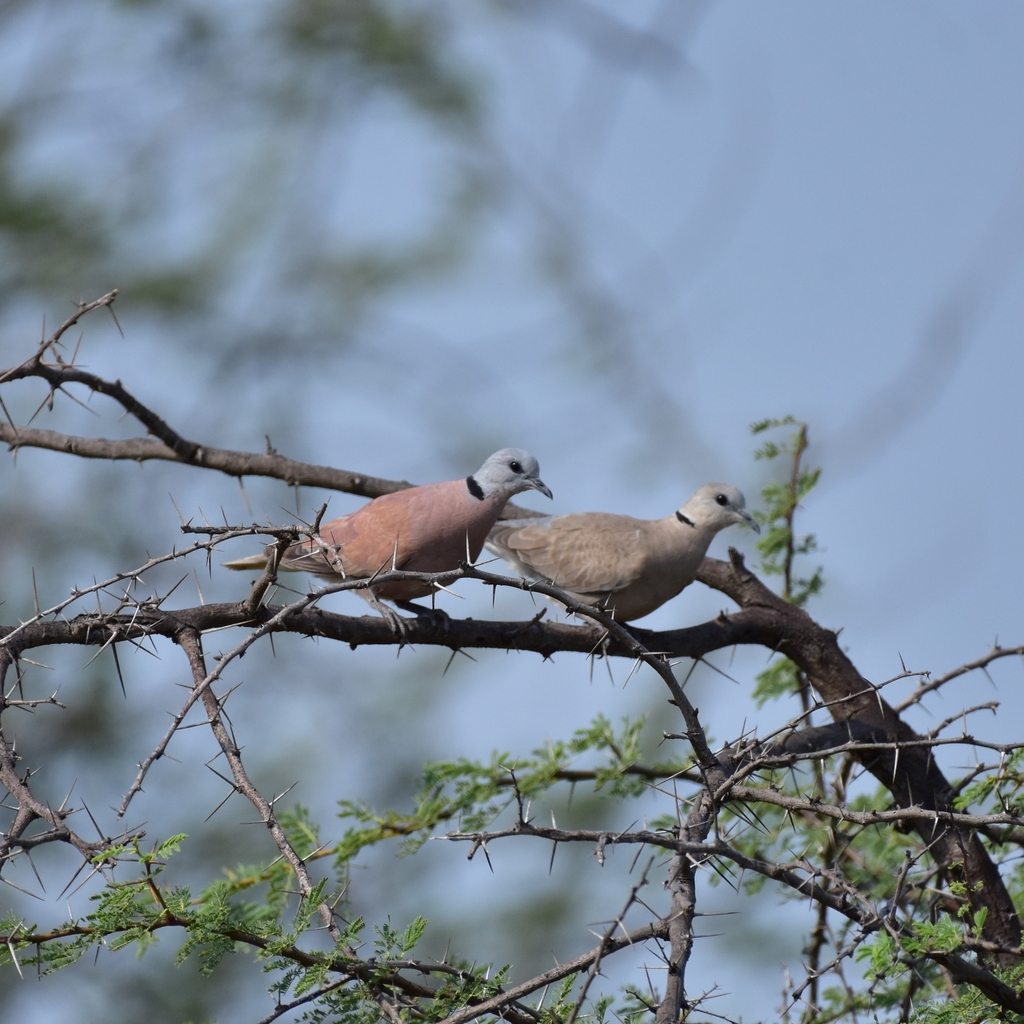
Red Collared Dove
Photo © Renjith Jacob Mathews
Photo © Renjith Jacob Mathews — CC BY 4.0 — Source: iNaturalist #169947436Identification
The red collared dove is a small pigeon, measuring 20.5–23 cm in length and weighing around 104 g. Sexual dimorphism is pronounced in this species. Males are distinctly handsome, featuring a blue-grey head contrasting sharply with a light red-brown body, and a characteristic black ring encircling the neck. Females are considerably plainer, with overall pinkish-brown plumage similar to the larger Eurasian collared dove, making them less conspicuous in the field.
Range & Habitat
This is an Oriental plains species with two recognized subspecies distributed across Asia. One subspecies ranges from eastern Nepal, northeastern India, and northeastern Tibet through northern China to the Philippines; the other inhabits Pakistan, peninsular India, and western Nepal. The species extends to Taiwan and the Philippines but remains uncommon in the Indonesian archipelago. It shows interesting migratory behaviour, with summer movements into cultivated valleys of Afghanistan where breeding occurs. Throughout much of India and especially Punjab, it is the most common dove species.
Red collared doves favour well-wooded habitats, particularly canal and roadside tree plantations, avoiding extensive desert regions and rocky foothills. Upon arrival in new areas during migration, birds gather in small flocks before dispersing into pairs for breeding.
Behaviour & Diet
While specific dietary details are limited in available sources, like other doves this species is primarily granivorous. Red collared doves are notably social, assembling in small flocks during migration before establishing breeding territories and pairs. Their breeding biology is tied to seasonal movements and resource availability in cultivated landscapes.
Best Time & Places to See It
The red collared dove is most reliably encountered in Punjab, where it is the dominant dove species. In India and Afghanistan, timing your visit for the breeding season will increase sighting probability, as summer migrants arrive and establish territories in wooded valleys and plantations. Look for them in cultivated areas with good tree cover along canals, roads, and agricultural lands rather than in open desert or rocky terrain.
Photography Tips
Male red collared doves offer superior photographic opportunities due to their striking blue-grey heads and contrasting red-brown plumage. Photograph them in early morning or late afternoon light to best capture the subtle colour gradations of the male's plumage and the metallic sheen often visible on the neck ring. The females' pale colouring can be challenging; use fill flash or shoot against backlit conditions to bring out detail. Look for perched birds on roadside trees and plantations, where they are most accessible for photography.
Kanha Tiger Reserve
Bandhavgarh National Park
Banke National Park
Bardiya National Park
Bogani Nani Wartabone National Park
Chitwan National Park
Doi Inthanon National Park
Gaoligong Mountain National Nature Reserve
Giant Panda National Park
Nothing matches these filters.
No community photos yet. Log in to add the first one.
No community observations of this species yet.