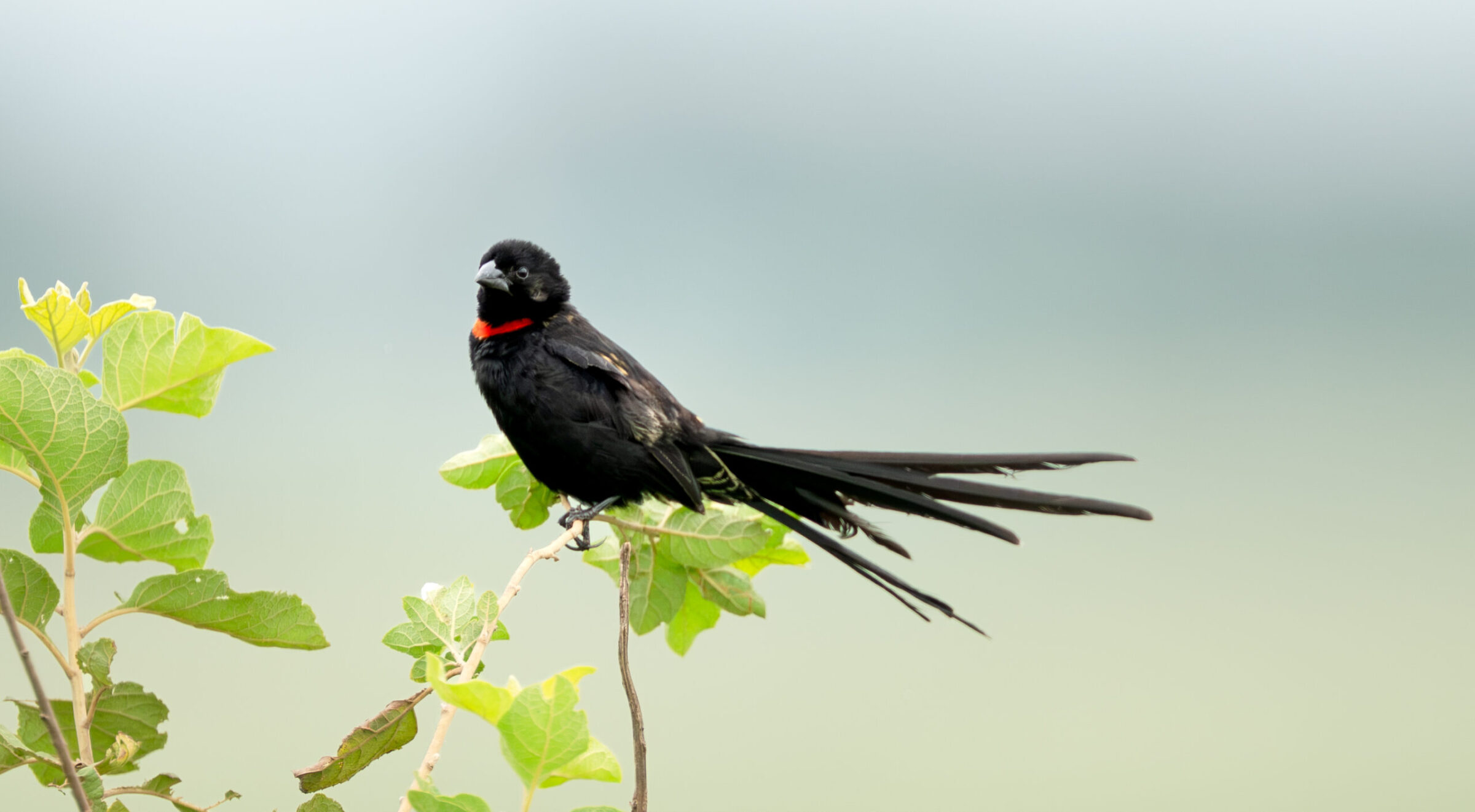
Red-collared Widowbird
Photo © wildatlasguide
Photo © wildatlasguide — Used with permissionIdentification
The red-collared widowbird is a striking weaver with pronounced sexual dimorphism. Breeding males are unmistakable: jet-black plumage adorned with a brilliant crescent-shaped red chest patch and an exceptionally long tail reaching approximately 22 cm. Females and non-breeding males are far more subdued, displaying streaky dull brown plumage with short tails around 4 cm. Males measure about 25 cm in length, while females are considerably smaller at just 13 cm. The red carotenoid badge varies noticeably in brightness and hue among individuals, making each bird distinctive to keen observers.
Range & Habitat
This species is distributed throughout Eastern and Southern Africa, inhabiting open grasslands, agricultural areas, forest clearings, and sparsely wooded slopes. Red-collared widowbirds favour landscapes with limited tree coverage, thriving in habitats where grass is abundant and ground feeding is productive. They often congregate with other weaver species including fan-tailed widowbirds, southern red bishops, and yellow bishops, creating impressive mixed-species flocks.
Behaviour & Diet
Red-collared widowbirds are highly gregarious, forming roosts of 50 to 100 individuals that feed together on the ground. They subsist primarily on grass seeds, particularly sorghum, supplemented by nectar, small berries, and invertebrates including ants, caterpillars, and termites. The breeding season spans October to April, during which males establish territories crucial to their reproductive success. Males provide only nest sites; females construct and maintain the oval nests, lining them with grass and laying clutches of 2–4 greyish or blue-green speckled eggs. Incubation and all chick-feeding duties fall entirely to females, with fledging occurring after 14–17 days.
Best Time & Places to See It
The breeding season from October to April offers the best opportunity to observe males in their stunning breeding plumage with full tail displays and vibrant red collars. Look for this species in open grasslands and agricultural areas throughout Eastern and Southern Africa, particularly in habitats with extensive grass cover. Mixed-species roosts provide excellent viewing opportunities, as birds often feed in accessible, open terrain where they are relatively approachable.
Photography Tips
Photograph breeding males during the October-April season to capture the dramatic black plumage, elongated tail, and brilliant red chest badge. The high variation in carotenoid coloration among males offers opportunities to document individual differences. Early morning ground feeding sessions provide excellent light and close approach opportunities. Females and non-breeding males require patience but reward careful stalking with intimate portraits of their subtle brown streaking. Capture territorial males in defensive postures for behavioural interest, and frame feeding flocks against grassland backdrops to convey their gregarious nature.
Arusha National Park
Tanzania
+555 birds+16 mammals
Where the slopes of Mount Mawenzi rise above the Arusha region, a compact yet ecologically rich national park unfolds across montane forest, moorland, and alpine zones.…
VIEW NATIONAL PARKVirunga National Park
Uganda
+418 birds+13 mammals
Where the Western Rift Valley fractures the landscape of North Kivu, Virunga National Park sprawls across terrain as geologically dramatic as it is ecologically vital. Volcanic…
VIEW NATIONAL PARKBwindi Impenetrable National Park
Kanyashogi, Uganda
+603 birds+26 mammals
Steep ridges cloaked in montane forest rise from Uganda's southwestern borderlands, where the landscape grows so dense and tangled that early explorers named it impenetrable. At…
VIEW NATIONAL PARKKidepo Valley National Park
Uganda
+478 birds+24 mammals
Where the Narus and Kidepo rivers carve through northeastern Uganda's semi-arid lowlands, a landscape of sparse acacia woodland, grassland, and riverine thickets creates one of East…
VIEW NATIONAL PARKMurchison Falls National Park
Uganda
+608 birds+33 mammals
Where the Victoria Nile compresses through a narrow gorge and explodes across a 45-meter precipice, the landscape speaks in thunder. Murchison Falls National Park sprawls across…
VIEW NATIONAL PARKMgahinga Gorilla National Park
Cyanika, Uganda
+429 birds+6 mammals
Where the Virunga Mountains rise steeply from the Uganda–Rwanda–Democratic Republic of Congo frontier, montane forest cloaks the volcanic slopes in a dense, moisture-laden embrace. Mgahinga Gorilla…
VIEW NATIONAL PARKToro-Semliki Proposed National Park
Uganda
+474 birds+5 mammals
Where the Albertine Rift's western escarpment rises above the Semliki River valley, a vast mosaic of forest, savanna and wetland converges to create one of East…
VIEW NATIONAL PARKQueen Elizabeth National Park
Uganda
+672 birds+30 mammals
Across the southwestern escarpment of Uganda, where the Western Rift Valley descends through ancient volcanic terrain, Queen Elizabeth National Park sprawls across more than 8,300 square…
VIEW NATIONAL PARKMabamba Swamp
Memere, Uganda
+464 birds+2 mammals
Across the Central Region of Uganda spreads one of Africa's most biodiverse freshwater wetlands, a sprawling nature reserve of roughly 283 square kilometres where papyrus swamps…
VIEW NATURE RESERVEPilanesberg National Park
Moses Kotane Local Municipality, South Africa
+364 birds+49 mammals
Granite peaks and volcanic ridges rise unexpectedly from the savanna floor across this 734-square-kilometre expanse in the North West province, creating a landscape of profound ecological…
VIEW NATIONAL PARKKruger National Park
Ba-Phalaborwa Local Municipality, South Africa
+540 birds+91 mammals
Across the low-lying savanna of northeastern South Africa unfolds one of Africa's largest and most ecologically intact protected areas, where acacia woodlands merge into mopane scrub…
VIEW NATIONAL PARKMountain Zebra National Park
Inxuba Yethemba Local Municipality, South Africa
+265 birds+35 mammals
Across the windswept plateaus and deeply incised valleys of the Eastern Cape's interior, Mountain Zebra National Park unfolds as a landscape of geological drama and ecological…
VIEW NATIONAL PARKAddo Elephant National Park
Sundays River Valley Local Municipality, South Africa
+388 birds+55 mammals
Where the Eastern Cape's semi-arid scrublands meet transitional woodland, Addo sprawls across 13,478 square kilometres of one of southern Africa's most biodiverse landscapes. The terrain rises…
VIEW NATIONAL PARKIthala Game Reserve
uPhongolo Local Municipality, South Africa
+328 birds+26 mammals
Rolling thornbush savanna and acacia woodland dominate the landscape of this 494-square-kilometre national park in KwaZulu-Natal's uPhongolo Local Municipality, where granite outcrops punctuate grassland plateaus and…
VIEW NATIONAL PARKMarakele National Park
Modimolle Local Municipality, South Africa
+341 birds+36 mammals
Granite ridges and sprawling grasslands dominate this 1,176-square-kilometre reserve in Limpopo's heartland, where bushveld transitions between rocky outcrops and open savanna. The park's rugged topography creates…
VIEW NATIONAL PARKZiwa Rhino and Wildlife Ranch
Nakasongola, Uganda
+359 birds+11 mammals
Where papyrus wetlands merge into sprawling savanna, Uganda's central landscape opens into one of East Africa's most vital rhino recovery zones. Ziwa Rhino and Wildlife Ranch…
VIEW WILDLIFE SANCTUARYNairobi National Park
Nairobi, Kenya
+515 birds+35 mammals
Just minutes from Kenya's capital, where the Nairobi River winds through acacia woodland and open grassland, lies one of Africa's most paradoxical wildlife sanctuaries. The park's…
VIEW NATIONAL PARKAberdare National Park
Mweiga ward, Kenya
+394 birds+30 mammals
Where the central highlands of Kenya rise to their elemental grandeur, the Aberdare range unfolds across Nyeri County as a montane stronghold of cool, misty forest…
VIEW NATIONAL PARKNo community observations of this species yet.