Red-crowned Woodpecker
Photo © Luis G Restrepo
Photo © Luis G Restrepo — CC BY 4.0 — Source: iNaturalist photo #13831948Identification
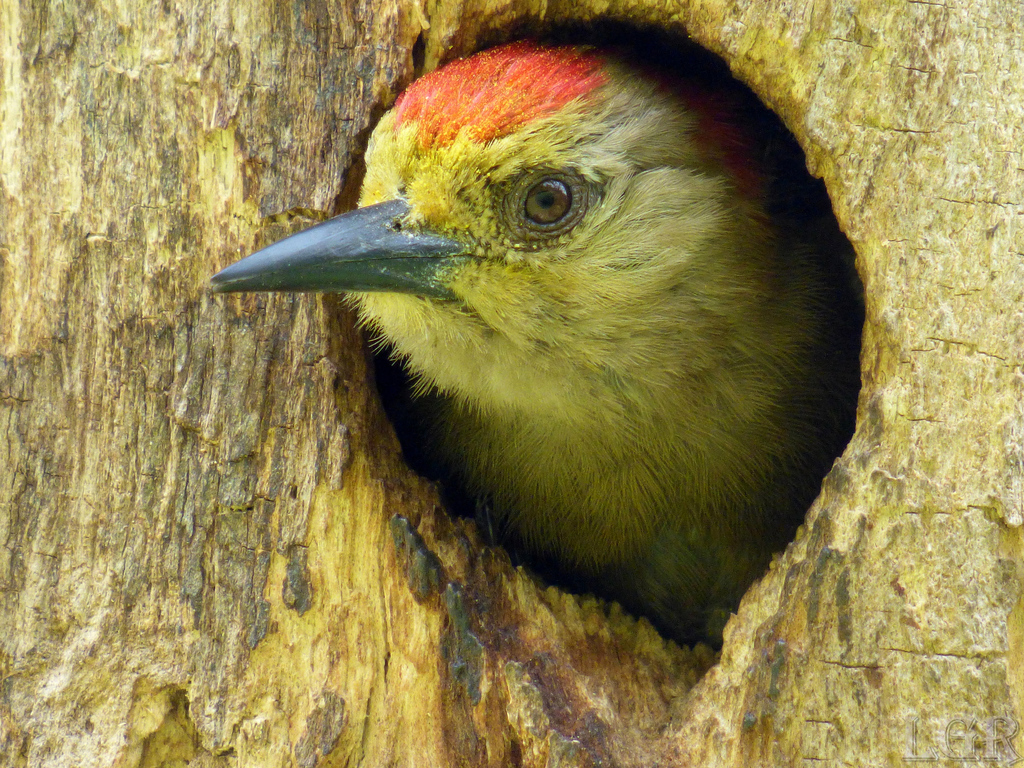
The red-crowned woodpecker is a small woodpecker, measuring 16 to 18.5 cm long and weighing 40 to 65 g. Males are distinctive with a pale yellow to whitish forehead, bright red crown, and orange-red nape and hindneck. Females share the pale forehead but have a pale gray-buff to whitish crown, though their nape and hindneck remain reddish to orange-red. Both sexes display grayish-buff cheeks, chin, and throat, with barred black-and-white mantles and backs. The rump and uppertail coverts are unbarred white, and the flight feathers are black with white bars. Their underparts are typically buffish-gray with an olive or yellowish wash and a distinctive reddish to orange-red patch on the central belly. The bill is longish and blackish, with red to brown iris and gray legs. Juveniles are duller and browner than adults, with less contrasting markings and a paler belly patch.
Range & Habitat
The red-crowned woodpecker is found across Central and South America, from southwestern Costa Rica through Panama into northern and central Colombia, northern Venezuela, Guyana, Suriname, and the island of Tobago. Four subspecies occur throughout this range, with slight variations in plumage. This adaptable species inhabits a wide variety of landscapes, both wet and dry, including mature deciduous forests, secondary forests, coastal scrublands, mangroves, plantations, and gardens. It typically occurs from sea level to 1,700 m in elevation, reaching as high as 1,900 m in Venezuela.
Behaviour & Diet
The red-crowned woodpecker is a year-round resident throughout its range. Its diet is notably diverse, comprising a large amount of fruits and berries—both wild and cultivated species like papayas and bananas—alongside many types of insects and spiders, though fewer wood-boring beetle larvae than most woodpeckers. It also takes nectar from flowers. The species forages at all levels but favors the middle and lower strata, typically seen singly or in pairs. It feeds by probing, gleaning, hammering, and by reaching for and pecking open large fruits. It readily visits feeders and is considered a nuisance in plantations and gardens due to its fruit-eating habits.
Breeding pairs stay together year-round and sometimes raise two broods annually. The breeding season varies geographically, spanning February to July in Costa Rica and Panama, May to June in Colombia, May to November in Venezuela, and March to July in Tobago. Both sexes excavate nest holes in large tree trunks, branches, cacti, or fence posts, typically 3 to 23 m above ground. Clutches contain three or four eggs, though usually only two young fledge. Both parents incubate eggs for 10 days and care for nestlings for 31 to 33 days until fledging, continuing to feed fledglings for at least another month.
Best Time & Places to See It
The red-crowned woodpecker is common throughout most of its range and abundant in Costa Rica and Panama, making it relatively easy to locate in suitable habitat. Year-round residency means it can be observed in any season, though breeding season activity (February to November depending on location) offers opportunities to observe courtship displays and parental behavior. It frequents a diverse range of habitats from forest edges and clearings to gardens and plantations, increasing accessibility for travelers. Several protected areas throughout its range support healthy populations, making these excellent destinations for observation.
Photography Tips
The distinctive red crown and nape of males, contrasting with their pale forehead and barred upperparts, make for striking photographs. The species' preference for middle and lower strata and its habit of foraging in open areas and gardens provides good photographic opportunities compared to woodpeckers that remain high in dense canopy. Look for individuals at flowering plants where they take nectar, or around fruit-bearing trees and feeders where they may linger. Early morning often provides the best light and activity levels. Photographing the characteristic belly patch requires a clear view of the underparts, best achieved when birds are perched or gleaning low on tree trunks. The sexually dimorphic head patterns—particularly the crown and nape coloration—allow for compelling comparative shots of males and females.
Guided Birding Tour
Corcovado National Park
Puerto Jiménez, Costa Rica
+444 birds+48 mammals
Where the Osa Peninsula juts into the Pacific, rainforest descends almost to the tide line, and Corcovado National Park protects one of Central America's most intact…
VIEW NATIONAL PARKManuel Antonio National Park
Quepos, Costa Rica
+426 birds+22 mammals
Where tropical rainforest descends steeply to a rocky Pacific coastline, Manuel Antonio National Park distills Central American biodiversity into one of Costa Rica's most compressed and…
VIEW NATIONAL PARKChirripó National Park
Rivas, Costa Rica
+274 birds+6 mammals
Where the volcanic spine of Costa Rica's Central Cordillera reaches its apex, Chirripó National Park encompasses a landscape that shifts dramatically with elevation, from montane cloud…
VIEW NATIONAL PARKPiedras Blancas National Park
Golfito, Costa Rica
+386 birds+24 mammals
Where the Golfo Dulce meets the southwestern Pacific coast of Costa Rica, Piedras Blancas National Park protects a dramatic transition zone where lowland rainforest descends toward…
VIEW NATIONAL PARKNatural Utría National Park
Alto Baudó (Pie de Pató), Colombia
+372 birds+11 mammals
Where the Chocó's coastal mountains plunge toward the Pacific, Utría National Park preserves one of Colombia's most biodiverse and least-visited wilderness expanses. Sprawling across 1,287 square…
VIEW NATIONAL PARKNatural Catatumbo Barí National Park
Convención, Colombia
+13 birds
Where the Andes descend into the humid lowlands of Norte de Santander, the 2,817-square-kilometre expanse of Natural Catatumbo Barí National Park spans a mosaic of montane…
VIEW NATIONAL PARKNatural Serranía de los Yariguíes National Park
El Carmen de Chucurí, Colombia
+320 birds+3 mammals
Where the northern cordilleras of Colombia rise toward cloud forest, the Serranía de los Yariguíes unfolds across nearly 1,820 square kilometers of some of the most…
VIEW NATIONAL PARKNatural Farallones de Cali National Park
Buenaventura, Colombia
+733 birds+27 mammals
Where the Pacific coastal plain meets the western slopes of the Andes, Farallones de Cali National Park sprawls across nearly 3,500 square kilometers of dramatic topography…
VIEW NATIONAL PARKNatural el Cocuy National Park
Güicán, Colombia
+313 birds+3 mammals
Where the Andes rise to their highest peaks in Colombia's eastern cordillera, El Cocuy National Park sprawls across more than 6,600 square kilometers of some of…
VIEW NATIONAL PARKMorrocoy National Park
Municipio Silva
+290 birds
Where the Caribbean coast of northwestern Venezuela meets protected coastal waters, a mosaic of mangrove forests, sandy beaches, and coral reef systems defines Morrocoy National Park.…
VIEW NATIONAL PARKPuracé National Natural Park
Puracé, Colombia
+327 birds+2 mammals
Where the Andes thrust upward across southwestern Colombia, Puracé National Natural Park spans nearly 2,631 square kilometers of some of South America's most dramatic montane terrain.…
VIEW NATIONAL PARKGuácharos Cave National Natural Park
Acevedo, Colombia
+359 birds
High in the Andean foothills of southern Huila, where mist-laden slopes rise above 1,600 metres, lies a landscape carved by underground rivers and crowned by karst…
VIEW NATIONAL PARKNatural Bahía Portete Kaurrele National Park
Colombia
+80 birds
Where the Caribbean coast of La Guajira rises to meet arid scrubland and seasonal wetlands, Natural Bahía Portete Kaurrele National Park spans 251 square kilometres of…
VIEW NATIONAL PARKNatural Uramba Bahía Málaga National Park
Buenaventura, Colombia
+308 birds+15 mammals
Where the Pacific coastal rainforest descends to mangrove estuaries and rocky headlands, Uramba Bahía Málaga National Park unfolds across nearly 1,000 square kilometres of Colombia's Valle…
VIEW NATIONAL PARKEl Tamá National Park
Toledo, Colombia
+435 birds
Where the Andes descend toward the Caribbean coastal lowlands of northern Colombia, El Tamá National Park sprawls across nearly 3,800 square kilometres of montane forest, cloud…
VIEW NATIONAL PARKCoiba National Park
Montijo, Panama
+260 birds+10 mammals
An archipelago of volcanic and sedimentary islands rises from the Pacific waters off Panama's southwestern coast, its densest rainforest canopy unbroken for millennia. Coiba National Park…
VIEW NATIONAL PARKBaru Volcano National Park
Cerro Punta, Panama
+402 birds+6 mammals
Where the land rises sharply toward the Caribbean's western spine, Baru Volcano National Park sprawls across roughly 220 square kilometres of southwestern Panama, anchored by the…
VIEW NATIONAL PARKGeneral de División Omar Torrijos Herrera National Park
La Pintada, Panama
+401 birds+2 mammals
Across the highlands of central Panama, where the continental divide funnels moisture-laden trade winds into steep river valleys, the terrain rises and falls in a landscape…
VIEW NATIONAL PARKSoberanía National Park
Cristóbal, Panama
+495 birds+34 mammals
Rainforest and riverine woodland blanket the rolling terrain of this 714-square-kilometre national park in Colón Province, where the Caribbean watershed feeds a maze of streams and…
VIEW NATIONAL PARKChagres National Park
Caimitillo, Panama
+486 birds+19 mammals
Where the Chagres River carves through the humid tropics of central Panama, a vast montane and lowland forest sprawls across more than 2,300 square kilometers, anchoring…
VIEW NATIONAL PARKDarién National Park
Tucutí, Panama
+534 birds+13 mammals
Where the spine of Central America crumbles into wetland and rainforest, Darién National Park sprawls across more than 20,000 square kilometres of some of the tropics'…
VIEW NATIONAL PARKPortobelo National Park
Portobelo, Panama
+366 birds+9 mammals
Where the Caribbean's turquoise waters meet the Darién's verdant shore, Portobelo National Park sprawls across 570 square kilometers of coastal forest, mangrove wetland, and coral-fringed islands…
VIEW NATIONAL PARKParque Internacional la Amistad
Teribe, Panama
+325 birds+11 mammals
Where the continental divide rises between the Caribbean and Pacific watersheds, a wilderness of extraordinary biological richness unfolds across the Talamanca Range and into lowland rainforest—a…
VIEW NATIONAL PARKMarino Golfo de Chiriquí National Park
Boca Chica, Panama
+82 birds+2 mammals
Where mangrove forests meet tropical Pacific waters, Marino Golfo de Chiriquí National Park spans 463 square kilometers of one of Central America's most biodiverse coastal systems.…
VIEW NATIONAL PARKCarara National Park
Tárcoles, Costa Rica
+397 birds+19 mammals
Where the Pacific coastal plain meets transitional forest, Carara National Park straddles one of Central America's most dynamic ecological boundaries. The park's landscape encompasses lowland deciduous…
VIEW NATIONAL PARKTapantí Macizo de la Muerte National Park
Orosi, Costa Rica
+503 birds+18 mammals
Where montane cloud forest rises steeply from the Orosi Valley, Tapantí Macizo de la Muerte National Park enfolds a landscape of perpetual moisture and emerald complexity.…
VIEW NATIONAL PARKLa Amistad International Park
Crorina, Costa Rica
+532 birds+20 mammals
Where the Caribbean slopes of Costa Rica's Talamanca Mountains rise steeply inland from Limón, the boundary between two nations dissolves into an unbroken expanse of rainforest.…
VIEW NATIONAL PARKMarino Ballena National Park
Bahía Ballena, Costa Rica
+336 birds+8 mammals
Where mangrove forests meet coral-fringed shorelines along Costa Rica's southern Pacific coast, Marino Ballena National Park encompasses a marine and terrestrial mosaic that ranks among Central…
VIEW NATIONAL PARKNo community photos yet. Log in to add the first one.
No community observations of this species yet.