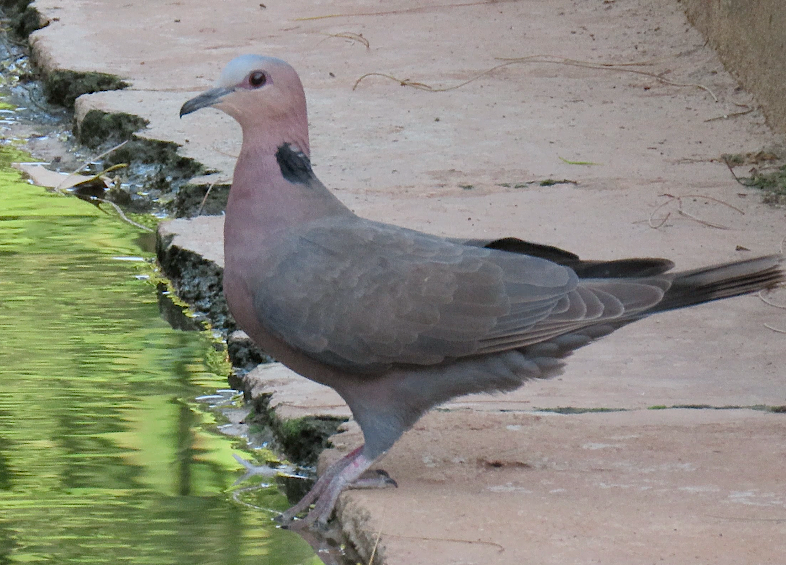
Red-eyed Dove
Photo © Florin Feneru
Photo © Florin Feneru — CC BY 4.0 — Source: iNaturalist photo #50103673Identification
The red-eyed dove is a distinctive medium-to-large dove, typically 30 cm (12 in) in length and weighing 162–310 g (5.7–10.9 oz), making it the largest of the "ringneck" dove species. Its plumage is a subtle study in warm and cool tones: the pale bluish-gray forehead deepens into a darker crown, while the neck, breast, and underparts display striking dark mauve-pink to wine-red coloring. The upperparts are grayish brown with black primaries, and the outer wing-coverts show distinctive dark slaty blue. A characteristic black half-collar adorns the sides of the neck, though it is indistinct and restricted to that area rather than forming a complete ring.
The species is most readily identified by its striking eye and facial features: the iris varies from yellowish to orange to deep red or orange-brown, and the orbital skin around the eye is distinctly purplish red. The bill is black and the legs are purplish red. Flanks, sides of rump, and underwing-coverts are bluish gray, while rectrices are dark gray basally and lighter brownish gray terminally. Most feathers show reddish buff or reddish brown edges with indistinct dark subterminal bars. Sexes are alike in appearance, though juveniles are noticeably duller and browner overall.
Range & Habitat
The red-eyed dove is widespread and common throughout Sub-Saharan Africa, absent only from desert zones where suitable habitat does not occur. It adapts well to a variety of environments, including forests near rivers, and thrives in most non-desert habitats across the continent. Interestingly, geographic variation exists: birds from the Ethiopian Highlands are larger than their counterparts in West Africa and coastal Kenya.
Unlike many dove species, red-eyed doves are not particularly gregarious and typically feed alone or in pairs rather than in large flocks. This solitary tendency makes them somewhat less conspicuous than more social dove species, though their widespread distribution ensures they are encountered regularly across suitable African landscapes.
Behaviour & Diet
Red-eyed doves are tree-nesting species, constructing simple stick nests in branches where females lay two white eggs per clutch. Their flight is characteristically rapid and direct, with the regular wingbeats and occasional sharp flicks of the wings that typify pigeons and doves in general. This agile, purposeful flight style allows them to navigate between feeding and roosting areas with ease.
Best Time & Places to See It
As a common, if not abundant, species across most Sub-Saharan African habitats, the red-eyed dove can be encountered year-round throughout its range. Look for them in forests near riverine corridors and in any wooded or cultivated habitat that provides trees for nesting and roosting. Patient observers feeding alone or in pairs will eventually spot these birds, particularly during early morning and late afternoon when doves are most active.
Photography Tips
The red-eyed dove's distinctive facial markings—particularly the vibrant red or orange eye and purplish-red orbital skin—make it a rewarding photographic subject. Capture close-up shots to showcase these striking features and the subtle plumage details, especially the dark half-collar and the varied tones of mauve-pink breast contrasting with grayish-brown upperparts. The bird's relatively large size compared to other ringneck doves provides good detail for photography.

Nothing matches these filters.
Bwindi Impenetrable National Park
Lake Mburo National Park
Mabamba Swamp
Murchison Falls National Park
Queen Elizabeth National Park
Aberdare National Park
Abijata-Shalla Lakes National Park
Addo Elephant National Park
Agulhas National Park
Nothing matches these filters.
No community photos yet. Log in to add the first one.
No community observations of this species yet.