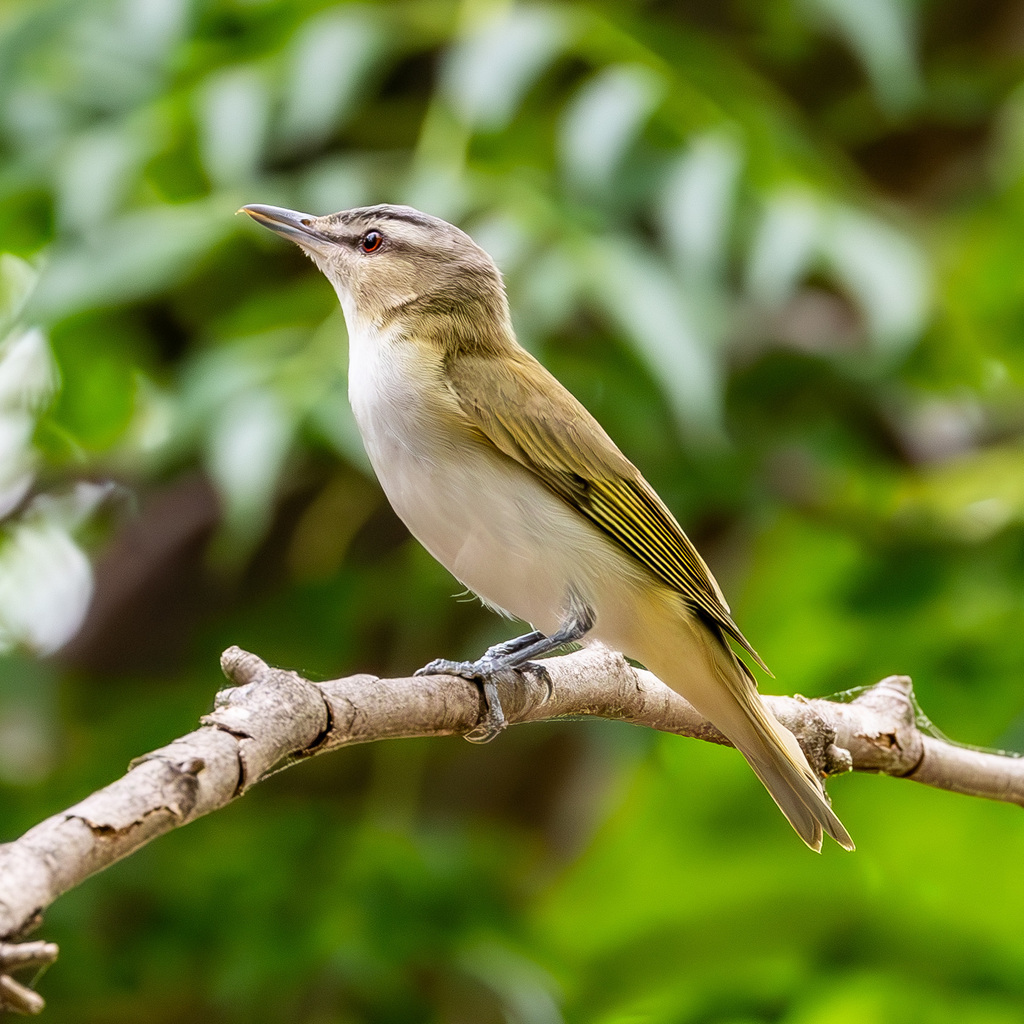
Red-eyed Vireo
Photo © tcantrell52
Photo © tcantrell52 — CC BY 4.0 — Source: iNaturalist photo #509744460Identification
The red-eyed vireo is a small songbird, 4.7–5.1 inches (12–13 cm) long with a wingspan of 9.1–9.8 inches (23–25 cm). Adults are mainly olive-green on the upper parts with white underparts. The most distinctive features are the bright red iris, grey crown edged with black, and a dark blackish line running through the eyes with a wide white stripe just above it. The bird has thick blue-grey legs and a stout bill, with yellowish flanks and undertail coverts.
Range & Habitat
The red-eyed vireo breeds across open wooded areas throughout Canada and the eastern and northwestern United States. It is an exclusively migratory species, wintering in South America with stopovers throughout Latin America and Mexico. Migration primarily occurs in May and September, with populations from northwestern boreal forests migrating east before heading south. Recent studies indicate these birds are shifting their migration timing earlier due to climate change.
Behaviour & Diet
Red-eyed vireos are among the most prolific singers in the bird world, often singing high in trees for extended periods in a distinctive question-and-answer rhythm. Remarkably, they hold the record for most songs in a single day, with over 20,000 songs recorded. Individual birds average 31 different song types, with some individuals producing over 70 variations.
During breeding season they are primarily insectivores, gleaning caterpillars, beetles, and aphids from foliage and sometimes snatching insects while hovering. In their South American wintering grounds they become almost exclusively frugivorous, feeding acrobatically on fruiting trees like tamanqueiro and gumbo-limbo, even hanging upside down to reach berries. They often join mixed-species feeding flocks in tropical regions. These birds build cup nests in tree forks and are frequent hosts to brown-headed cowbird parasitism.
Best Time & Places to See It
Red-eyed vireos are common and widespread throughout their breeding range in North America during spring and summer months. They are most vocal and visible during May and September migration periods. In North America, search open woodlands and mixed forests. The species occasionally wanders to western states, particularly California, and is one of the more frequent American songbird vagrants to Europe, with regular sightings in Ireland and Great Britain.
Photography Tips
Photograph this species in the canopy where it spends most of its time foraging and singing high in trees. Early morning provides the best light and greatest singing activity. The distinctive red eye, contrasting head pattern, and olive-green plumage photograph well in bright conditions. Patience is essential—these birds often remain in one area while singing. Look for them during migration when they may be more approachable and active in feeding before continuing their journey.
Acadia National Park
Alaska Maritime National Wildlife Refuge
Algonquin Provincial Park
Alligator River National Wildlife Refuge
Amacayacu National Park
Arenal Volcano National Park
Arrecifes de Cozumel National Park
Badlands National Park
Bahuaja Sonene National Park
Nothing matches these filters.
No community photos yet. Log in to add the first one.
No community observations of this species yet.