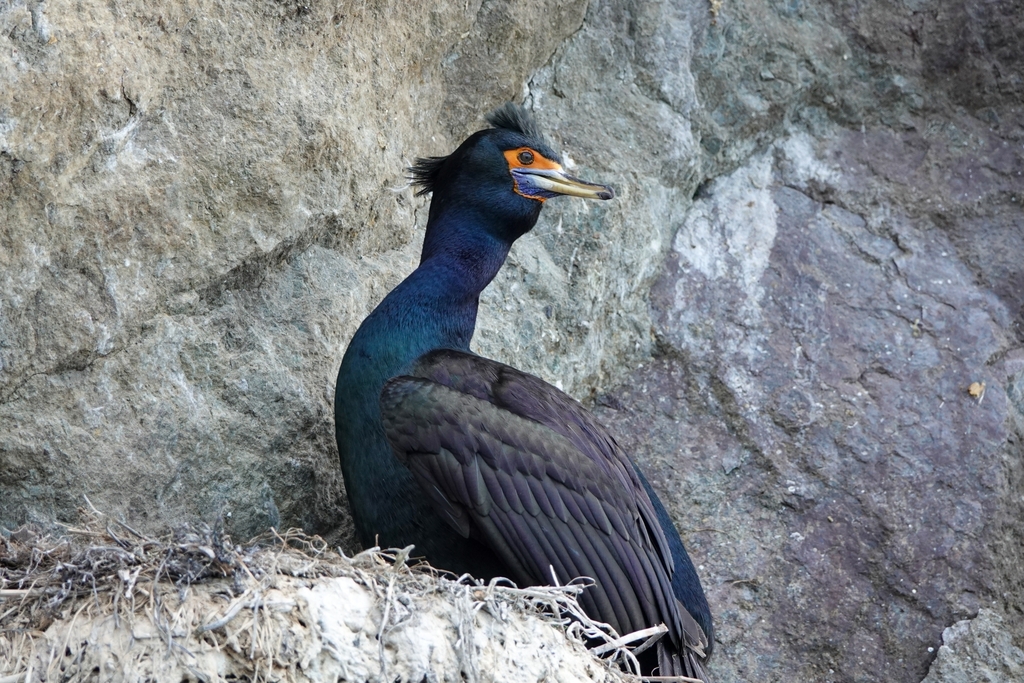
Red-faced Cormorant
Photo © Валерия Ковалева
Photo © Валерия Ковалева — CC BY 4.0 — Source: iNaturalist photo #407314742The red-faced cormorant (Urile urile), red-faced shag or violet shag, is a bird species of the family Phalacrocoracidae. Its range spans from the eastern tip of Hokkaidō in Japan, northern korean peninsula, via the Kuril Islands, the southern tip of the Kamchatka Peninsula and the Aleutian Arc to the Alaska Peninsula and Gulf of Alaska. == Taxonomy == The red-faced cormorant was formally described in 1789 by the German naturalist Johann Friedrich Gmelin in his revised and expanded edition of Carl Linnaeus's Systema Naturae. He placed it in the genus Pelecanus and coined the binomial name Pelecanus urile. Gmelin based his description on the "red faced shag" of John Latham and the "red faced corvarant" of Thomas Pennant. The authors cited different translations of an account of Georg Wilhelm Steller's exploration of the Kamchatka Peninsula. The red-faced cormorant was formerly classified in the genus Phalacrocorax; it was moved to the resurrected genus Urile based on a molecular phylogenetic study published in 2014. The genus had been introduced in 1856 by the French naturalist Charles Lucien Bonaparte. The epithet urile is possibly derived from the Russian vernacular name of this species, referring to the Kuril Islands where this species is now…
Kenai Fjords National Park
Kenai Peninsula Borough, United States
+164 birds+19 mammals
Granite peaks and tidewater glaciers dominate Alaska's Kenai Peninsula, where nearly 7,900 square kilometers of pristine coastal wilderness descend from the Harding Icefield toward the Gulf…
VIEW NATIONAL PARKKatmai National Park
Lake and Peninsula Borough, United States
+160 birds+19 mammals
Across southwestern Alaska's Lake and Peninsula Borough, nearly 27,000 square kilometers of subarctic wilderness sprawl between volcanic peaks and coastal wetlands, anchored by the confluence of…
VIEW NATIONAL PARKSt. Paul Island
Saint Paul, United States
+255 birds+8 mammals
Windswept tundra rolls across this remote Pribilof island, where volcanic basalt cliffs plunge into the Bering Sea and fog rolls in thick enough to erase the…
VIEW PROTECTED LANDSCAPEKodiak National Wildlife Refuge
United States
+221 birds+22 mammals
Where temperate rainforest meets subarctic coast, Kodiak National Wildlife Refuge sprawls across Alaska's largest island, a sanctuary defined by steep valleys carved by tidewater glaciers and…
VIEW WILDLIFE SANCTUARYKenai National Wildlife Refuge
United States
+152 birds+16 mammals
Across Alaska's Kenai Peninsula, where glacial valleys descend toward the Cook Inlet and the Gulf of Alaska, lies one of North America's most expansive subarctic wildlife…
VIEW WILDLIFE SANCTUARYAlaska Maritime National Wildlife Refuge
Alaska, United States
+391 birds+58 mammals
Where the North Pacific collides with Alaska's rugged coastline, a sprawling archipelago of islands, rocky outcrops, and coastal headlands forms one of North America's most remote…
VIEW WILDLIFE SANCTUARYIzembek National Wildlife Refuge
Cold Bay, United States
+138 birds+9 mammals
Where the Aleutian archipelago reaches westward into the Bering Sea, subarctic tundra and shallow coastal waters converge to create one of Alaska's most ecologically vital wildlife…
VIEW WILDLIFE SANCTUARYBecharof National Wildlife Refuge
United States
+146 birds+2 mammals
Across southwestern Alaska's windswept lowlands, where the Bristol Bay watershed spills into vast tidal flats and sedge marshes, lies one of North America's most pristine subarctic…
VIEW WILDLIFE SANCTUARYNo community photos yet. Log in to add the first one.
No community observations of this species yet.