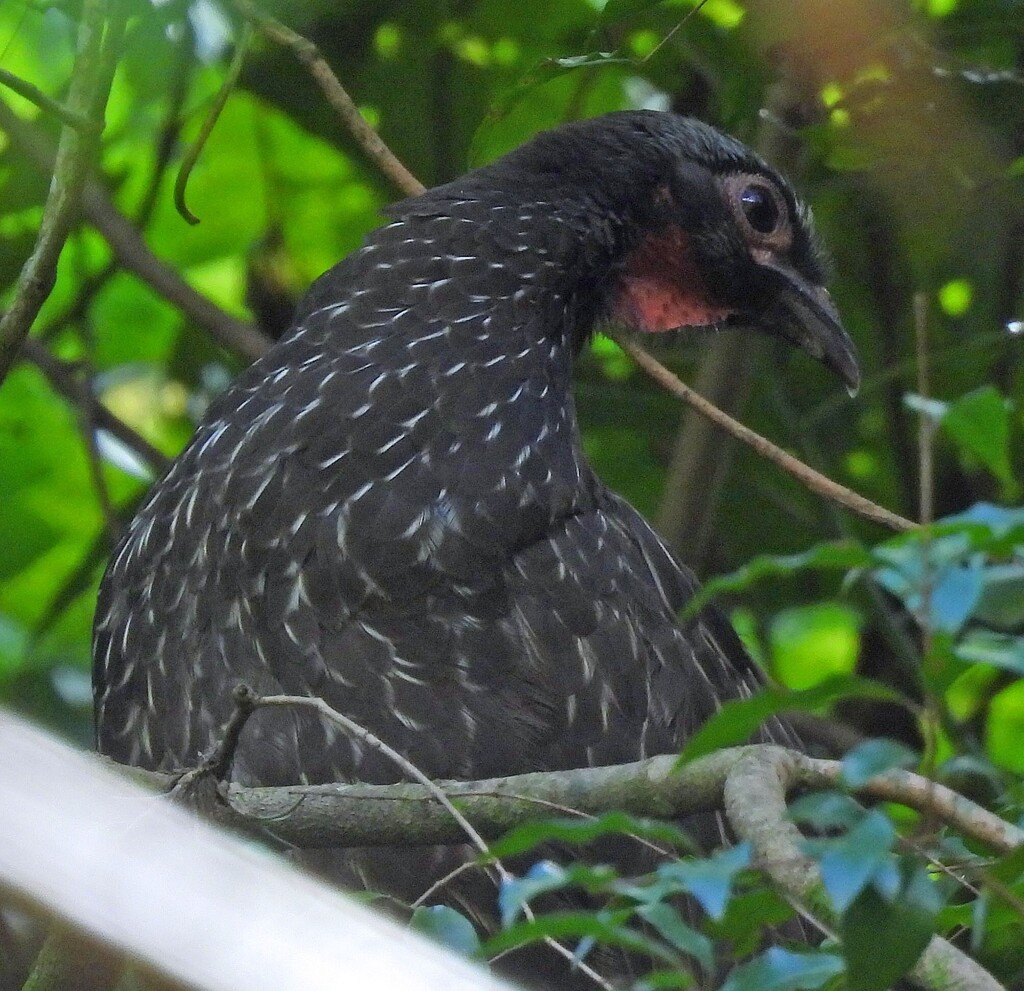
Red-faced Guan
Photo © Hugo Hulsberg
Photo © Hugo Hulsberg — CC0 1.0 — Source: iNaturalist #355556113Identification
The red-faced guan is a medium-sized bird measuring 63 to 69 cm in length, with a distinctively colourful face that makes identification straightforward. Its plumage is rich brown overall, adorned with white or silvery flecking across the head, breast, and upper back. The most striking features are its bare pinkish-red facial skin and the characteristic red dewlap—a hanging fold of skin typical of guans—which give the species its common name. A whitish supercilium (eyebrow stripe) further enhances its facial pattern, creating an alert and distinctive expression.
Range & Habitat
The red-faced guan occupies a narrow band on the eastern slopes of the Andes, distributed across southern Bolivia and northwestern Argentina. This species is a specialist of the Yungas cloudforests, preferring extensive tracts of large, mature trees where it can forage among the canopy. While it typically favours undisturbed primary forest, it occasionally ventures into smaller forest patches and young secondary growth. Elevational range spans primarily between 1,800 and 2,500 metres, though birds have been recorded as low as 1,300 metres.
Behaviour & Diet
The red-faced guan is largely sedentary, though some altitudinal movement occurs in Argentina. These birds typically forage in pairs, though larger groups have occasionally been observed. They are both arboreal and terrestrial feeders, spending considerable time in the treetops but regularly descending to the ground. Their diet is primarily frugivorous, supplemented with leaves and arthropods. The species exhibits vocal activity predominantly at dawn, producing distinctive wing-whirring displays and "random-sounding gruff notes" delivered in level series. When alarmed, it emits loud, throaty repeated calls of "kroa, kroa" interspersed with whistled "luuuii" notes.
Best Time & Places to See It
Displaying and calling pairs have been documented between September and December, making these months ideal for locating birds through sound and behaviour. The species occurs in several protected areas throughout its range, which offer the best opportunities for observation. Its preference for remote, inaccessible cloudforest habitat means that dedicated hiking to higher elevations on the eastern Andean slopes offers the most reliable chances of encounter. Early morning visits when birds are most vocal will substantially increase sighting probability.
Photography Tips
The red-faced guan's distinctive facial markings and rich brown coloration photograph well in the soft, diffused light typical of cloudforests. The bird's habit of foraging in pairs and calling at dawn provides opportunities for behavioural photography. A telephoto lens is essential, as birds often remain in the canopy. The whitish flecking on the head and breast and the contrasting red facial skin provide striking detail when captured at close range. Patient positioning near calling birds during dawn hours will reward photographers with dynamic images of this charismatic species.
No community photos yet. Log in to add the first one.
No community observations of this species yet.