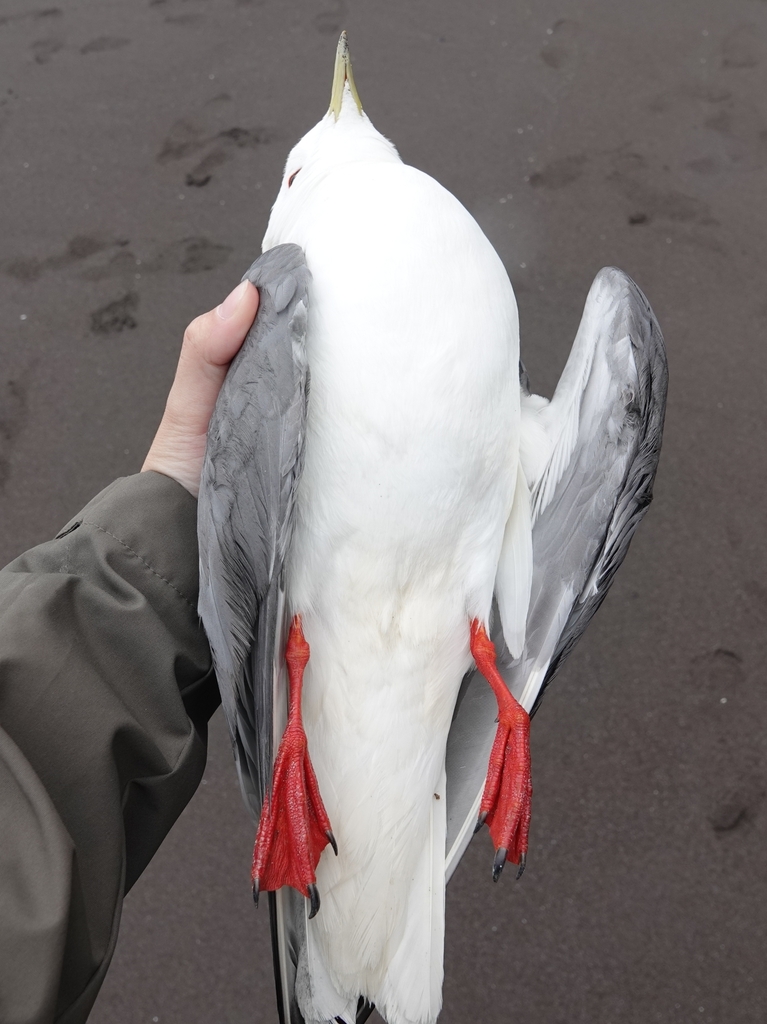
Red-legged Kittiwake
Photo © Валерия Ковалева
Photo © Валерия Ковалева — CC BY 4.0 — Source: iNaturalist #176571351Identification
The red-legged kittiwake is a small gull, measuring 35–39 cm in length with a wingspan of 84–92 cm and weighing 325–510 g. As its name suggests, the most striking feature is its bright red legs, which distinguish it from its close relative, the black-legged kittiwake. Other distinguishing characteristics include a notably shorter bill, larger eyes, a larger and rounder head, and darker gray wings. The plumage is otherwise typical of kittiwakes, with white and gray coloring.
Juveniles are remarkably similar to adults and take three years to reach full maturity. A key difference from juvenile black-legged kittiwakes is the absence of the black tail band and distinctive "W" marking across the wings. Because occasional black-legged kittiwakes can develop reddish legs, observers reporting red-legged kittiwakes outside their normal range should note all distinguishing features, not solely the leg color, for the sighting to be accepted by bird recording authorities.
Range & Habitat
This is a highly localized subarctic Pacific species with a restricted breeding range of 192,000 km². Red-legged kittiwakes breed in the Pribilof Islands, Bogoslof Island, and Buldir Island in the Bering Sea off Alaska's coast, as well as at the Commander Islands in Russia. They are cliff-nesting seabirds, favoring narrow ledges on steep coastal cliffs during the breeding season.
Red-legged kittiwakes are migratory, spending winters at sea rather than at their breeding colonies. They overwinter in the northwestern Pacific Ocean and the Gulf of Alaska, departing their breeding cliffs in September to begin their oceanic migration.
Behaviour & Diet
Red-legged kittiwakes are specialist feeders on small marine prey. Their diet consists primarily of lanternfish (Myctophidae), squid, and various invertebrates. Like all kittiwakes, they are highly adapted seabirds, catching their food while diving or surface-feeding in open ocean waters.
These birds exhibit strong site fidelity, returning annually to established cliff breeding colonies where they nest on narrow ledges. The breeding season is spent almost entirely at these colonies, before the birds disperse entirely to pelagic waters for the winter months.
Best Time & Places to See It
Red-legged kittiwakes are most reliably seen during the breeding season from spring through early September at their breeding colonies in the Pribilof Islands, Bogoslof Island, and Buldir Island in the Bering Sea, or at the Commander Islands in Russia. These remote locations require dedicated seabird-watching expeditions and are challenging to access, but offer the best opportunity for sightings.
During winter months, the species disperses across the northwestern Pacific Ocean and Gulf of Alaska, making them very difficult to locate and observe. Winter sightings away from breeding colonies are rare and unpredictable.
Photography Tips
Photographing red-legged kittiwakes requires reaching remote breeding colonies during the summer months. The birds' cliff-nesting habitat can present both compositional opportunities and logistical challenges. Focus on capturing the distinctive red legs, which are the species' most recognizable feature. Adequate telephoto lenses are essential, as approach distances to breeding birds should be respectful to minimize disturbance.
The subarctic breeding grounds often feature dramatic coastal scenery and changeable weather conditions. Photographers should be prepared for variable lighting and take advantage of the extended daylight hours typical of high northern latitudes during summer.
St. Paul Island
Saint Paul, United States
+255 birds+8 mammals
Windswept tundra rolls across this remote Pribilof island, where volcanic basalt cliffs plunge into the Bering Sea and fog rolls in thick enough to erase the…
VIEW PROTECTED LANDSCAPEKodiak National Wildlife Refuge
United States
+221 birds+22 mammals
Where temperate rainforest meets subarctic coast, Kodiak National Wildlife Refuge sprawls across Alaska's largest island, a sanctuary defined by steep valleys carved by tidewater glaciers and…
VIEW WILDLIFE SANCTUARYAlaska Maritime National Wildlife Refuge
Alaska, United States
+391 birds+58 mammals
Where the North Pacific collides with Alaska's rugged coastline, a sprawling archipelago of islands, rocky outcrops, and coastal headlands forms one of North America's most remote…
VIEW WILDLIFE SANCTUARYNo community photos yet. Log in to add the first one.
No community observations of this species yet.