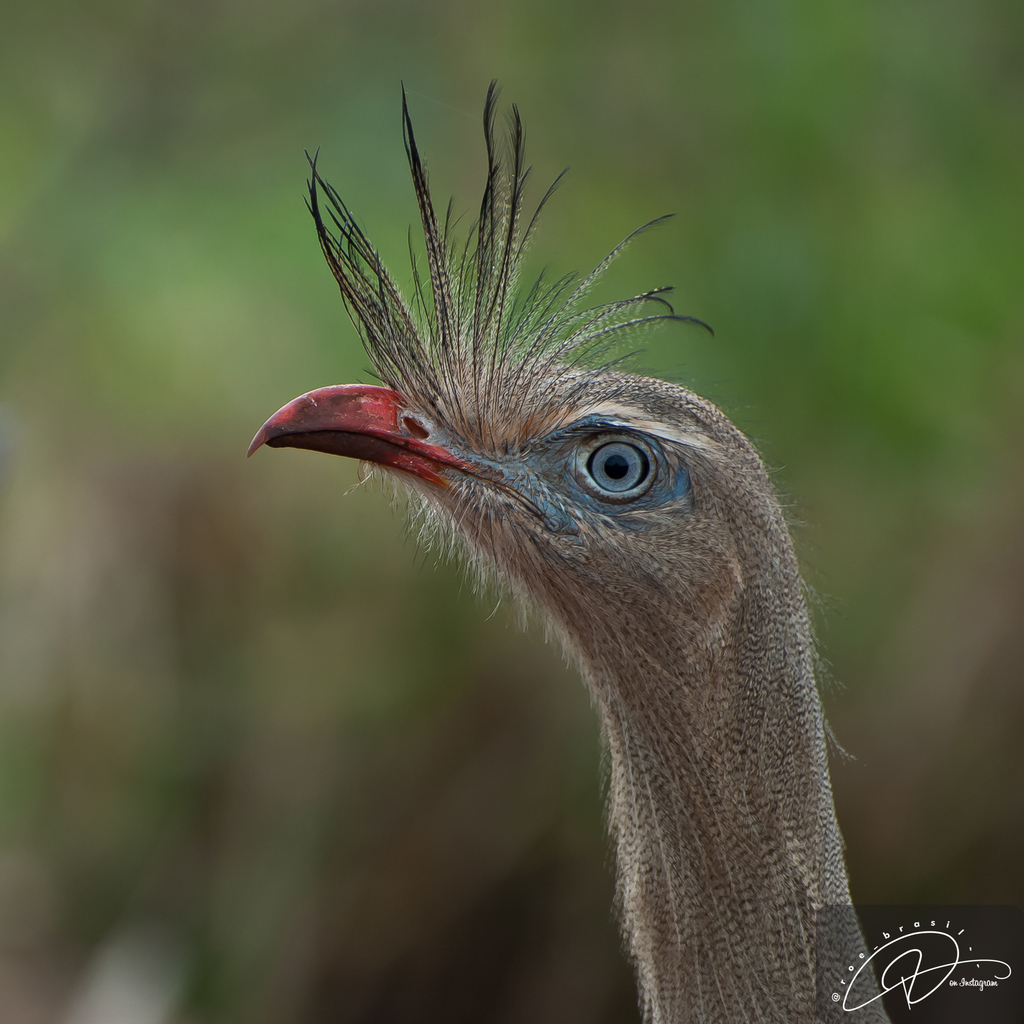
Red-legged Seriema
Photo © Reinaldo de Oliveira Elias
Photo © Reinaldo de Oliveira Elias — CC BY 4.0 — Source: iNaturalist #103112064Identification
The red-legged seriema is a distinctive terrestrial bird standing 75 to 90 centimetres tall and weighing 1.5 to 2.2 kilograms, with notably long legs, neck, and tail. Males are slightly larger than females. The bird's most striking feature is its fan-shaped crest of soft feathers emerging from the base of the bill. Its plumage is greyish-brown, finely barred and vermiculated with dark brown and black, pale brown on the head and neck, and white on the belly. The long, broad outer tail displays a subterminal black band and white tip. Look for its reddish beak, salmon-coloured legs, and distinctive yellow eyes.
Range & Habitat
The red-legged seriema is widely distributed across central and eastern Brazil, Paraguay, eastern and southeastern Bolivia, Uruguay, and northeastern Argentina, occurring at elevations up to 2,000 metres. This species strongly prefers grassland habitat and is typically found in lush meadows near rivers, semi-open and fairly dry areas such as thorny scrub, semi-arid woodland regions, savannas, and ranchlands. It is very typical in the Caatinga, Cerrado, and Chaco ecosystems, though it will not readily move into wetlands or crop fields.
Behaviour & Diet
Wary, territorial, and diurnal birds, red-legged seriemas are generally sedentary, though temperature-related migrations have been reported. They are typically seen singly or in pairs, occasionally in family groups of up to four. These birds walk easily on the ground and can run faster than a human, reaching speeds up to 25 km/h before taking flight. They employ an unusual hunting technique, picking up vertebrate prey in their beak and repeatedly throwing it at the ground until stunned or dead.
Red-legged seriemas are omnivorous, feeding mainly on arthropods such as grasshoppers, beetles, ants, and spiders, along with insect larvae, lizards, amphibians, snakes, and small rodents. They occasionally consume corn grains, wild fruits, tree gum, and bird eggs and chicks. Foraging typically occurs alone or in pairs, with birds walking steadily through ground vegetation and low growth, their cryptic plumage often keeping them obscured from view.
Best Time & Places to See It
The red-legged seriema is most vocal at dawn and, to a lesser extent, at dusk, making these the prime times for detecting and observing the species. Its distinctive loud song can be heard several kilometres away. Emas National Park in Brazil is a documented location where these birds can be observed, with multiple individuals and groups singing simultaneously. The birds are sedentary year-round in most of their range, making them potentially viewable throughout the year in suitable grassland habitats across their South American distribution.
Photography Tips
The red-legged seriema's long legs, striking crest, and colourful bill and leg markings make it an appealing photographic subject. Early morning visits to grassland and savanna habitats offer the best opportunities, as birds are most vocal and active at dawn. Position yourself in open grassland areas where you can scan for individuals walking on the ground—their height makes them relatively conspicuous once spotted. Be prepared for their speed; birds can flee at up to 25 km/h before flying, so a telephoto lens is recommended. The distinctive yellow eyes and salmon-coloured legs provide excellent focal points for close-up shots.
Emas National Park
Brazil
+333 birds+23 mammals
Across the high plateaux of central Brazil, where the cerrado grasslands roll toward distant horizons under an immense sky, Emas National Park anchors one of South…
VIEW NATIONAL PARKSerra do Cipó National Park
Brazil
+379 birds+5 mammals
Where granite escarpments rise above the Atlantic Forest transition zone in southeastern Brazil, Serra do Cipó National Park unfolds across a landscape of dramatic ridges, cascading…
VIEW NATIONAL PARKItatiaia National Park
Brazil
+519 birds+12 mammals
Where granite peaks pierce the Atlantic rainforest canopy in southeastern Brazil, Itatiaia National Park rises as one of the country's oldest and most ecologically vital protected…
VIEW NATIONAL PARKPeixe National Park Lagoon
Brazil
+293 birds+4 mammals
Where the coastal plains of Rio Grande do Sul meet the Atlantic, Peixe National Park Lagoon sprawls across nearly 2,200 square kilometres of shallow waters, reed…
VIEW NATIONAL PARKSerra da Bocaina National Park
Brazil
+441 birds+5 mammals
Where the escarpment of the Serra da Bocaina rises sharply from the Atlantic coastal plain, tropical rainforest cloaks steep mountainsides that climb toward peaks exceeding 2,000…
VIEW NATIONAL PARKIguaçu National Park
Brazil
+387 birds+17 mammals
Where the Paraná Plateau plunges toward the Atlantic watershed, six thousand square kilometers of subtropical rainforest cling to steep gorges and river valleys in this corner…
VIEW NATIONAL PARKIlha Grande National Park
Brazil
+233 birds
Across the subtropical plateaus and Atlantic forest remnants of southern Brazil, a vast protected landscape spanning nearly 4,600 square kilometers safeguards one of the continent's most…
VIEW NATIONAL PARKSerra da Capivara National Park
Brazil
+156 birds+6 mammals
Across the semi-arid plateaus and deeply incised canyons of northeastern Brazil, where Piauí's ancient sandstone formations rise and fall in weathered waves, Serra da Capivara National…
VIEW NATIONAL PARKSão Joaquim National Park
Brazil
+222 birds+9 mammals
Where the southern Brazilian highlands rise above the Atlantic Forest, São Joaquim National Park protects nearly 1,000 square kilometers of montane terrain that shifts between temperate…
VIEW NATIONAL PARKSerra dos Órgãos National Park
Brazil
+446 birds+13 mammals
Granite peaks thrust skyward through the Atlantic Forest canopy in the mountains immediately north of Rio de Janeiro, their bare rock faces rising above a landscape…
VIEW NATIONAL PARKSete Cidades National Park
Brazil
+125 birds+1 mammals
Sete Cidades sprawls across 113 square kilometres of northeastern Brazil's interior plateau, where weathered sandstone formations rise dramatically from the cerrado landscape. The park's geology tells…
VIEW NATIONAL PARKChapada dos Guimarães National Park
Brazil
+450 birds+1 mammals
Where weathered sandstone plateaus rise above the cerrado grasslands of central Brazil, Chapada dos Guimarães National Park protects 624 square kilometres of ecological transition zone that…
VIEW NATIONAL PARKChapada dos Veadeiros National Park
Brazil
+324 birds+6 mammals
Where granite plateaus rise above the cerrado savanna in central Brazil, Chapada dos Veadeiros National Park unfolds across 6,665 square kilometres of some of the world's…
VIEW NATIONAL PARKPantanal Matogrossense National Park
Brazil
+322 birds+17 mammals
Where the flooded forests of central Brazil meet vast seasonally inundated grasslands, Pantanal Matogrossense National Park sprawls across nearly 2,900 square kilometers of one of the…
VIEW NATIONAL PARKChapada Diamantina National Park
Brazil
+346 birds+5 mammals
Where granite peaks and sandstone cliffs rise abruptly from the Brazilian interior, Chapada Diamantina National Park sprawls across 4,215 square kilometers of some of Brazil's most…
VIEW NATIONAL PARKSerra do Gandarela National Park
Brazil
+333 birds+3 mammals
Where granite massifs rise through Atlantic Forest in southeastern Brazil's highlands, Serra do Gandarela National Park protects nearly 1,000 square kilometres of montane terrain that few…
VIEW NATIONAL PARKCatimbau National Park
Brazil
+118 birds+6 mammals
Where sandstone plateaus rise from the semi-arid scrublands of northeastern Brazil, Catimbau National Park unfolds across more than 1,000 square kilometres of geological drama and surprising…
VIEW NATIONAL PARKBrasília National Park
Plano Piloto, Brazil
+338 birds+15 mammals
Cerrado grassland and scattered woodland sweep across the central Brazilian plateau where this national park sprawls across more than a thousand square kilometres of the Federal…
VIEW NATIONAL PARKSerra Geral National Park
Brazil
+211 birds+2 mammals
Where basalt cliffs and sandstone escarpments rise above the subtropical forests of southern Brazil, Serra Geral National Park preserves one of the Atlantic region's most dramatic…
VIEW NATIONAL PARKRío Pilcomayo National Park
Argentina
+271 birds+13 mammals
Where the Río Pilcomayo cuts through northeastern Argentina's subtropical lowlands, a sprawling mosaic of wetlands, grasslands, and seasonally flooded forests creates one of South America's most…
VIEW NATIONAL PARKEl Rey National Park
Municipio de Las Lajitas, Argentina
+317 birds+4 mammals
Where the eastern slopes of the Andes descend into northwestern Argentina's subtropical transition zone, El Rey National Park unfolds across 841 square kilometers of dramatically varied…
VIEW NATIONAL PARKCalilegua National Park
Municipio de Calilegua, Argentina
+288 birds+8 mammals
Where the eastern Andean slopes plunge into northwestern Argentina's humid subtropics, nearly 2,645 square kilometers of steep terrain and luxuriant forest compose one of South America's…
VIEW NATIONAL PARKParque Provincial Pampa del Indio
Laguna Limpia, Argentina
+231 birds+4 mammals
Across the flat horizons of Chaco Province, where the Paraná River system spills into vast wetlands and grasslands, Parque Provincial Pampa del Indio protects one of…
VIEW NATURE RESERVEChaco National Park
Municipio de Presidencia de la Plaza, Argentina
+258 birds+7 mammals
Across the humid subtropical lowlands of northeastern Argentina, where the Paraná River basin feeds vast seasonal wetlands and gallery forests, Chaco National Park protects one of…
VIEW NATIONAL PARKNo community photos yet. Log in to add the first one.
No community observations of this species yet.