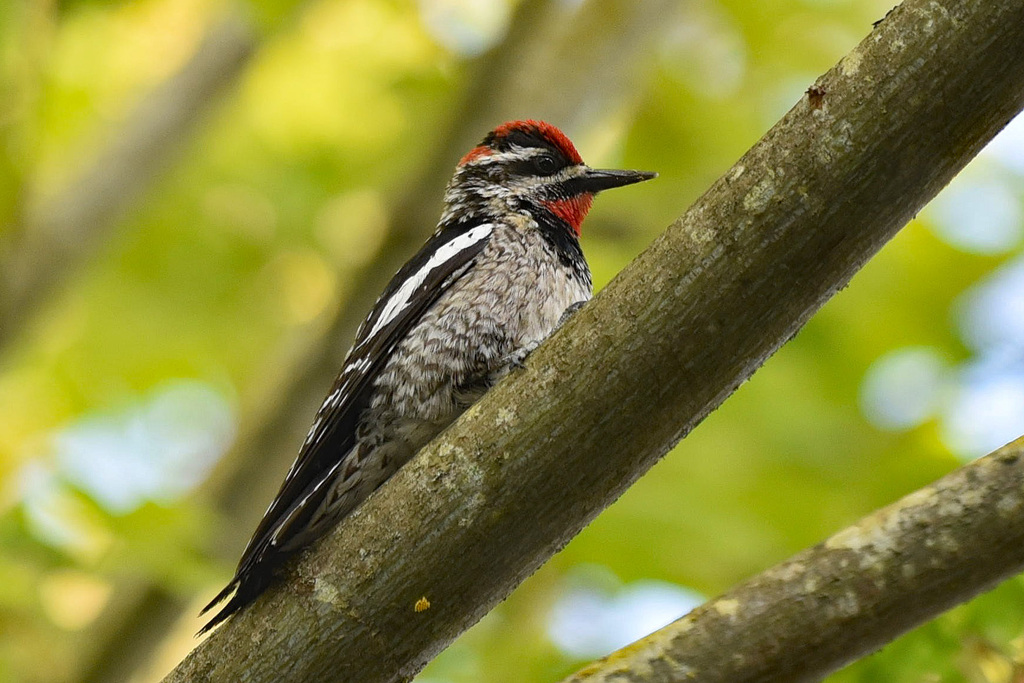
Red-naped Sapsucker
Photo © Marcel_Pepin
Photo © Marcel_Pepin — CC BY 4.0 — Source: iNaturalist photo #490873960Identification
The red-naped sapsucker is a medium-sized woodpecker measuring 19–21 cm long and weighing 32–66 g. Adults are unmistakable with their striking black head marked by a bright red forehead and a distinctive red patch on the nape (back of the head). White stripes accent the face, while the back and wings are black with white barring and a prominent white wing patch. The throat patch differs between sexes: males display a full red throat, while females show red only on the lower throat with white above. The belly is yellow on the upper portion and white below, with a white rump completing the pattern.
Range & Habitat
Red-naped sapsuckers breed in mixed forests of the Rocky Mountains and Great Basin regions of North America, nesting in cavities within dead trees. These birds are migratory, moving south and vacating higher-elevation areas seasonally. Forest management practices significantly impact their habitat; while woodpeckers readily use logged areas where standing timber remains, extensive logging and inadequate snag retention can severely degrade nesting site quality and reduce sapsucker populations.
Behaviour & Diet
True to their name, red-naped sapsuckers drill distinctive rows of holes in living trees to feed on the sap and the insects attracted to it. They supplement this diet by catching insects in flight, as well as eating seeds and berries. During breeding, they excavate cavities in trees with decay-softened heartwood, particularly trembling aspen, often starting relatively low and moving to progressively higher sites in subsequent years. They typically lay 3–7 white eggs; incubation lasts 12–13 days, and young fledge 25–29 days after hatching.
Best Time & Places to See It
Look for red-naped sapsuckers in mixed forest habitats throughout the Rocky Mountains and Great Basin during breeding season. Search aspen groves and mixed-conifer forests where dead or dying trees provide nesting cavities. The birds' distinctive feeding holes, arranged in characteristic horizontal rows on tree trunks, often reveal their presence before the bird itself is spotted.
Photography Tips
The red-naped sapsucker's striking plumage—particularly the bold red markings on the head and contrasting black-and-white patterns—makes it an attractive subject. Focus on capturing the diagnostic red nape patch and throat markings, which are key identification features. Photograph birds at their feeding trees early in the morning when light is optimal; their active foraging behaviour provides excellent action opportunities. The white wing patch is particularly conspicuous in flight, offering dynamic compositional possibilities.
Arizona in Winter
Nothing matches these filters.
Arches National Park
Banff National Park
Bear River Migratory Bird Refuge
Big Bend National Park
Bitter Lake National Wildlife Refuge
Black Canyon of the Gunnison National Park
Bosque del Apache National Wildlife Refuge
Bryce Canyon National Park
Cabeza Prieta National Wildlife Refuge
Nothing matches these filters.
No community photos yet. Log in to add the first one.
No community observations of this species yet.