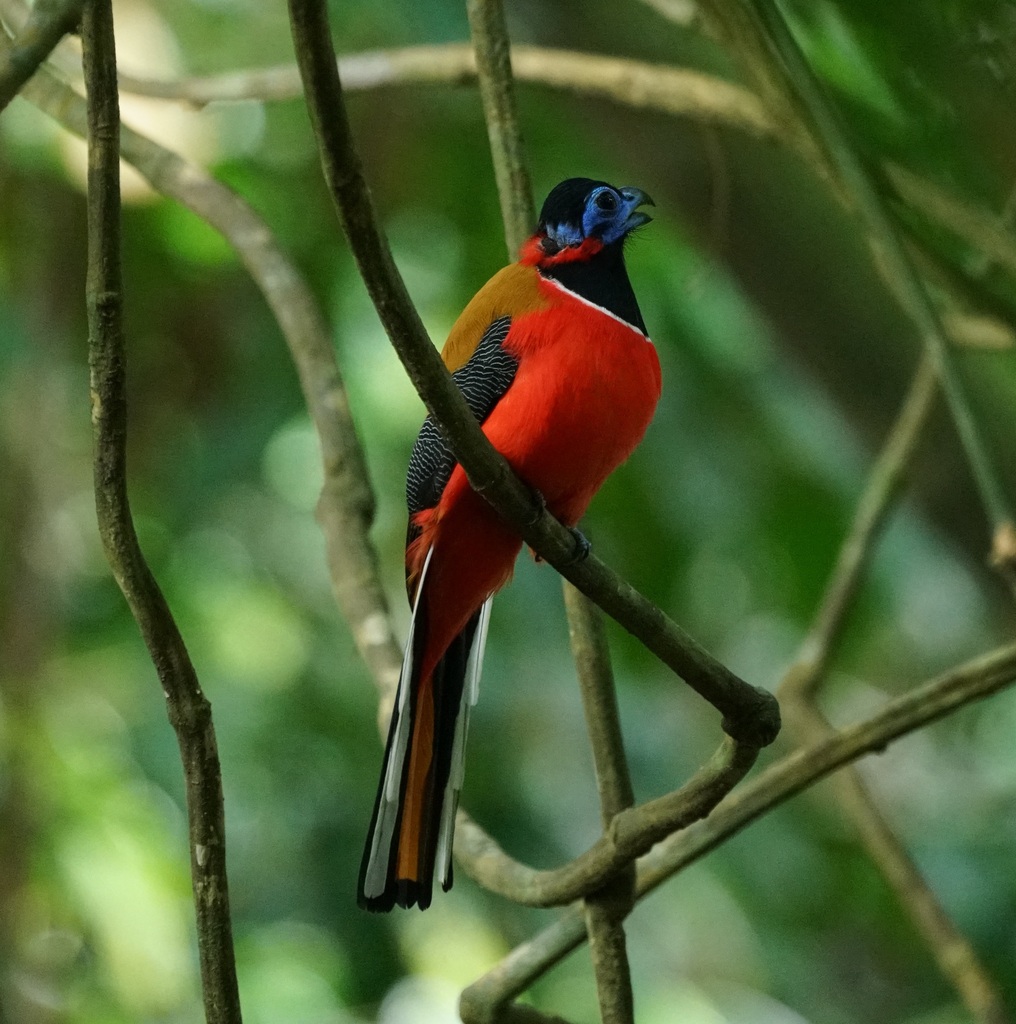
Red-naped Trogon
Photo © Tim
Photo © Tim — CC BY 4.0 — Source: iNaturalist #331798901Identification
The red-naped trogon is a strongly sexually dimorphic species, with males far more striking than females. Males display a black head and upper breast, bright blue bill and eye ring with blue face, yellow-brown upperparts and upper tail with black outlines, a white breast-line, bright red underparts, and black-and-white under-tail. The most defining feature is a band of bright red feathers around the back of the head, giving the species its name. Females are considerably duller, with grey-brown heads and upper breasts and yellow underparts. Both sexes reach 32 centimetres in length and live approximately 7.3 years.
Red-naped trogons possess compact bodies, short strong wings, and long tails. Their legs and feet are notably short and weak—among the weakest of all birds, with leg muscle comprising only 3% of body weight. They cannot walk but shuffle occasionally along branches. Their feet are heterodactylous, with the third and fourth toes projecting forward and the first and second backward, an arrangement unique among birds that prevents turning on a branch without wing assistance.
Range & Habitat
The red-naped trogon is found in Brunei, Indonesia, Malaysia, and Thailand, confined to the Sundaic lowland regions. The species is a sedentary, non-migratory resident, remaining year-round in the same location. Its natural habitat is subtropical and tropical moist lowland forests, though it is increasingly threatened by habitat loss throughout its range.
Behaviour & Diet
Red-naped trogons are generally inactive outside regular feeding patterns, earning a reputation for their lack of engaging behaviour beyond their obvious beauty. Their inactivity functions as a predation defence strategy. Like other trogons, they shift along branches to keep their dull backs toward observers while rotating their heads up to 180 degrees, like owls, to watch for predators. Hawks and predatory mammals are their main threats.
The species is mainly insectivorous, preferring stick insects and spiders, supplemented with small lizards, fruits, and seeds. Their serrated bill edges and decurved bill tip aid in securing live prey and cutting food into smaller pieces. Red-naped trogons typically forage using sally-glean flight: flying from an observation perch to target prey on another perch or in foliage, hovering briefly, snatching the prey, and returning to consume it.
Best Time & Places to See It
As a permanent resident, the red-naped trogon is present year-round throughout its range in Brunei, Indonesia, Malaysia, and Thailand. The species is most reliably found in subtropical and tropical moist lowland forests. Its sedentary nature means birds remain in established territories, making them potentially predictable for those familiar with specific forest locations, though their inactive behaviour and preference for keeping their backs to observers requires patience and skill to locate.
Photography Tips
The brilliant male plumage—particularly the bright red nape band, blue face, and red underparts—offers striking photographic opportunities when light permits. Position yourself early in the day to capture males at their observation perches during feeding sessions. Photograph from below or at eye level to showcase the diagnostic red nape band and facial features. Males' singing behaviour during breeding season may help you locate them and anticipate their movements between perches.
Expect to wait quietly; red-naped trogons are notoriously inactive and will only move when feeding. Their short, weak legs and inability to walk mean they rarely descend to ground level, so focus on mid-storey perches in lowland forest. The serrated bill profile is a useful identifying detail worth capturing for field-guide documentation, particularly when comparing males and duller females.
No community photos yet. Log in to add the first one.
No community observations of this species yet.