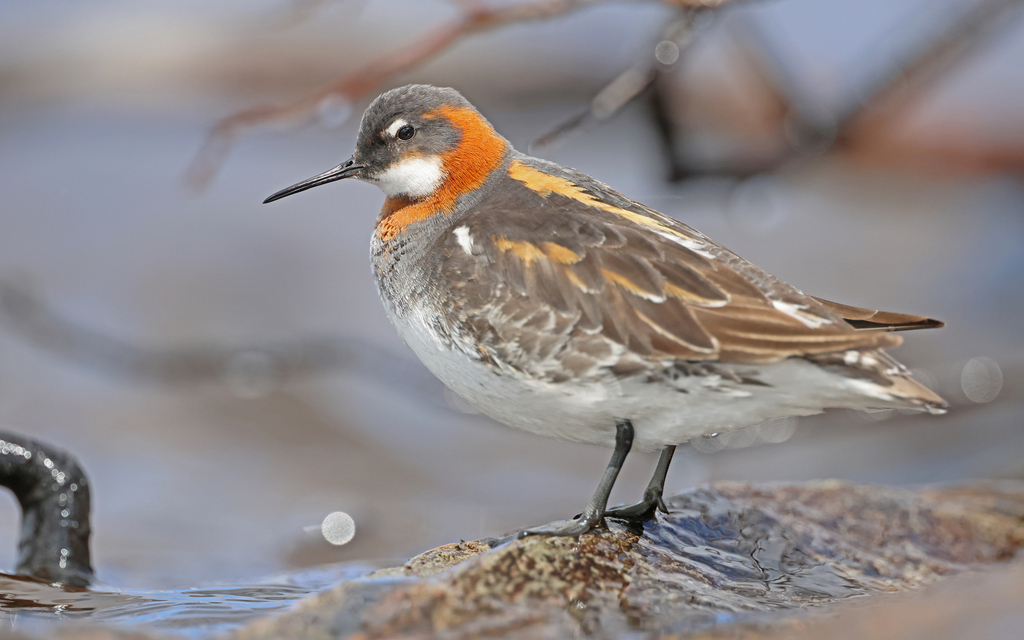
Red-necked Phalarope
Photo © Christoph Moning
Photo © Christoph Moning — CC BY 4.0 — Source: iNaturalist photo #306699104Identification
The red-necked phalarope is a small wader, approximately 18 cm in length, distinguished by its lobed toes and fine, straight bill. Breeding females are striking: predominantly dark grey above with a distinctive chestnut neck and upper breast, black face, and white throat. Males are noticeably duller versions of females. A white wing stripe is a reliable field mark that helps separate this species from the similar Wilson's phalarope. Young birds appear grey and brown above with buff underparts and a characteristic black eye patch. In winter plumage, the bird becomes essentially grey above and white below, though the black eye patch remains visible year-round. The species has a sharp call described as a whit or twit.
Range & Habitat
The red-necked phalarope breeds in the Arctic regions of both North America and Eurasia, making it a truly circumarctic species. It is highly migratory and unusual among waders in that it winters at sea on tropical oceans rather than on coastal shores. In Britain and Ireland, it is a rare and localised breeding species found at the extreme edge of its world range. Shetland is the most reliable location, particularly the Loch of Funzie on Fetlar, with smaller populations in the Scottish Outer Hebrides and occasionally the Scottish mainland. Breeding has been recorded in western Ireland since around 1900, though records have become scarce since the 1970s.
Behaviour & Diet
The red-necked phalarope exhibits remarkable behaviour, particularly during the breeding season. Females are generally larger than males and pursue males aggressively, defending their mates until incubation begins. Uniquely among most birds, males perform all incubation and chick-rearing duties while females may seek additional mates. Young are precocial and able to fly within 20 days of hatching.
When feeding, the bird exhibits a distinctive behaviour: it swims rapidly in small circles to create a whirlpool, which stirs food from shallow water bottoms. The phalarope then plucks small insects and crustaceans from the vortex with its bill. On the open ocean, they congregate where converging currents produce upwellings rich in food. During migration, flocks gather at locations like the Bay of Fundy to exploit tidal disturbances that expose prey.
Best Time & Places to See It
For observers in Britain and Ireland, Shetland offers the most reliable opportunities, especially the Loch of Funzie on Fetlar during the breeding season. The Outer Hebrides, particularly where watchpoints have been established such as at Loch na Muilne, also provide chances to encounter this species. The red-necked phalarope spends almost all its non-breeding season on open water, rarely coming into contact with humans, which means it can be unusually tame when encountered. During migration periods, coastal areas and open-water sites may offer sightings of this oceanic wader.
Photography Tips
Photographing red-necked phalaropes presents unique challenges given their preference for open water and remote Arctic breeding grounds. During breeding season, the striking plumage of females—with their contrasting chestnut, grey, and black markings—provides excellent photographic subjects. The bird's characteristic swimming behaviour, creating small whirlpools while feeding, offers distinctive action shots. Because the species is unusually tame and rarely encounters humans, patient photographers may find breeding birds relatively approachable. The bird's small size and fine bill require careful focusing and adequate magnification. Shetland's Loch of Funzie remains your best bet for accessible photography of breeding birds in their natural habitat.
Tombstone Territorial Park
Abijata-Shalla Lakes National Park
Acadia National Park
Alaska Maritime National Wildlife Refuge
Algonquin Provincial Park
Alligator River National Wildlife Refuge
Amboseli National Park
Arabuko Sokoke Forest Reserve
Arctic National Wildlife Refuge
Nothing matches these filters.
No community photos yet. Log in to add the first one.
No community observations of this species yet.