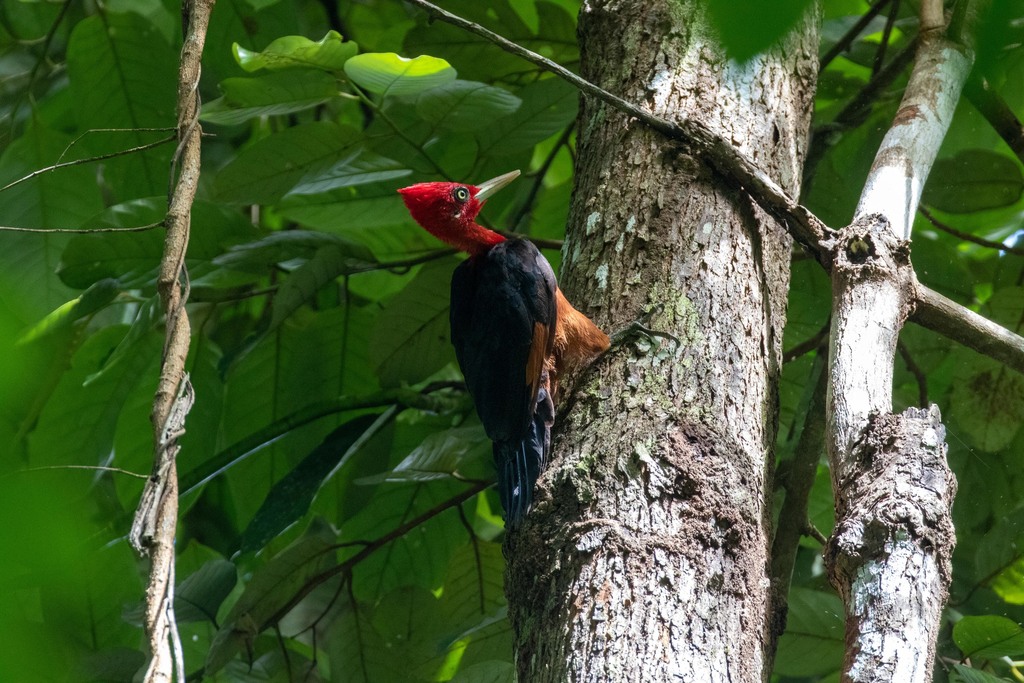
Red-necked Woodpecker
Photo © Thibaud Aronson
Photo © Thibaud Aronson — CC BY-SA 4.0 — Source: iNaturalist photo #113764213Identification
The red-necked woodpecker is a large woodpecker, measuring 30 to 35 cm in length and weighing 178 to 236 grams. Both sexes display black to brownish-black upperparts and rufous coloring on the inner flight feathers. The most striking feature is the bright red breast that fades to rufous cinnamon towards the vent. Adult males are unmistakable with an entirely red head and neck, while females lack the male's distinctive head coloring but display a characteristic whitish stripe bordered in black extending from the bill to the ear coverts. Juveniles are duller and browner overall, with more orange-toned red markings. The bird has a long pale grayish-white chisel bill, yellowish-white iris, and dark gray or olive legs.
Range & Habitat
This species is found throughout the Amazon Basin across mainland South America, notably absent only from Argentina, Chile, Paraguay, and Uruguay. Three subspecies are recognized, distributed from eastern Colombia and Ecuador through the Guianas and northern Brazil, with additional populations in western and central Brazil, Peru, and Bolivia. The red-necked woodpecker inhabits tropical rainforests, terra firme and várzea forests, favoring the forest interior while also occurring at forest edges, secondary forests, and riparian woodland in savannah regions. Elevation ranges from sea level to 600 meters throughout most of its range, though it locally reaches higher altitudes in southern Venezuela, northwestern Brazil, and Bolivia.
Behaviour & Diet
This species is a year-round resident throughout its range. Red-necked woodpeckers typically forage in pairs or small family groups, searching trunks and limbs from mid-story to canopy level, though they also hunt near the ground on rotting stubs. Their diet consists primarily of beetle and moth larvae supplemented with fruit. The most common vocalization is an explosive nasal call, described as "ngkah-ngkah" or "kikka," repeated frequently. When agitated, they produce churring calls, and their drumming consists of loud double-raps. Breeding occurs between January and May in northern populations, November in Ecuador, and September in Peru, with nests typically located high in dead trees or palms.
Best Time & Places to See It
The red-necked woodpecker's year-round resident status means it can be encountered throughout the year within its range. The best opportunities for observation occur in primary and secondary rainforests across the Amazon Basin, particularly in protected areas spanning Colombia, Ecuador, Venezuela, the Guianas, Brazil, Peru, and Bolivia. Look for them foraging in forest mid-story and canopy levels, where their explosive calls often betray their presence. Early morning hours when woodpeckers are most vocal offer the best chance of locating them.
Photography Tips
Patience and early morning visits to primary and secondary forest will improve your chances of photographing this species. The bright red coloring of males makes them relatively conspicuous against dark forest foliage, though their preference for mid-canopy foraging requires a telephoto lens of at least 400mm. Listen carefully for their distinctive nasal calls and drumming sounds to locate them before attempting photography. Overcast conditions are preferable to bright sunlight for rendering the subtle rufous and red plumage tones accurately. When birds are vocalizing repeatedly, they may remain in one area long enough for careful approach and composition.
Amacayacu National Park
Amazônia National Park
Anavilhanas National Park
Bahuaja Sonene National Park
Campos Amazónicos National Park
Cantão State Park
Chapada dos Guimarães National Park
French Guiana Amazonian Park
Jaú National Park
Nothing matches these filters.
No community photos yet. Log in to add the first one.
No community observations of this species yet.