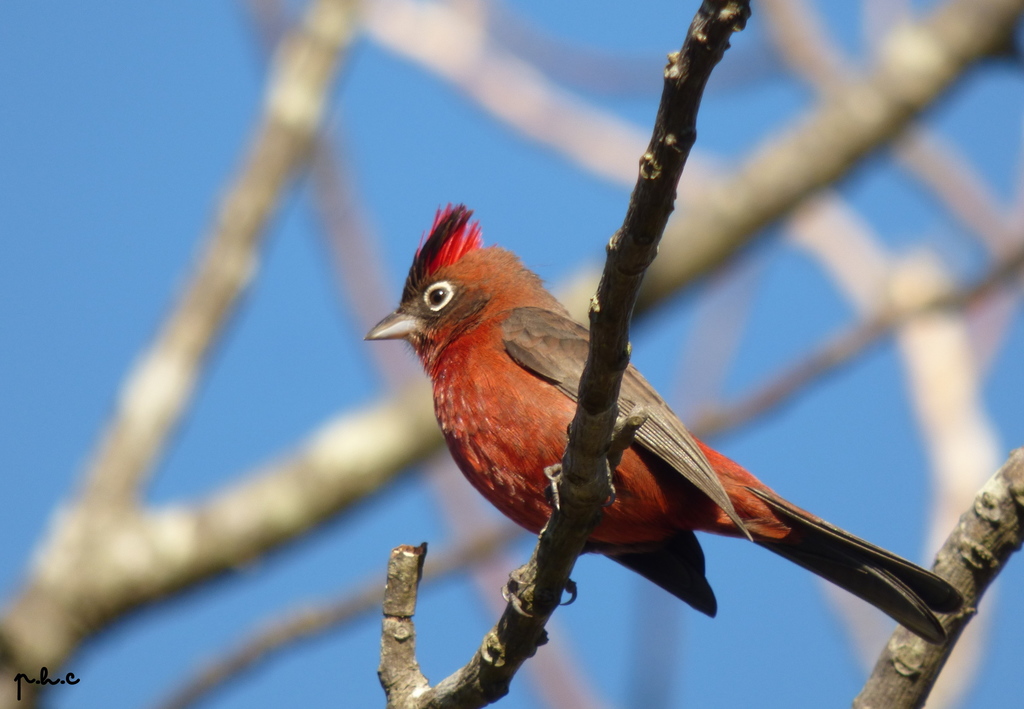
Red Pileated Finch
Photo © Pablo H Capovilla
Photo © Pablo H Capovilla — CC BY 4.0 — Source: iNaturalist photo #134449920Identification
The red pileated finch is a small songbird, measuring about 13.5 cm (5.3 inches) in length. The most striking feature is the male's prominent red crest paired with a black crown, which gives the species its distinctive name. Males display dark wine-red upper parts with a reddish rump, while the underparts are a drab reddish colour. Both sexes possess a characteristic white eye ring. Females lack the red crest and black head markings of males; their upper parts are somewhat more brown in tone, with a white throat and pink underparts, making them noticeably different from their male counterparts.
Range & Habitat
This species has an extensive range across South America, found in Argentina, Bolivia, Brazil, Ecuador, French Guiana, Guyana, Paraguay, and Peru, predominantly on the eastern side of the Andes. The bird's distribution spans from southern Brazil and northern Argentina, extending from Brasília and Rio de Janeiro southwards to Buenos Aires and westwards to the Andean foothills. Additional isolated populations occur in dry mountain valleys of Ecuador, Peru, and Bolivia, as well as in northern Brazil and the Guyana Shield region.
The red pileated finch inhabits subtropical and tropical dry forests, moist lowland forests, dry shrubland, and heavily degraded former forest areas. It is seldom found above 1,500 metres (4,900 feet) in elevation, though in the Cusco area of southeastern Peru it may occur up to approximately 2,000 metres (6,600 feet).
Behaviour & Diet
While the source material does not provide detailed information about the red pileated finch's specific behaviours or dietary preferences, its classification within the Thraupidae family (tanagers and allies) suggests it shares characteristics with other tanagers, which are typically active songbirds. The species belongs to a sister group that includes several tanager species, indicating its position within a broader family of small to medium-sized passerines.
Best Time & Places to See It
The red pileated finch is a common species with a steady population trend throughout its range, making it a reliable subject for wildlife observation. The extensive distribution across South America means that visitors to suitable habitats across Argentina, Bolivia, Brazil, Ecuador, French Guiana, Guyana, Paraguay, and Peru have good opportunities to encounter this bird. Its preference for accessible elevations below 1,500 metres makes it relatively approachable in lowland and foothill regions.
Photography Tips
The male's striking red crest and contrasting black crown provide excellent photographic subjects, particularly when the bird is perched prominently. The white eye ring is a useful identifying feature to capture in photographs. Female birds, with their more subtle brown and pink colouration, offer different photographic challenges and opportunities. The bird's occurrence in open shrubland and degraded forest areas may provide better visibility and shooting angles than dense forest habitats.
Emas National Park
Brazil
+333 birds+23 mammals
Across the high plateaux of central Brazil, where the cerrado grasslands roll toward distant horizons under an immense sky, Emas National Park anchors one of South…
VIEW NATIONAL PARKSerra do Cipó National Park
Brazil
+379 birds+5 mammals
Where granite escarpments rise above the Atlantic Forest transition zone in southeastern Brazil, Serra do Cipó National Park unfolds across a landscape of dramatic ridges, cascading…
VIEW NATIONAL PARKPodocarpus National Park
Zamora, Ecuador
+496 birds+6 mammals
Where the Andes descend toward the Amazon basin, Podocarpus National Park sprawls across nearly 2,800 square kilometres of the most biodiverse terrain in Ecuador's southern highlands.…
VIEW NATIONAL PARKSumaco Napo-Galeras National Park
Loreto, Ecuador
+563 birds+4 mammals
Where Ecuador's Amazon transitions into cloud forest, a massive shield volcano rises from the emerald lowlands of Orellana Province, anchoring one of the continent's most biodiverse…
VIEW NATIONAL PARKPeixe National Park Lagoon
Brazil
+293 birds+4 mammals
Where the coastal plains of Rio Grande do Sul meet the Atlantic, Peixe National Park Lagoon sprawls across nearly 2,200 square kilometres of shallow waters, reed…
VIEW NATIONAL PARKIguaçu National Park
Brazil
+387 birds+17 mammals
Where the Paraná Plateau plunges toward the Atlantic watershed, six thousand square kilometers of subtropical rainforest cling to steep gorges and river valleys in this corner…
VIEW NATIONAL PARKIlha Grande National Park
Brazil
+233 birds
Across the subtropical plateaus and Atlantic forest remnants of southern Brazil, a vast protected landscape spanning nearly 4,600 square kilometers safeguards one of the continent's most…
VIEW NATIONAL PARKChapada dos Guimarães National Park
Brazil
+450 birds+1 mammals
Where weathered sandstone plateaus rise above the cerrado grasslands of central Brazil, Chapada dos Guimarães National Park protects 624 square kilometres of ecological transition zone that…
VIEW NATIONAL PARKChapada dos Veadeiros National Park
Brazil
+324 birds+6 mammals
Where granite plateaus rise above the cerrado savanna in central Brazil, Chapada dos Veadeiros National Park unfolds across 6,665 square kilometres of some of the world's…
VIEW NATIONAL PARKPantanal Matogrossense National Park
Brazil
+322 birds+17 mammals
Where the flooded forests of central Brazil meet vast seasonally inundated grasslands, Pantanal Matogrossense National Park sprawls across nearly 2,900 square kilometers of one of the…
VIEW NATIONAL PARKSerra do Gandarela National Park
Brazil
+333 birds+3 mammals
Where granite massifs rise through Atlantic Forest in southeastern Brazil's highlands, Serra do Gandarela National Park protects nearly 1,000 square kilometres of montane terrain that few…
VIEW NATIONAL PARKBrasília National Park
Plano Piloto, Brazil
+338 birds+15 mammals
Cerrado grassland and scattered woodland sweep across the central Brazilian plateau where this national park sprawls across more than a thousand square kilometres of the Federal…
VIEW NATIONAL PARKAraucárias National Park
Brazil
+231 birds+3 mammals
Where the southern Brazilian highlands rise into cool temperate forest, Araucárias National Park protects one of the Atlantic Forest's most distinctive ecosystems across 506 square kilometres…
VIEW NATIONAL PARKEl Palmar National Park
Distrito Sexto, Argentina
+244 birds+14 mammals
Across the Paraná River floodplain in northeastern Argentina, palms rise from wetland and grassland in a landscape shaped by water and time. El Palmar National Park…
VIEW NATIONAL PARKRío Pilcomayo National Park
Argentina
+271 birds+13 mammals
Where the Río Pilcomayo cuts through northeastern Argentina's subtropical lowlands, a sprawling mosaic of wetlands, grasslands, and seasonally flooded forests creates one of South America's most…
VIEW NATIONAL PARKIguazú National Park
Puerto Iguazú, Argentina
+346 birds+15 mammals
Where the Paraná Plateau plunges toward the Atlantic watershed, nearly 800 square kilometers of subtropical rainforest drape across Misiones Province in a landscape carved by millennia…
VIEW NATIONAL PARKEl Rey National Park
Municipio de Las Lajitas, Argentina
+317 birds+4 mammals
Where the eastern slopes of the Andes descend into northwestern Argentina's subtropical transition zone, El Rey National Park unfolds across 841 square kilometers of dramatically varied…
VIEW NATIONAL PARKCalilegua National Park
Municipio de Calilegua, Argentina
+288 birds+8 mammals
Where the eastern Andean slopes plunge into northwestern Argentina's humid subtropics, nearly 2,645 square kilometers of steep terrain and luxuriant forest compose one of South America's…
VIEW NATIONAL PARKParque Provincial Pampa del Indio
Laguna Limpia, Argentina
+231 birds+4 mammals
Across the flat horizons of Chaco Province, where the Paraná River system spills into vast wetlands and grasslands, Parque Provincial Pampa del Indio protects one of…
VIEW NATURE RESERVENo community photos yet. Log in to add the first one.
No community observations of this species yet.