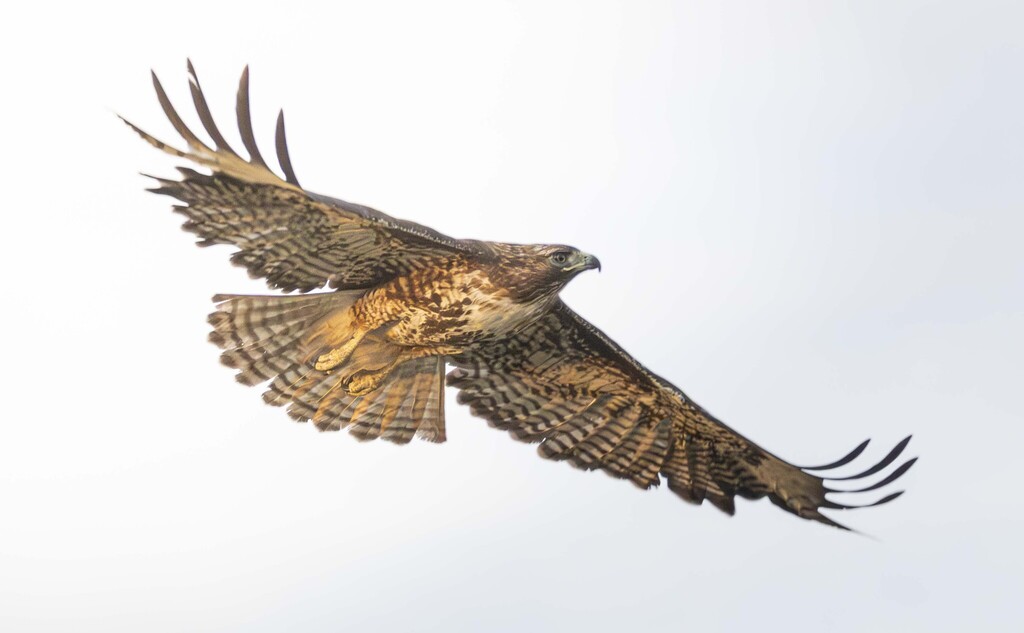
Red-tailed Hawk
Photo © Brooke J.
Photo © Brooke J. — CC BY 4.0 — Source: iNaturalist photo #658909456Identification
The red-tailed hawk is one of the largest members of the genus Buteo in North America, typically weighing from 690 to 1,600 g and measuring 45–65 cm in length, with a wingspan from 110–145 cm. Females are about 25% heavier than males. The species is distinguished by its stocky body with broad wings and, most notably, by its eponymous tail, which is uniformly brick-red above and light buff-orange below. At least 14 recognized subspecies vary in appearance and range, with some individuals—particularly Harlan's hawk—displaying markedly different plumage with blackish and white coloring lacking the warm brick-red tones characteristic of other populations.
Range & Habitat
The red-tailed hawk is one of the most common hawks in North America. It breeds throughout most of the continent, from western Alaska and northern Canada to as far south as Panama and the West Indies. The species occupies a wide range of habitats and altitudes, including deserts, grasslands, coniferous and deciduous forests, agricultural fields, and urban areas. It is notably absent in areas of unbroken forest and in the high arctic. The red-tailed hawk is legally protected in Canada, Mexico, and the United States by the Migratory Bird Treaty.
Behaviour & Diet
The red-tailed hawk feeds on a wide range of small animals, such as rodents, birds, and reptiles. Despite being colloquially known in the United States as one of three species called the "chickenhawk," it rarely preys on adult chickens. Pairs stay together for life, taking a new mate only when the original mate dies. The pair constructs a stick nest in a high tree, in which a clutch of one to three eggs is laid. Because they are so common and easily trained as capable hunters, most hawks captured for falconry in the United States are red-tailed hawks.
Best Time & Places to See It
The red-tailed hawk's abundance and adaptability to diverse habitats make it accessible to observers across much of North America. Different subspecies exhibit varying migratory patterns; some populations breed and winter across broad ranges, while others remain resident year-round in their territories. Open and semi-open habitats—agricultural fields, grasslands, and deserts—offer the best viewing opportunities, as the species avoids unbroken forest. Urban and suburban areas also support red-tailed hawk populations, making sightings possible even near populated centers.
Photography Tips
The red-tailed hawk's distinctive brick-red tail is the key feature to capture, particularly the contrasting coloration between the reddish upper surface and light buff-orange underside. The bird's large size and broad wings make it relatively easy to photograph when perched in high trees or soaring overhead. When photographing different subspecies, note the considerable variation in plumage; some individuals, particularly those from western and Central American populations, may display darker overall coloration or paler head markings. The feathers and other parts of the red-tailed hawk are considered sacred to many American indigenous people, making respectful documentation of this culturally significant species especially important.
Tombstone Territorial Park
Acadia National Park
Alaska Maritime National Wildlife Refuge
Algonquin Provincial Park
Arches National Park
Arctic National Wildlife Refuge
Arenal Volcano National Park
Barra del Colorado National Wildlife Refuge
Baru Volcano National Park
Nothing matches these filters.
No community photos yet. Log in to add the first one.
No community observations of this species yet.