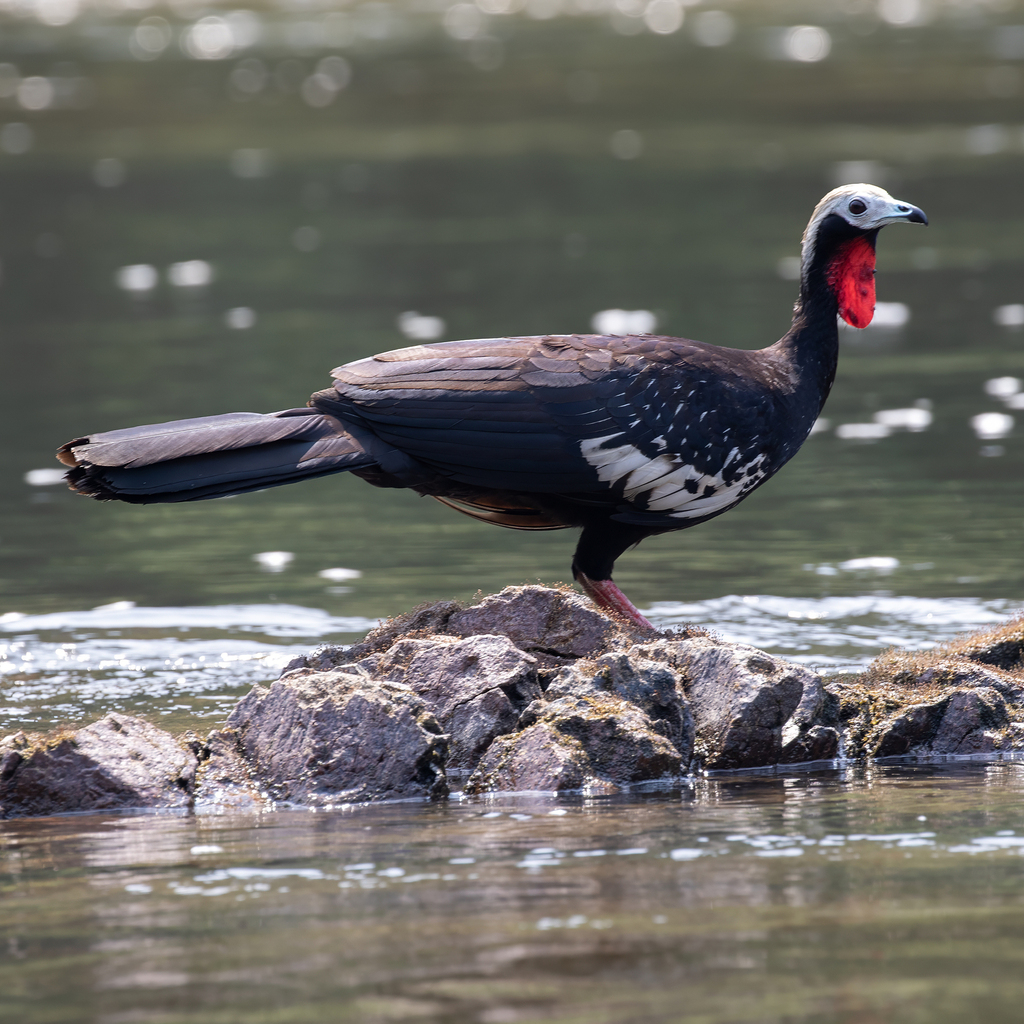
Red-throated Piping Guan
Photo © Dan Vickers
Photo © Dan Vickers — CC BY 4.0 — Source: iNaturalist #260961656Identification
The red-throated piping guan is a striking black bird measuring 69 to 76 cm in length. Its most distinctive features include a shaggy white crest atop its head, bare pale blue skin on the face, and a vivid red gular patch (throat patch) that gives the species its name. White speckles pattern the breast, and black-and-white patches adorn the wings. Two subspecies exist: the nominate subspecies displays a glossier plumage with a blue sheen and smaller white wing patches, while P. c. nattereri, weighing 1,100 to 1,300 grams, appears less glossy overall.
Range & Habitat
This species is endemic to South America, found only in Bolivia and Brazil. The nominate subspecies occurs in north-central Brazil south of the Amazon River, ranging from the lower Madeira River east into northern Pará state. P. c. nattereri inhabits western Amazonian Brazil across an area bounded by Pará, Goiás, Amazonas, and Rondônia states, and extends into the eastern Santa Cruz department of Bolivia.
Red-throated piping guans favour tropical and semi-deciduous forests in lowland areas up to 700 metres elevation. They show a marked preference for forests with a minimum canopy height of 15 metres, making them birds of tall, mature woodland rather than disturbed or secondary growth.
Behaviour & Diet
This guan is a social species, typically foraging in flocks of up to about 30 individuals, and occasionally joining mixed-species flocks with blue-throated piping guans. They forage primarily in the forest canopy, though they sometimes descend to the ground. While their complete diet remains undocumented, they are known to feed on fruit and flowers.
Red-throated piping guans are vocal birds, producing a distinctive rising series of clear whistles, typically heard in the morning hours. At dawn, they perform a wing-whirring display that generates a coarse, doubled, ripping noise. Little else is known about their breeding biology and reproductive timing.
Best Time & Places to See It
Early morning is the optimal time to locate red-throated piping guans, when their rising whistle song is most active. Visitors should search tall primary and mature secondary forests in western Amazonian Brazil or eastern Bolivia. The species is considered fairly common to common throughout much of its range, improving the chances of successful encounters for patient observers. Look for flocks moving through the mid to upper canopy, though ground foraging opportunities also occur.
Photography Tips
The bird's striking plumage—white crest, red throat patch, and contrasting black body—provides excellent photographic potential against green forest foliage. Position yourself in lowland forest areas with adequate canopy height and search the middle to upper branches where these birds forage. Early morning light combined with the species' vocal activity will guide your search. The glossy blue sheen of the nominate subspecies and the distinctive bare blue facial skin make for compelling detail shots. Patient waiting near fruiting trees may reward photographers with multiple birds in frame, as their gregarious nature means where one appears, others often follow.
Serra do Pardo National Park
Brazil
+153 birds
Vast upland forests and weathered plateaus define this 7,129-square-kilometre protected expanse in the heart of Pará's remote interior, where ancient bedrock and swollen rivers have carved…
VIEW NATIONAL PARKChapada dos Guimarães National Park
Brazil
+450 birds+1 mammals
Where weathered sandstone plateaus rise above the cerrado grasslands of central Brazil, Chapada dos Guimarães National Park protects 624 square kilometres of ecological transition zone that…
VIEW NATIONAL PARKPantanal Matogrossense National Park
Brazil
+322 birds+17 mammals
Where the flooded forests of central Brazil meet vast seasonally inundated grasslands, Pantanal Matogrossense National Park sprawls across nearly 2,900 square kilometers of one of the…
VIEW NATIONAL PARKAmazônia National Park
Brazil
+439 birds+6 mammals
Where the Rio Amazonas and its tributaries weave through the heart of Pará state, a vast tapestry of rainforest stretches across 23,611 square kilometers of unbroken…
VIEW NATIONAL PARKCampos Amazónicos National Park
Amazonas, Brazil
+434 birds+7 mammals
Sprawling across the southwestern Amazon basin in Amazonas state, this 27,263-square-kilometre national park encompasses some of the region's most pristine lowland rainforest, where terra firme forest…
VIEW NATIONAL PARKNo community photos yet. Log in to add the first one.
No community observations of this species yet.