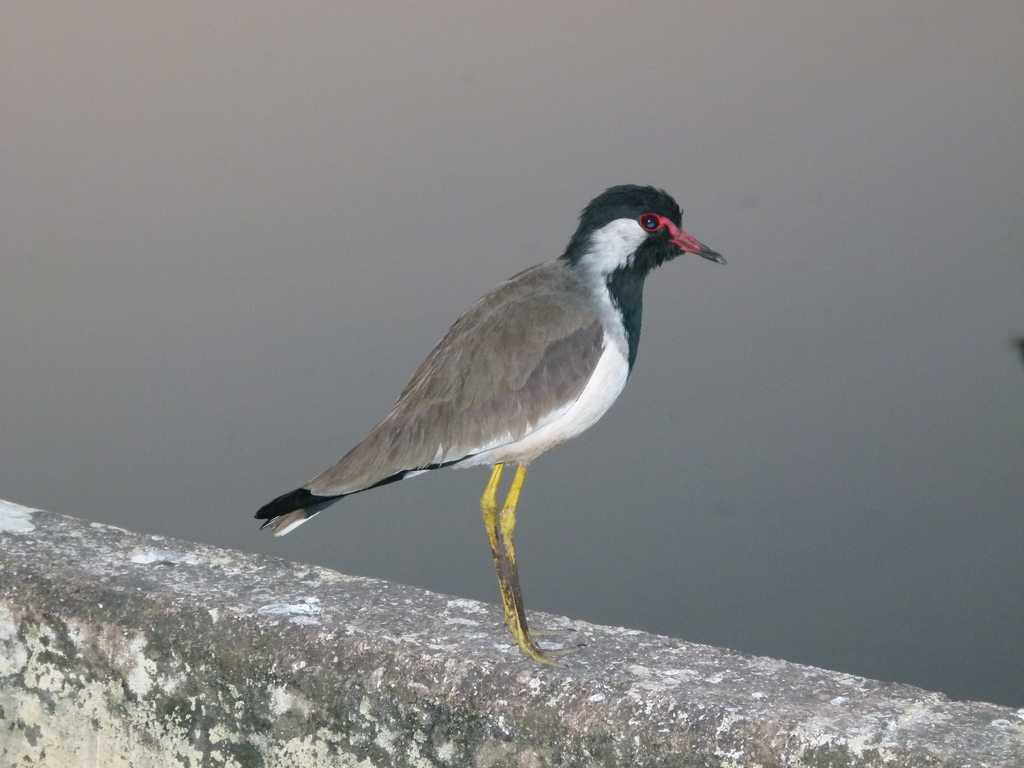
Red-wattled Lapwing
Photo © Yves Bas
Photo © Yves Bas — CC BY 4.0 — Source: iNaturalist photo #72194871Identification
The red-wattled lapwing is a large wader measuring about 35 cm (14 in) in length. Its most distinctive features are immediately eye-catching: a bright red fleshy wattle in front of each eye, a black-tipped red bill, and long yellow legs. The plumage combines contrasting colours—the wings and back are light brown with a purple to green sheen, while the head, throat bib, and back of the neck are striking black. A prominent white patch runs from the belly and tail, flanking the neck to the sides of the crown, creating a bold facial pattern. The short tail is tipped black, and in flight, the bird displays prominent white wing bars formed by white on the secondary coverts. Males and females are similar, though males have slightly longer wings and carpal spurs.
Range & habitat
The red-wattled lapwing is widespread across Asia, breeding from West Asia (Iraq, southwestern Iran, and the Persian Gulf) eastwards through South Asia including Afghanistan, Pakistan, the entire Indian subcontinent, Sri Lanka, and reaching up to 1800 m in Kashmir and Nepal. A separate subspecies extends further east into Southeast Asia. Four recognized subspecies show subtle plumage variations across this range; for example, the Sri Lankan race is notably smaller and darker than others. While the species is declining in its western range, it remains abundant across much of South Asia.
These birds favour well-watered open country including ploughed fields, grazing land, margins of tanks, dry beds of puddles, and forest clearings around rain-filled depressions. They are generally resident populations, though some altitude migration occurs in spring and autumn, and populations spread widely during the monsoon season when suitable wetland habitats are created.
Behaviour & diet
Red-wattled lapwings are characteristically noisy, ground-dwelling birds incapable of perching. They are usually seen in pairs or small groups near water, though they occasionally form large flocks of 26 to 200 birds in the non-breeding season. Their loud, scolding call—variously rendered as "did-he-do-it"—is heard day and night and has earned them the colloquial name "did-he-do-it bird." They are renowned for their ceaseless vigilance and were traditionally considered a nuisance by hunters, as they are always the first to detect intruders and raise an alarm.
These plovers feed in the typical plover manner, running about in short spurts and dipping forward obliquely with unflexed legs to pick up food. They are said to feed actively at night, especially around the full moon. During breeding season (mainly March to August), males perform elaborate courtship displays, puffing their feathers and pointing their beaks upward before shuffling around the female. The species nests in ground scrapes, laying three to four cryptically patterned eggs. Both adults fiercely defend their nest, diving at predators while calling noisily, and chicks immediately follow their parents to feed, hiding by lying low when threatened.
Best time & places to see it
Red-wattled lapwings are abundant and relatively easy to find throughout their South Asian range, being seen at almost any wetland habitat. Look for them in open, well-watered country, particularly around the margins of tanks, puddles, and ploughed fields. The best viewing opportunities are during daylight, though their nocturnal activity means they can be active around the full moon. In regions where they occur, their loud and distinctive calls make them easy to locate even before they are seen.
Photography tips
The red-wattled lapwing's striking appearance and bold colour contrasts make it rewarding to photograph. Focus on capturing the distinctive red wattles, red bill, and bright yellow legs against the black and white head pattern. These ground birds are often found in open habitats with minimal cover, providing excellent photographic opportunities. Their alert nature and constant movement mean fast shutter speeds are essential. Their characteristic posture—running in short spurts and dipping forward to feed—offers dynamic compositional possibilities. Photographing them near their nests during the breeding season requires patience and discretion to avoid disturbing the birds.
Lunugamvehera National Park
Sri Lanka
+204 birds+14 mammals
Dry scrubland and shallow wetlands converge in Sri Lanka's southeastern lowlands, where Lunugamvehera National Park anchors one of the island's most ecologically vital landscapes. The park's…
VIEW NATIONAL PARKMinneriya National Park
Sri Lanka
+158 birds+9 mammals
Across the dry zone of Sri Lanka's North Central Province spreads a landscape of shallow tanks, grassland margins, and scattered dry forest—a mosaic of water and…
VIEW NATIONAL PARKWasgamuwa National Park
Sri Lanka
+156 birds+8 mammals
Dry deciduous forest and open grassland sweep across the North Central lowlands where Wasgamuwa National Park protects one of Sri Lanka's largest remaining tracts of this…
VIEW NATIONAL PARKAngamedilla National Park
Polonnaruwa, Sri Lanka
+40 birds+2 mammals
Ancient tanks and sal forests define this water-rich sanctuary in Sri Lanka's North Central heartland, where seasonal wetlands and dry deciduous woodland create a mosaic of…
VIEW NATIONAL PARKOrang National Park
Rangagarapathar, India
+298 birds+1 mammals
Where the Brahmaputra's floodplains meet the foothills of Assam, Orang National Park unfolds across a mosaic of riverine grasslands, forests and wetlands that pulse with the…
VIEW NATIONAL PARKIndravati National Park
Bijapur, India
+41 birds
Where the Indravati River cuts through the elevated plateaus of central India, a landscape of deciduous forest and open woodland unfolds across Bijapur district in Chhattisgarh.…
VIEW NATIONAL PARKRanthambhore National Park
Sawai Madhopur, India
+294 birds+20 mammals
Granite ridges and ravines carved through the Aravalli Range frame this protected landscape in eastern Rajasthan, where deciduous forest mingles with open scrubland and seasonal water…
VIEW NATIONAL PARKEravikulam National Park
Devikulam, India
+192 birds+7 mammals
High in the Western Ghats of Kerala, where monsoon mists cling to slopes that rise above 2,000 metres, Eravikulam National Park preserves one of South India's…
VIEW NATIONAL PARKHat Noppharat Thara-Mu Ko Phi Phi National Park
Ao Nang, Thailand
+253 birds+9 mammals
Where limestone karsts rise dramatically from turquoise waters, Hat Noppharat Thara-Mu Ko Phi Phi National Park unfolds across a mosaic of beach, mangrove forest, and island…
VIEW NATIONAL PARKKhao Yai National Park
Prachantakham District, Thailand
+377 birds+46 mammals
Evergreen dipterocarp forest blankets the rolling terrain of this national park in eastern Thailand, where limestone hills rise abruptly from the forest floor and seasonal streams…
VIEW NATIONAL PARKKhao Laem Ya-Mu Ko Samet National Park
Mueang Rayong District, Thailand
+159 birds+3 mammals
Where limestone hills meet the Gulf of Thailand, Khao Laem Ya–Mu Ko Samet National Park stitches together a mosaic of terrestrial and marine worlds that few…
VIEW NATIONAL PARKKhao Laem National Park
Sangkhla Buri District, Thailand
+197 birds
Where the Vajiralongkorn Reservoir sprawls across the forested valleys of Kanchanaburi's northern borderlands, Khao Laem National Park protects a landscape where limestone ridges rise dramatically from…
VIEW NATIONAL PARKKanha Tiger Reserve
Kanha Kisli F.V., India
+321 birds+23 mammals
Where sal forests give way to emerald meadows and crystalline streams carve through ancient valleys, one of India's finest wilderness reserves unfolds across the Maikal Range.…
VIEW NATIONAL PARKTadoba National Park
Palasgaon Singru, India
+270 birds+20 mammals
Where sal forests meet open grasslands and rocky outcrops rise from red laterite soil, central India's landscape unfolds in raw, untamed beauty. Ancient teak woodlands and…
VIEW NATIONAL PARKBandhavgarh National Park
Garhpuri, India
+285 birds+17 mammals
Where granite ridges rise dramatically above sal and bamboo forests, one of India's most pristine tiger reserves unfolds across the Vindhyan plateau. Ancient rock formations tower…
VIEW NATIONAL PARKPanna National Park
Badgadi Kalan, India
+271 birds+17 mammals
Where granite gorges slice through central India's Vindhyan plateau, a landscape of stark beauty unfolds across nearly six hundred square kilometers. The Ken River carves through…
VIEW NATIONAL PARKKaziranga National Park
Kohora, India
+422 birds+26 mammals
Dawn breaks over the floodplains of the Brahmaputra, where tall grasslands stretch endlessly beneath monsoon-heavy skies. This sprawling wilderness of northeastern Assam is a mosaic of…
VIEW NATIONAL PARKKeoladeo National Park
Shreenagar Rural, India
+326 birds+14 mammals
Where shallow wetlands shimmer beneath vast Rajasthani skies, one of Asia's finest bird sanctuaries pulses with extraordinary life. This former maharaja's hunting reserve, now spanning 29…
VIEW NATIONAL PARKPeriyar National Park
Mlappara, India
+232 birds+4 mammals
Dawn breaks over mist-shrouded ridges where the Western Ghats tumble toward Kerala's spice-scented lowlands. Here, ancient tropical forests envelope a glittering artificial lake, creating a mosaic…
VIEW NATIONAL PARKPampadum Shola National Park
Vattavada, India
+258 birds+14 mammals
Where misty shola forests cling to the high plateaus of the Nilgiri Mountains, ancient evergreen remnants create a world apart. This 2,316-hectare reserve protects one of…
VIEW NATIONAL PARKBandipur National Park
Hirehalli, India
+302 birds+19 mammals
Where the Western Ghats descend into the Deccan plateau, ancient deciduous forests blanket a landscape carved by the Nugu River. Bandipur unfolds across 880 square kilometres…
VIEW NATIONAL PARKGir National Park
Asundrali, India
+258 birds+13 mammals
Dry deciduous forests cloak the rolling hills of western Gujarat where the Gir landscape rises as a final sanctuary for one of the world's rarest felids:…
VIEW NATIONAL PARKGaoligong Mountain National Nature Reserve
Nujiang Lisu Autonomous Prefecture, China
+443 birds+13 mammals
VIEW NATURE RESERVENo community photos yet. Log in to add the first one.
No community observations of this species yet.