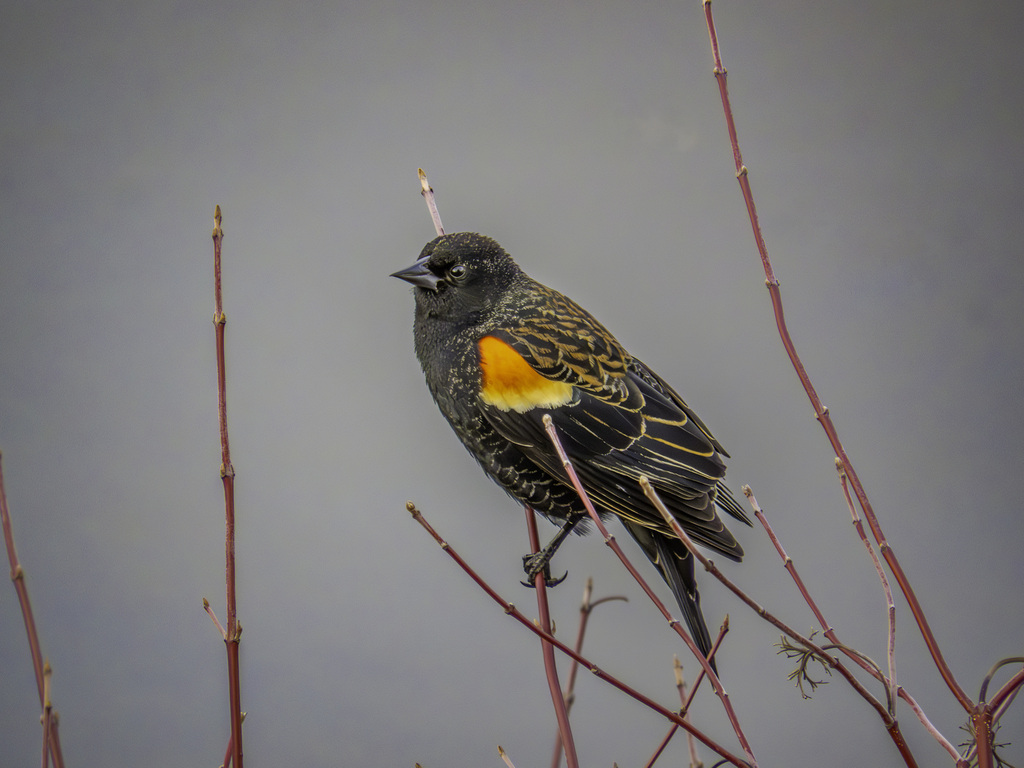
Red-winged Blackbird
Photo © Shaun Coleman
Photo © Shaun Coleman — CC BY 4.0 — Source: iNaturalist photo #356158178Identification
The red-winged blackbird is highly sexually dimorphic, making identification straightforward once you know what to look for. Males are unmistakable: entirely black plumage with a striking red shoulder patch and bright yellow wing bar. Females are far more subdued, appearing as nondescript dark brown birds that can be easily overlooked. However, subspecific variation exists, particularly among populations in California and central Mexico, where some males lack the yellow wing bar entirely, and females show greatly reduced or restricted veining patterns. Between 20 and 24 subspecies are recognized, though most are quite similar in appearance.
Range & Habitat
This species is found across most of North America and much of Central America, breeding from Alaska and Newfoundland south through Florida, the Gulf of Mexico, and into Mexico and Guatemala, with isolated populations extending into western El Salvador, northwestern Honduras, and northwestern Costa Rica. Northern populations are generally migratory, moving south to Mexico and the Southern United States for winter, though some birds may remain as far north as Pennsylvania and British Columbia. The red-winged blackbird ranks among the most abundant land birds in North America, with breeding populations potentially exceeding 250 million pairs in peak years, and wintering flocks sometimes numbering over a million birds.
Behaviour & Diet
The genus name Agelaius derives from Ancient Greek meaning "gregarious," reflecting the species' highly social nature, particularly during migration and winter when they form massive flocks. The red-winged blackbird feeds primarily on seeds and insects, making it an adaptable forager across its extensive range. This species ranks among the best-studied wild birds in the world, providing researchers with invaluable insights into avian ecology and behavior.
Best Time & Places to See It
Red-winged blackbirds are year-round residents throughout much of their range, though availability varies by location and season. In northern regions, spring and summer offer the best viewing during breeding season when males are most vocal and visible. Winter offers spectacular opportunities to witness the massive flocks in southern wintering grounds. Wetland habitats, including marshes and areas with cattails, are prime locations throughout the breeding range.
Photography Tips
The striking red and yellow shoulder patches of breeding males provide excellent color contrast for photography, particularly during spring when birds are most active and vocal. The subtle plumage of females requires careful lighting and focus to capture detail. Photographing birds within large flocks offers opportunities for compelling composition and behavior documentation, though isolating individual birds against clean backgrounds will showcase the species' distinctive sexual dimorphism most effectively.
Tombstone Territorial Park
Acadia National Park
Alaska Maritime National Wildlife Refuge
Algonquin Provincial Park
Alligator River National Wildlife Refuge
Arches National Park
Arenal Volcano National Park
Badlands National Park
Banff National Park
Nothing matches these filters.
No community photos yet. Log in to add the first one.
No community observations of this species yet.