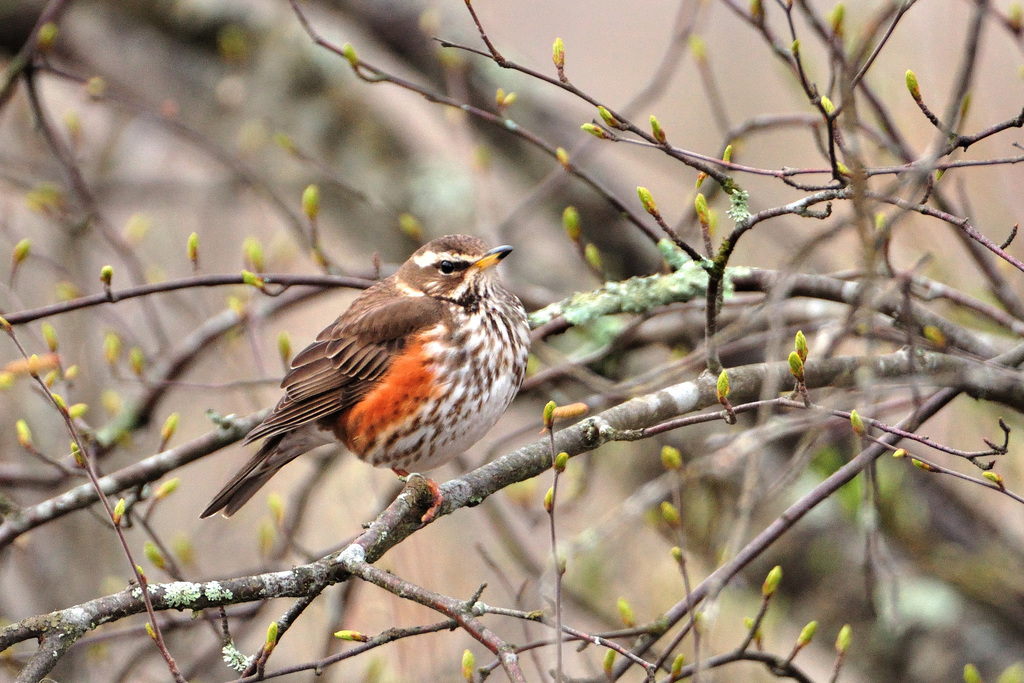
Redwing
Photo © Viktor N. Chekan
Photo © Viktor N. Chekan — CC BY 4.0 — Source: iNaturalist photo #126711423Identification
The redwing is a small thrush, measuring 20–24 cm in length with a wingspan of 33–34.5 cm, making it slightly smaller than the related song thrush. Both sexes are similar in appearance, featuring plain brown backs with dark brown spots on white underparts. The bird's most distinctive features are its red flanks and underwings—which give the species its English name—combined with a creamy white stripe above the eye. These striking red markings provide reliable identification, particularly in flight.
Range & Habitat
The redwing breeds across northern Europe and the Palearctic, from Iceland south to the northernmost regions of Scotland, and east through Scandinavia, the Baltic States, northern Poland, Belarus, and across most of Russia to about 165°E in Chukotka Autonomous Okrug. In recent years, the species has expanded its range slightly, now breeding into northern Ukraine and colonising areas of southern Greenland. During breeding season, redwings favour conifer and birch forests, as well as tundra habitats.
The species is highly migratory, wintering across western, central and southern Europe, north-west Africa, and south-west Asia east to northern Iran. Some birds in south-western Norway remain resident year-round, while eastern populations undertake extraordinary migrations of 6,500–7,000 km to reach their wintering grounds.
Behaviour & Diet
During migration and winter, redwings are highly social, forming loose flocks ranging from 10 to at least 200 individuals. They frequently feed alongside fieldfares, common blackbirds, starlings, and occasionally mistle thrushes and song thrushes. Unlike the song thrush, redwings are nomadic and do not tend to return regularly to the same wintering areas. Migration occurs between autumn and early winter, often at night, with birds maintaining contact through distinctive "Tseep" calls that carry considerable distances.
Redwings are omnivorous feeders, consuming a wide range of insects and earthworms throughout the year, supplemented by berries in autumn and winter, particularly rowan and hawthorn. Males produce a varied short song with distinctive regional dialects, alongside a characteristic whistling flight call.
Best Time & Places to See It
Autumn and winter offer the best opportunities to observe redwings in western and central Europe, when migratory populations pass through or establish temporary wintering grounds. During breeding season, visitors to Iceland, Scandinavia, northern Scotland, and the boreal regions of Russia may encounter redwings in conifer and birch forests. The species' nomadic habits and preference for feeding in loose flocks mean that sightings are often unpredictable, though winter feeding areas with abundant berry-bearing trees increase the chances of encounters.
Photography Tips
The redwing's striking red flanks and underwing markings provide excellent photographic subjects, particularly when birds are in flight or actively feeding. The creamy white eyebrow stripe offers a distinctive feature for portrait photography. Winter feeding sites with rowan or hawthorn berries create opportunities for natural behaviour photography. Early morning or late afternoon light will best highlight the contrasting plumage patterns and the distinctive red underwing coverts. Photographing birds in flocks requires patience, as redwings often move rapidly between feeding locations, particularly during migration periods when nocturnal movement is common.
Aggtelek National Park
Alpilles Regional Nature Park
Alta Murgia National Park
Appennino Lucano Val d’Agri Lagonegrese National Park
Appennino Tosco-Emiliano National Park
Åsnens National Park
Avesnois Regional Nature Park
Bannau Brycheiniog National Park
Bardenas Reales
Nothing matches these filters.
No community photos yet. Log in to add the first one.
No community observations of this species yet.