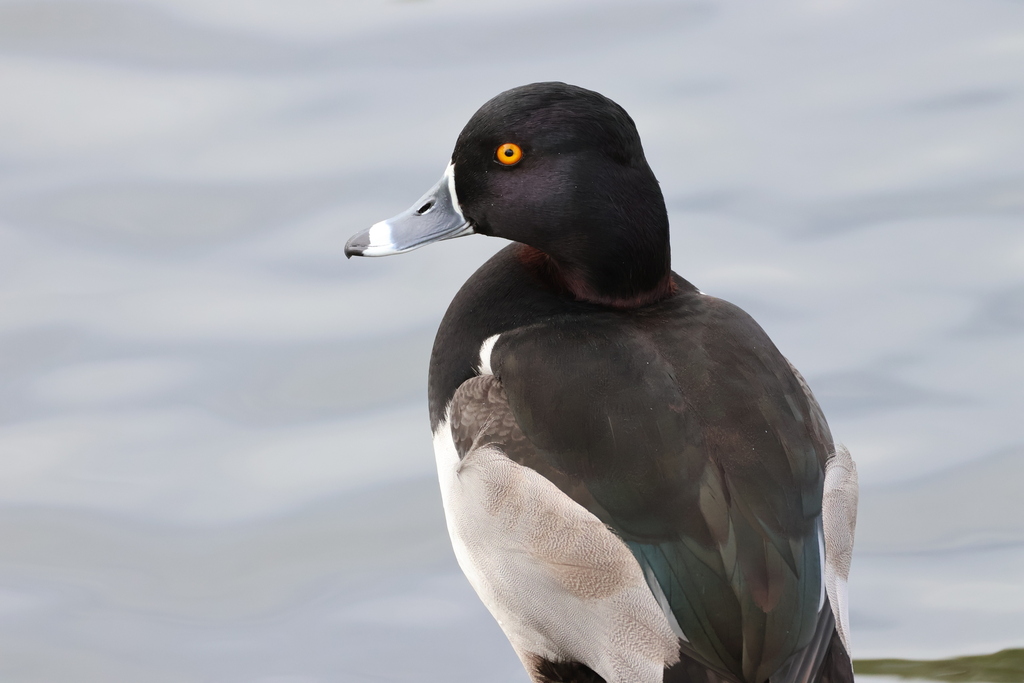
Ring-necked Duck
Photo © Millie Basden
Photo © Millie Basden — CC BY 4.0 — Source: iNaturalist photo #605188554Identification
The ring-necked duck is a small to medium-sized diving duck measuring 15.3–18.1 inches in length with a wingspan of 24.4–24.8 inches. Males are noticeably larger than females and display distinctive plumage: a shiny black angular head, black back, white breast, and striking yellow eyes. Two white rings encircle the gray bill, and a white line marks the wings. The cinnamon neck ring that gives the species its name is usually subtle and difficult to observe in the field, leading to the alternative nickname "ringbill."
Female ring-necked ducks are considerably duller, with a grayish-brown angular head and body, dark brown back, and brown eyes surrounded by white rings. Their bill is darker than the male's, with a more subdued light band. Females can be distinguished by their grayish-blue feet and produce a distinctive trrr vocalization. At first glance, males may resemble the related Eurasian tufted duck, though the ring-necked duck's angular head shape and white breast distinguish it.
Range & Habitat
Ring-necked ducks breed in wooded lakes and ponds across the northern United States and Canada, with their primary breeding range centered in the boreal forests of the northwest, and smaller populations in eastern Canadian boreal regions. During winter months, they migrate southward to freshwater lakes, ponds, rivers, and bays throughout southern North America. This species is a strong migrant and occasionally appears as a rare but regular vagrant to western Europe, with small flocks documented in Scotland and England. Individuals are seen year-round in Ireland, and they regularly appear in Central America between October and June, with occasional sightings in northern South America.
Behaviour & Diet
Ring-necked ducks are omnivorous foragers that feed both by diving and dabbling at the water's surface. Young ducklings rely heavily on animal matter, consuming insects, earthworms, leeches, midges, and snails. As they mature, their diet shifts toward submerged aquatic plants such as pondweed and coontail, along with emergent vegetation including annual wild rice and snails.
During breeding season, pairs form during spring migration. Ducks that arrive unpaired on breeding grounds typically do not breed that season. Pairs remain together only for reproduction before separating. Females construct bowl-shaped nests on water within dense emergent vegetation of sedges and woody plants, laying 8 to 10 eggs over successive days. The female incubates eggs for 25–29 days and may remain with her young until they fledge.
Best Time & Places to See It
Spring and fall migration periods offer the best opportunities to observe ring-necked ducks in their North American range. In summer, visit wooded lakes and ponds across northern United States and Canada, particularly in boreal forest regions. Winter offers excellent viewing in southern North America's freshwater wetlands. Birders in western Europe should watch for occasional vagrants in autumn and spring, particularly in Scotland and southern England. Those traveling to Central America may encounter ring-necked ducks between October and June on lakes and ponds.
Photography Tips
Photograph males in good light to capture their glossy black head and striking white breast and bill rings. The subtle cinnamon neck ring rarely shows clearly, so focus on the distinctive head pattern and yellow eyes as key identifying features. Females present a greater challenge due to their muted plumage; position yourself with backlighting or side-lighting to reveal detail in the grayish-brown plumage. Early morning and late afternoon light works best for all plumage phases. Capture diving behavior by anticipating their feeding dives, and photograph ducklings in summer to showcase the dramatic dietary and plumage changes from young to adult birds.
Tombstone Territorial Park
Acadia National Park
Alaska Maritime National Wildlife Refuge
Algonquin Provincial Park
Alligator River National Wildlife Refuge
Arches National Park
Arctic National Wildlife Refuge
Arenal Volcano National Park
Badlands National Park
Nothing matches these filters.
No community photos yet. Log in to add the first one.
No community observations of this species yet.