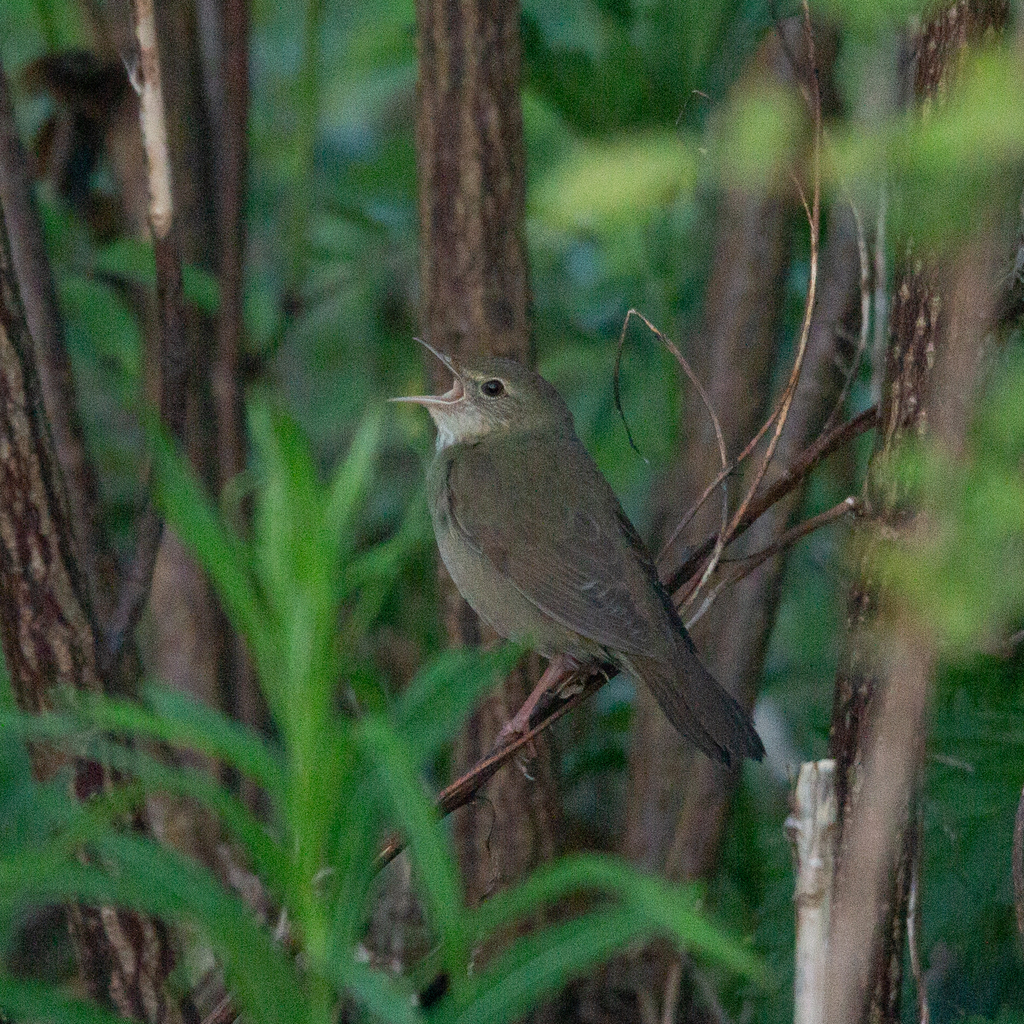
River Warbler
Photo © Павел Кунгуров
Photo © Павел Кунгуров — CC BY 4.0 — Source: iNaturalist #335471792Identification
The river warbler is a largish warbler with distinctly plain plumage. Adults show an unstreaked grey-brown back contrasting with whitish-grey underparts, while the undertail is darker with conspicuous white feather tips creating a striking pattern. The sexes are identical, though younger birds display yellower underparts. Some individuals exhibit reduced dark markings on the undertail coverts, appearing superficially similar to Savi's warbler, yet they typically retain a streaked breast and more olive upperparts. This is an intensely skulking species, extremely difficult to observe except when singing, as it creeps methodically through grass and low foliage.
Range & Habitat
The river warbler breeds across eastern and central Europe, then undertakes long-distance migration to winter in inland southern Africa, ranging from around the Zambezi River southward to the vicinity of Pretoria in South Africa. The species favours dense deciduous vegetation in close proximity to water, particularly in boggy areas and near rivers. It is classified as a rare vagrant to western Europe, with occasional records from Britain and remarkably, one exceptional vagrant photographed in Gambell, Alaska, in October 2017.
Behaviour & Diet
The river warbler is primarily insectivorous, gleaning small invertebrates from vegetation and low growth. During the breeding season, males produce a distinctive monotonous, mechanical insect-like reeling song with a pronounced sewing-machine quality, often delivered at dusk and sustained for extended periods. This vocalization is similar to that of related Locustella species but possesses a characteristic mechanical tone. Breeding birds lay five to seven eggs in a nest constructed in a grass tussock or on the ground.
Best Time & Places to See It
River warblers are most readily located during the breeding season in spring and early summer in suitable habitat across eastern and central Europe, where they can be detected by their distinctive reeling song, particularly at dawn and dusk. In their southern African wintering grounds, they are present from late autumn through early spring. The species remains exceptionally difficult to observe visually, as it rarely ventures into open view; birders should listen carefully for the characteristic song in appropriate wetland habitats near rivers and boggy areas.
Photography Tips
Photographing river warblers presents considerable challenges due to their secretive nature and preference for dense cover. Success requires patience and a willingness to work in low light conditions, particularly at dawn and dusk when males are most vocal. Locate birds by ear using their distinctive mechanical reeling song, then position yourself quietly and allow the bird to approach or become momentarily visible at the edge of dense vegetation. Fast film speeds and quiet camera equipment are essential, as any disturbance will send the warbler deeper into cover.
Aggtelek National Park
Avesnois Regional Nature Park
Białowieża National Park
Biebrza National Park
Bieszczady National Park
Bükk National Park
Danube Delta Biosphere Reserve
De Biesbosch National Park
De Loonse en Drunense Duinen National Park
Nothing matches these filters.
No community photos yet. Log in to add the first one.
No community observations of this species yet.