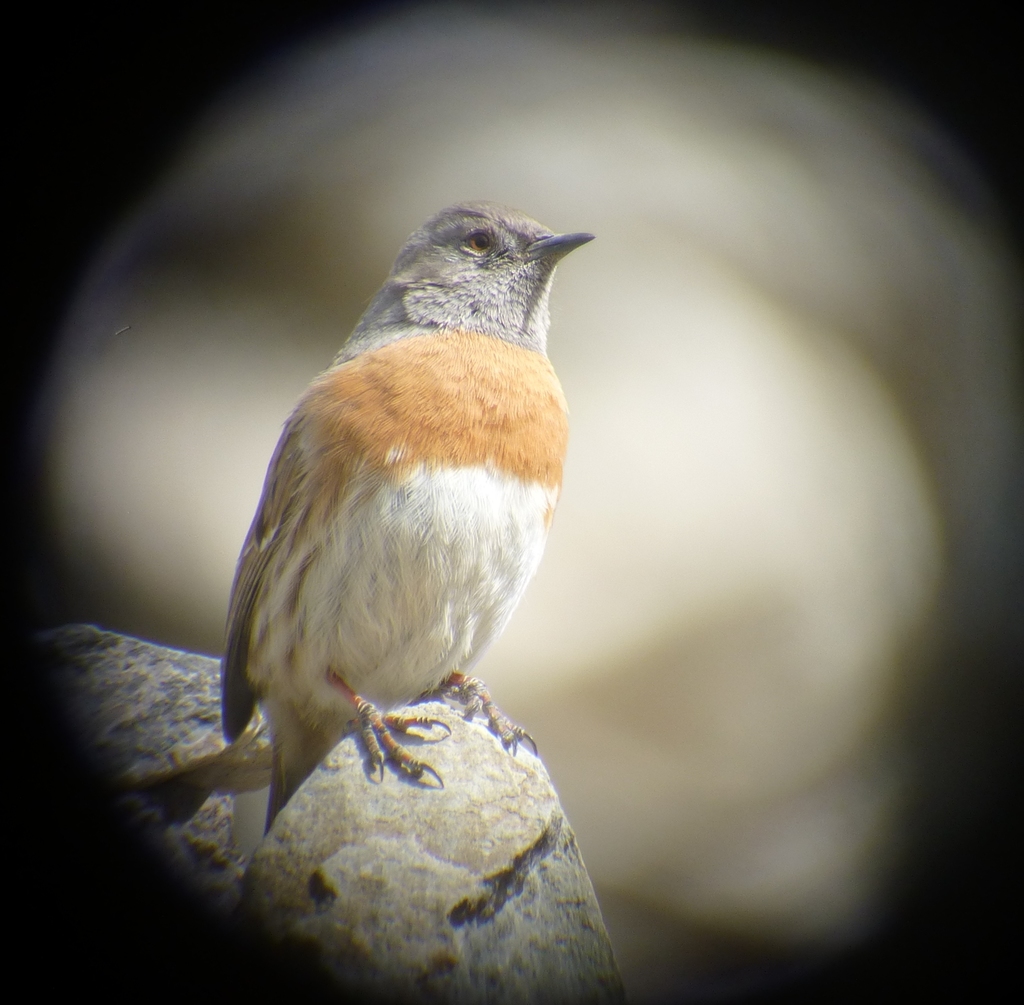
Robin Accentor
Photo © Sheelagh Halsey
Photo © Sheelagh Halsey — CC BY 4.0 — Source: iNaturalist #34160807Identification
The robin accentor is a large member of the accentor family, growing to approximately 17 cm in length. Its plumage is distinctive and relatively easy to identify in its high-altitude habitat. The head and neck are soft grey, contrasting sharply with rich reddish-orange on the throat and upper breast, while the belly is pale buff. The upper parts are warm brown with fine black streaking, and the wing coverts are tipped white. Like all accentors, it has the characteristic slender, sharply-pointed beak of an insect-eating bird. The sexes are similar in appearance, making field identification straightforward.
In life, the robin accentor is vocal and distinctive. Its call is a high trill or repeated "tszi tszi," while its song is musical and energetic, rendered by observers as "si-tsi-si-tsi-tsu-tsitsi." These calls are often the first sign of the bird's presence in the sparse high-altitude terrain it favours.
Range & Habitat
This species is found exclusively in the mountainous regions of Afghanistan, Pakistan, India, Nepal, Bhutan, and China, where it is restricted to high-altitude zones typically between 3,000 and 5,500 metres elevation. Within China, it occurs in the Tibet Autonomous Region and the provinces of Qinghai, Gansu, and Sichuan. The robin accentor is non-migratory and normally resident above the tree-line but below the snowline, occupying a distinctive alpine ecological niche.
The species favours open grasslands and scrubby vegetation, often seen foraging on the ground in alpine gullies that contain streams. In winter, birds may move to slightly lower elevations and are frequently encountered near human habitations in stony areas, suggesting some flexibility in habitat use during harsh seasons.
Behaviour & Diet
The robin accentor is primarily a ground forager, feeding on insects, other invertebrates, and seeds. It often feeds in small groups, which may offer some advantages in the challenging alpine environment. The species exhibits an unusual breeding system in which females mate with several males. Each male employs an interesting reproductive strategy, attempting to remove sperm already present in a female's cloaca before his own mating attempt—a behaviour that reflects intense sperm competition.
Nesting occurs between May and August, with birds constructing cup-shaped nests off the ground in tussock grass, bushes, or scrub. A typical clutch comprises about four blue or green eggs with no markings. Birds may raise two broods during the extended breeding season, taking advantage of the brief alpine summer.
Best Time & Places to See It
The robin accentor is common in parts of its range and maintains stable populations throughout. The breeding season from May to August is the best period to observe this species, when birds are actively vocalizing and defending territories in their alpine grassland habitats. The Himalayas—particularly in Nepal, Bhutan, and northern India—offer the most accessible opportunities for encounter, though the species also occurs in the Tibetan Plateau and associated high ranges of western China.
Winter visitors may find birds more easily located near human settlements at slightly lower elevations, where they visit stony ground close to habitation. Patient observers watching open alpine grasslands and scrubby gullies during the warmer months will have the best chance of encountering this engaging high-altitude specialist.
Photography Tips
The robin accentor's ground-foraging behaviour and preference for open grasslands make it relatively approachable for photography compared to many alpine birds. The species' striking orange-red breast and grey head provide excellent colour contrast and are most visible when birds are active on the ground. Patience and a low profile are essential; approach slowly across open terrain and allow birds to resume normal foraging behaviour rather than flushing them repeatedly.
The harsh high-altitude light and minimal vegetation provide clean backgrounds ideal for portraiture. Early morning and late afternoon provide the best directional light to illuminate the robin accentor's distinctive breast colouration. Photographing small groups of birds together can capture the species' social feeding behaviour, while distant shots in their alpine landscape context convey the dramatic habitat these remarkable birds inhabit.
Langtang National Park
Helambu, Nepal
+364 birds+14 mammals
Where the southern slopes of the Himalayan highlands descend toward the subtropical valleys of central Nepal, Langtang National Park sprawls across one of the subcontinent's most…
VIEW NATIONAL PARKGangotri National Park
Bhatwari, India
+119 birds+1 mammals
Where the Bhagirathi River carves through the western Himalayas in northern Uttarakhand, Gangotri National Park rises across steep alpine terrain that defines the boundary between temperate…
VIEW NATIONAL PARKSagarmatha National Park
Khumjung, Nepal
+219 birds+7 mammals
Soaring peaks and deep glacial valleys define this alpine wilderness in northeastern Nepal, where the terrain rises from forested foothills into a realm of high-altitude tundra…
VIEW NATIONAL PARKKhangchendzonga National Park
Sakkyong, India
+290 birds+1 mammals
Where the eastern Himalayas surge toward their crowning peaks, Khangchendzonga National Park embraces a landscape of almost overwhelming vertical drama. Rising from subtropical river valleys into…
VIEW NATIONAL PARKGiant Panda National Park
Mianyang, China
+447 birds+47 mammals
Where the eastern slopes of China's Sichuan plateau descend into cloud-wrapped valleys, one of Asia's most biodiverse landscapes unfolds across more than 350,000 square kilometres. This…
VIEW NATIONAL PARKHuanglong Scenic and Historic Interest Area
Ngawa Tibetan and Qiang Autonomous Prefecture, China
+194 birds+7 mammals
Across the high plateau of northwestern Sichuan, a geological wonder unfolds where limestone terraces and mineral-rich springs have sculpted one of China's most distinctive natural monuments.…
VIEW NATURAL MONUMENTHemis National Park
Raigahar Dhar, India
+131 birds+13 mammals
Where granite gorges cleave through the Himalayas at dizzying altitudes, a vast wilderness of alpine desert unfolds across the rain shadow of Ladakh. Hemis sprawls across…
VIEW NATIONAL PARKSanjiangyuan National Park
Nagqu, China
+187 birds+25 mammals
Where the headwaters of three great Asian rivers emerge from a high alpine plateau, the landscape unfolds in tundra and dwarf shrubland—a world of austere beauty…
VIEW NATIONAL PARKWolong National Nature Reserve
Wenchuan County, China
+333 birds+17 mammals
Where the Qingyi River cuts through the eastern flanks of the Minshan Range, a temperate montane forest cloaks steep valleys in dense canopy that thins dramatically…
VIEW NATURE RESERVEQinghai Lake National Nature Reserve
Hainan Tibetan Autonomous Prefecture, China
+243 birds+11 mammals
At 3,200 metres above sea level on the Tibetan plateau, where winter temperatures plunge far below freezing and snow blankets the landscape for half the year,…
VIEW NATURE RESERVEBaima Snow Mountain National Nature Reserve
Diqing Tibetan Autonomous Prefecture, China
+204 birds+3 mammals
High-altitude ridges and steep-sided valleys define this reserve in northwestern Yunnan, where elevations surge from around 3,000 metres to peaks above 4,100 metres. The terrain supports…
VIEW NATURE RESERVENo community photos yet. Log in to add the first one.
No community observations of this species yet.