Rock Dove
Photo © Daughter Dad
Photo © Daughter Dad — CC BY 4.0 — Source: iNaturalist photo #619419317Identification
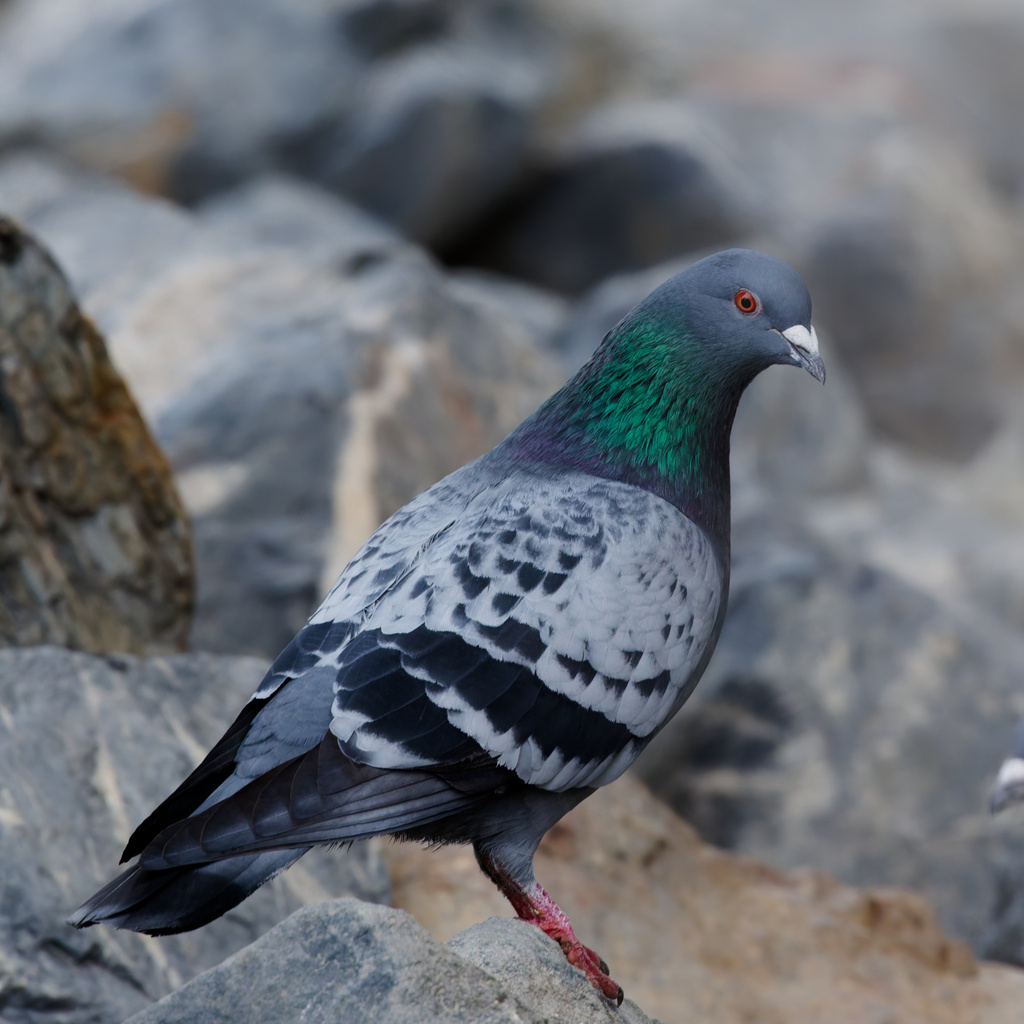
The rock dove is a medium-sized pigeon measuring 30 to 35 cm in length with a wingspan of 62 to 68 cm. The wild rock dove has a distinctive appearance: a dark bluish-grey head, neck, and chest with glossy greenish to reddish-purple iridescence along the neck feathers. The most reliable field mark is the white lower back, combined with two black bars on each pale grey wing. The tail features a black band at the tip with white margins on the outer feathers. The feet are red to pink, and the iris is red-brown.
Males and females are very similar in appearance, though females show less intense iridescence on the neck and often have an obscure breast iridescence. Young birds are duller overall. In flight, the white underwing becomes conspicuous when the bird circles overhead. Unlike the feral and domestic pigeons familiar in towns worldwide—which exhibit tremendous colour variation including red, brown, checkered, and pied plumages—the pure wild rock dove maintains this uniform pale grey colouration with distinctive markings.
Range & Habitat
The rock dove originated in Southern Europe, North Africa, and Western Asia. Nine subspecies are recognized across this range, from west and central Europe through north Africa to central Asia, with populations extending to the Himalayas, Afghanistan, Pakistan, and south India. The nominate subspecies persists most notably in the far north and west of Scotland, particularly in the Outer Hebrides, where the true wild type is best encountered.
Rock doves inhabit various open and semi-open environments where they can forage on the ground. In the wild, they rely on cliffs and rock ledges for roosting and breeding. Today, when including their domestic and feral descendants, rock doves are among the most abundant birds globally, with an estimated population of 17 to 28 million wild and feral birds in Europe alone and up to 120 million worldwide, making them a least-concern species according to the IUCN.
Behaviour & Diet
The rock dove is a strong flier that frequently glides, characteristically holding its wings in a pronounced V shape during these gliding passages. The bird's voice is a soft dovecot coo, more subdued than the wood pigeon's distinctive call. Its behaviour and flight style are typical of the genus Columba, reflecting its adaptation to life in open terrain and around rocky outcrops.
Rock doves forage on the ground, pecking for seeds and other food items in open and semi-open spaces. They are highly gregarious birds, often seen in flocks, and are known for their homing ability and strong pair bonds, which made them valuable as domesticated birds centuries ago.
Best Time & Places to See It
The Scottish Outer Hebrides offer the most reliable opportunity to encounter true wild rock doves in their natural state, particularly in the far north and west of Scotland. Fair Isle in Scotland is historically significant as the location of the neotype specimen that defines the species. For those unable to travel to remote locations, rock doves can be observed year-round in coastal areas with suitable cliff habitat throughout their range in Southern Europe, North Africa, and Western Asia.
Photography Tips
The rock dove's iridescent neck and the striking white lower back provide excellent photographic subjects in good light. Capture birds in flight to showcase the conspicuous white underwing visible when they circle overhead, and aim to photograph the characteristic V-shaped wing posture during glides. The pale grey plumage with black wing bars and white rump are most visible from above and at angles that allow light to catch the glossy iridescence on the head and neck feathers.
Since true wild rock doves are best found in remote Scottish locations, patience and early morning or late afternoon light will yield the best results. Avoid photographing feral pigeons in urban settings if seeking images representative of the pure wild type, as their highly variable plumage—ranging from red and brown to checkered patterns—differs markedly from the pale grey wild ancestor.

Nothing matches these filters.
Bwindi Impenetrable National Park
Kanha Tiger Reserve
Lake Mburo National Park
Mabamba Swamp
Minneriya National Park
Murchison Falls National Park
Queen Elizabeth National Park
Abel Tasman National Park
Abijata-Shalla Lakes National Park
Nothing matches these filters.
No community photos yet. Log in to add the first one.
No community observations of this species yet.