Rock Shag
Photo © Nicolas Olejnik
Photo © Nicolas Olejnik — CC BY 4.0 — Source: iNaturalist photo #54328579Identification
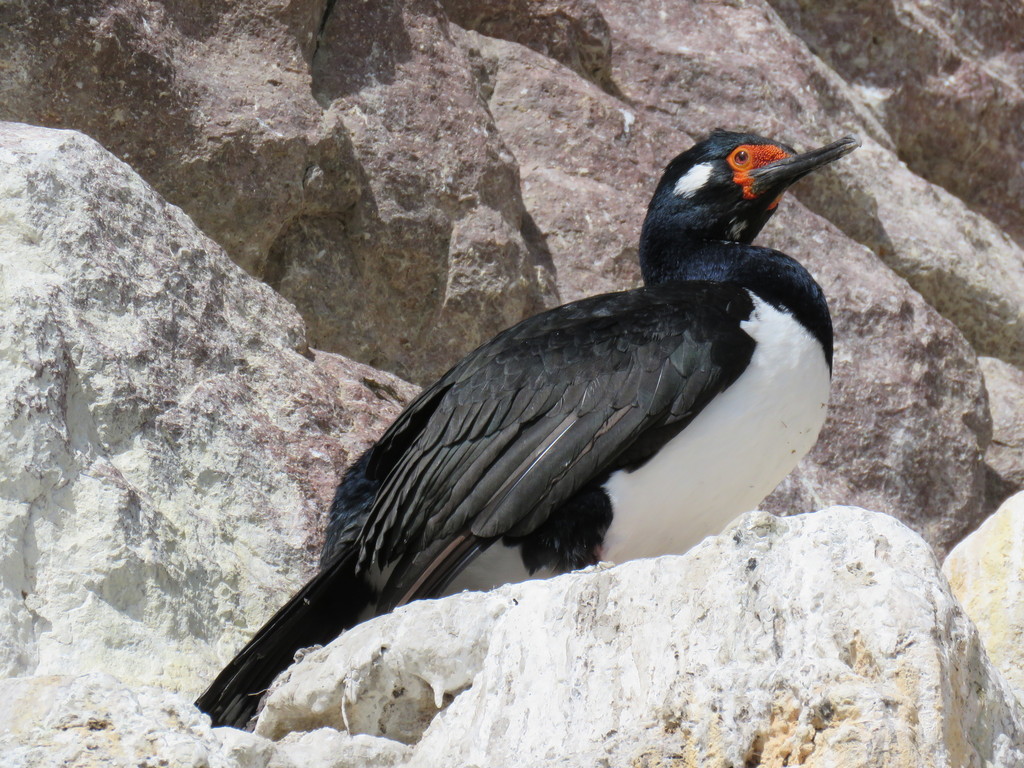
At first glance, the rock shag is a striking black and white bird, with a black head, neck and upperparts contrasting sharply with a white chest and underparts. Look closer and you'll discover remarkable iridescence—the black areas shimmer with metallic blue and oily green hues, often flecked with white. The bare skin around the beak and eyes is brick red, while the legs and feet are pink and fleshy. During breeding season, males develop a blackish (though subtle) crest on the forehead and a distinctive white ear patch. Males are noticeably larger than females, typically 5–10% bigger across most measurements, though sexual dimorphism is less pronounced in this species than in many other cormorants.
Range & Habitat
This marine specialist inhabits the southernmost coasts of South America, from around Valdivia in Chile south through Cape Horn and Tierra del Fuego, and north to Punta Tombo in Argentina. The species also breeds around the Falkland Islands. In winter, rock shags disperse further north, with individuals reaching as far as Santiago on Chile's west coast and Uruguay on the east coast, though they remain primarily coastal birds.
Behaviour & Diet
Like all cormorants, the rock shag is a pursuit diver, hunting underwater for fish. It favours shallow coastal waters, often diving at the edges of kelp beds where small fish shelter among the weed. The primary prey consists of cod icefishes (Patagonotothen species). Despite hunting near the seafloor, this species is a relatively shallow diver—depth gauge studies show it typically descends about 5 metres below the surface, with few dives exceeding 10 metres. Typical dive duration is around 30 seconds. Where its range overlaps with the imperial shag, the two species avoid direct competition by foraging in different zones: the imperial shag tends to hunt in deeper water further offshore.
Rock shags are colonial breeders, nesting on ledges of steep, bare rocky cliffs. They typically lay three eggs, though clutches range from two to five. Breeding colonies vary considerably in size, from as few as five pairs to nearly 400 pairs.
Best Time & Places to See It
For the best chance of encountering rock shags, visit the southern coasts of Chile and Argentina during the breeding season, particularly around Punta Tombo, Cape Horn, or Tierra del Fuego, where they congregate in their cliff-based colonies. The Falkland Islands offer another reliable location. In winter months, search further north along both coasts, including the coastlines near Santiago and Uruguay, though sightings become less concentrated.
Photography Tips
The rock shag's striking black-and-white plumage and iridescent sheen photograph beautifully in bright southern light. Position yourself to capture the contrast between dark upperparts and white underparts, and use polarizing filters to enhance the metallic blue and green sheens on the head and neck. Breeding birds with their distinctive white ear patches and forehead crests make particularly striking subjects. Since they nest on cliff ledges and feed close to shore in kelp beds, a telephoto lens is essential for capturing detail without disturbing colonies. Early morning light often provides the best conditions for rendering their subtle colour variations.
Chile: Fuegian Snipe & Juan Fernandez
Port Stephens
Port Stephens, Falkland Islands
+29 birds
Windswept moorlands sweep down to pristine beaches where kelp forests fringe the turquoise shallows, their giant fronds swaying in the southern current. Port Stephens, cradled on…
VIEW NATURE RESERVEMurrell Farm
falskland islands, Falkland Islands
+54 birds
Rolling grasslands sweep across windswept plateaux where the South Atlantic exerts its relentless influence on the vegetation, sculpting tussock grassland into a tapestry of browns and…
VIEW NATURE RESERVECape Dolphin
falskland islands, Falkland Islands
+54 birds+1 mammals
Where windswept grasslands meet dramatic coastal cliffs, the Falkland Islands' northern reaches reveal one of the Southern Hemisphere's most compelling seabird sanctuaries. The terrain here is…
VIEW NATURE RESERVEVolunteer Point
Stanley, Falkland Islands
+70 birds+3 mammals
Windswept grasslands meet volcanic black sand beaches where three penguin species converge in the South Atlantic's most theatrical wildlife theatre. This remote peninsula on East Falkland…
VIEW NATURE RESERVEWest Point Island
West Point, Falkland Islands
+67 birds+3 mammals
Windswept cliffs plunge dramatically into the South Atlantic, their rust-coloured rock faces sculpted by millennia of gales and spray. This northwestern outpost of the Falkland Islands…
VIEW ISLAND & ARCHIPELAGOChiloé National Park
Dalcahue, Chile
+122 birds+6 mammals
Temperate rainforest cloaks the Chiloé archipelago's northwestern reaches, where granite ridges thrust through dense, moisture-laden canopy and freshwater streams carve ravines toward the Pacific. Across approximately…
VIEW NATIONAL PARKTorres del Paine National Park
Torres del Paine, Chile
+143 birds+10 mammals
Where granite spires pierce the Patagonian sky, Torres del Paine commands one of South America's most dramatic landscapes. Across 4,106 square kilometres of southern Chile, jagged…
VIEW NATIONAL PARKMonte León National Park
Argentina
+100 birds+4 mammals
Where the Patagonian steppe meets the Atlantic, Monte León National Park protects a landscape of windswept coastal cliffs, rocky outcrops, and semi-arid grassland spanning over 1,200…
VIEW NATIONAL PARKNo community photos yet. Log in to add the first one.
No community observations of this species yet.