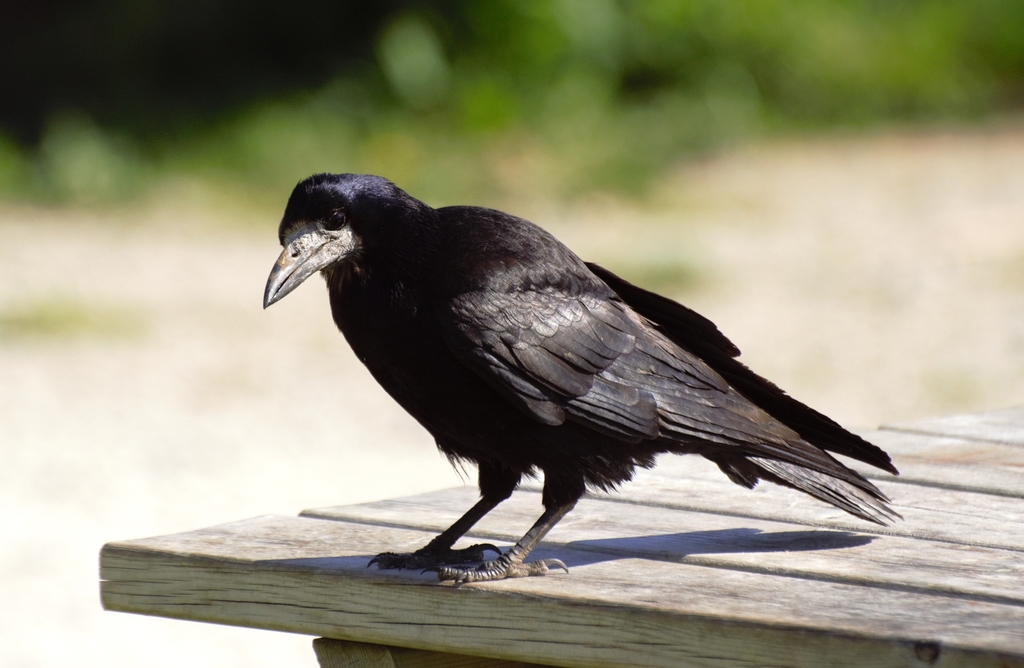
Rook
Photo © Victor Heng
Photo © Victor Heng — CC BY 4.0 — Source: iNaturalist photo #196366939Identification
The rook is a large black corvid measuring 44–46 cm in length with a wingspan of 81–99 cm. Adults are unmistakable: glossy black plumage with a distinctive bare whitish patch of skin on the face in front of the eye and around the base of the bill. This bare patch is the key feature separating rooks from similar species, particularly the carrion crow. The feathering on the head, neck and shoulders is notably dense and silky, and the leg feathering appears shaggier than that of carrion crows. In flight, rooks show proportionally longer and narrower wings. Juveniles lack the bare facial patch and have a thinner bill, taking about six months to develop adult characteristics.
The rook's bill is grey-black, legs and feet black, and eyes dark brown. In bright sunlight, the black feathers display a distinctive blue or bluish-purple sheen. The average lifespan is six years.
Range & Habitat
The rook is found across the Palearctic from Scandinavia and western Europe to eastern Siberia. Two subspecies are recognised: the western rook ranges from western Europe to southern Russia and extreme northwestern China, while the eastern rook ranges from central Siberia and northern Mongolia eastward across Asia. Western populations are resident in Ireland and Britain, though northernmost populations migrate southward to escape harsh winters.
Rooks favour open agricultural landscapes with pasture and arable land, provided tall trees are available for breeding. They avoid forests, swamps, marshes, heaths and moorland, and are typically lowland birds with most rookeries below 120 m elevation. They are strongly associated with human settlements, nesting near farms, villages and open towns but avoiding heavily built-up urban areas. Their colonial nesting sites, known as rookeries, are established in the tops of tall trees often close to human habitation.
Behaviour & Diet
Rooks are highly gregarious birds, living and moving in flocks of various sizes. Pairs bond for life and remain together within flocks. They forage mainly on the ground, striding about and probing soil with their powerful bills, feeding largely on grubs and soil-based invertebrates. They also consume cereals and other plant material. In evening, birds congregate at their rookery before moving to communal roost sites, often in the company of jackdaws and other corvid species. Flocks increase substantially in autumn as groups amalgamate.
Like other corvids, rooks are intelligent birds with complex behavioural traits and an ability to solve simple problems. Historically, farmers have viewed them as crop damagers, though their primary diet consists of soil invertebrates beneficial to agricultural land.
Best Time & Places to See It
Rooks are year-round residents across much of western Europe and Britain, making them reliably visible throughout the year in suitable habitat. Spring offers excellent viewing as birds return to rookeries for breeding, often with dramatic communal displays. Autumn and winter are particularly rewarding, as flocks increase substantially in size and birds congregate at dusk in spectacular numbers at communal roost sites, often alongside jackdaws.
Look for rooks in open farmland, pastures and cultivated land with scattered tall trees. Early morning and evening provide the best opportunities to observe flocking behaviour and movement between feeding grounds and roost sites. Established rookeries near farms and villages are reliable locations, particularly during the breeding season in spring.
Photography Tips
The rook's bare facial patch is essential for positive identification in photographs, so frame shots to capture the head clearly. The glossy blue-purple sheen on black feathers is best rendered in bright sunlight, so plan sessions for sunny conditions. Photograph birds in flight to show the proportionally long, narrow wings that distinguish them from carrion crows. Flocking behaviour offers compelling compositions, particularly at roost sites during dusk congregations when hundreds of birds gather.
Early morning light is ideal for capturing the texture of the dense, silky plumage on the head, neck and shoulders. Wide-angle shots of rookeries in tall trees provide context for their colonial nesting behaviour. When photographing juveniles, note the absence of the facial patch and thinner bill before they develop adult characteristics around six months of age.
Alpilles Regional Nature Park
Altai Tavan Bogd National Park
Avesnois Regional Nature Park
Bannau Brycheiniog National Park
Baronnies Provençales Regional Nature Park
Bavarian Forest National Park
Berwyn National Nature Reserve
Białowieża National Park
Biebrza National Park
Nothing matches these filters.
No community photos yet. Log in to add the first one.
No community observations of this species yet.