Ross’s Turaco
Photo © wildatlasguide
Photo © wildatlasguide — Used with permissionIdentification
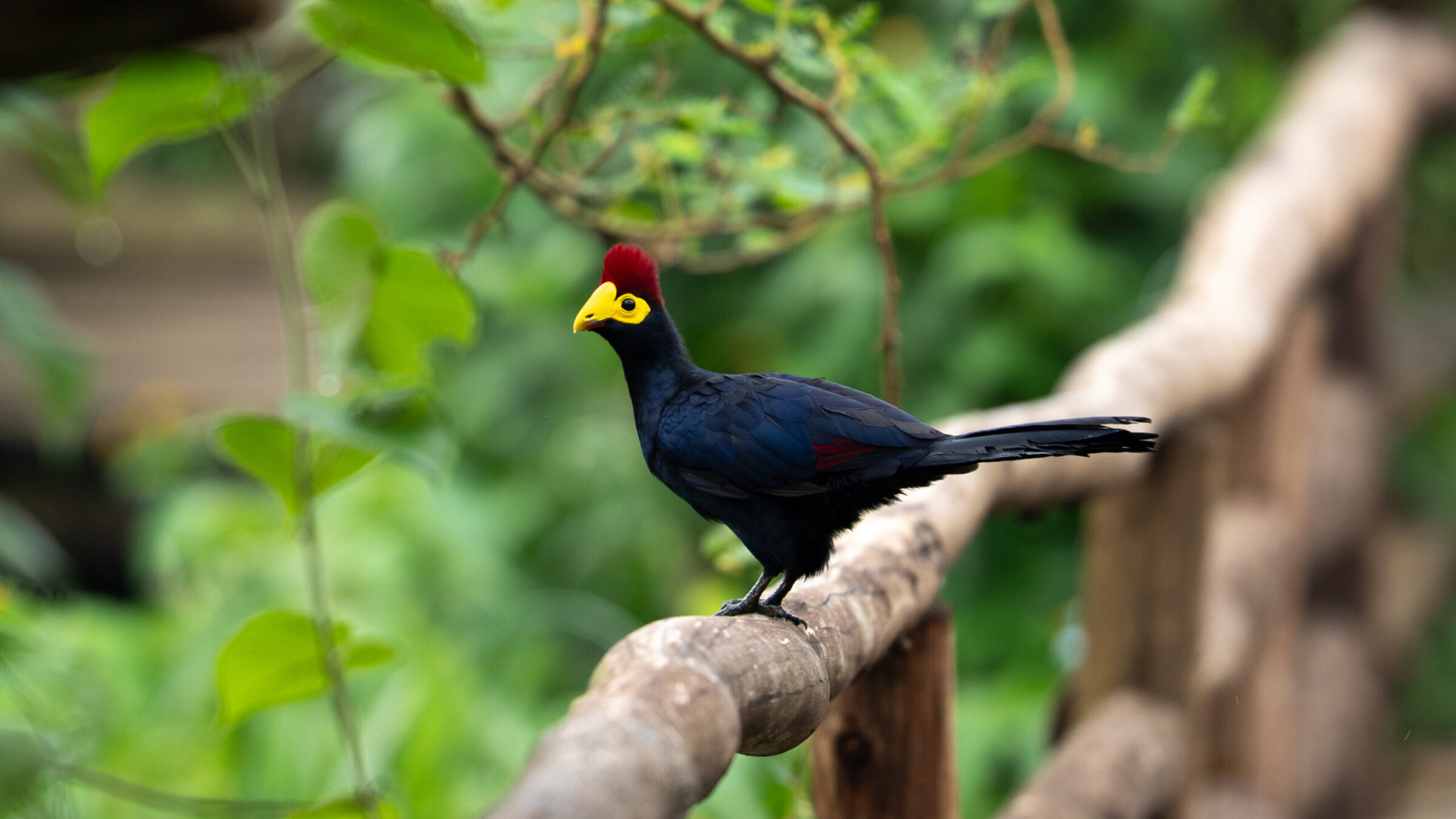
Ross's turaco is a striking African bird dressed in deep blue plumage with a distinctive red crown. Both males and females share this bold coloration, making sexual dimorphism minimal—a rarity among birds. Males sport bright yellow beaks, while females display slightly more yellow-green tones. Both sexes feature an orange forehead shield that extends across the face, creating an unmistakable facial pattern. Their wings are notably short and rounded, adapted for short bursts of powered flight rather than sustained flight.
Compact and sturdy, these birds measure 15 to 18 inches in length and weigh just under one pound. Their black legs and feet are specially adapted for climbing: three toes face forward, while a fourth toe is semi-zygodactylous, giving them remarkable agility in the canopy. These hardy birds can live 8 to 20 years, making them long-lived inhabitants of African woodlands.
Range & Habitat
Ross's turaco is widely distributed across sub-Saharan Africa, found in Angola, Botswana, Bursuccundi, Cameroon, Central African Republic, Democratic Republic of the Congo, Gabon, Kenya, Rwanda, South Sudan, Tanzania, Uganda, and Zambia. They favour woodlands, open forests, and riparian habitats where they can move freely through the canopy. Unlike many bird species, they deliberately avoid heavily forested areas, preferring more open woodland environments.
These non-migratory birds show strong site fidelity, rarely traveling far from their birthplace unless food becomes scarce. Despite threats from agricultural expansion and habitat destruction, their populations remain robust across their range, demonstrating their adaptability to changing landscapes.
Behaviour & Diet
Ross's turaco are primarily frugivorous, feeding on fruits, flowers, and seeds from wild and cultivated plants. They display a particular preference for figs but will consume a wide variety of fruits. Interestingly, despite their family name Musophagidae meaning "plantain eater," they rarely visit banana or plantain trees. During breeding season, their diet expands to include small insects such as termites and snails, providing vital protein for growing chicks. Their opportunistic feeding habits make them significant seed dispersers throughout their range, though this same behavior often classifies them as agricultural pests.
Socially, Ross's turaco form monogamous pairs that share incubation and chick-rearing duties. Young birds remarkably become largely independent before they can fly, preferring to climb through the canopy on their semi-zygodactylous feet. They reach sexual maturity after one year and remain in extended family flocks numbering up to thirty individuals. These flock members cooperatively raise chicks, providing crucial support particularly to first-time mothers. During breeding season, they become notably territorial, defending their nesting areas from predatory or unfamiliar birds.
Best Time & Places to See It
Ross's turaco can be encountered year-round across their African range, as they are non-migratory. Woodlands and open forest habitats offer the best opportunities for sightings. Look for them in riparian zones and around fruiting trees, particularly fig trees where they congregate to feed. Early morning often provides the best viewing opportunities when birds are actively foraging. Extended family flocks make them relatively conspicuous despite their forest habitat preference.
Photography Tips
The vivid blue and red plumage of Ross's turaco makes them rewarding photography subjects. Their preference for open woodlands rather than dense forest means better lighting conditions than many forest birds. Photograph them while foraging on fruiting trees at eye level or slightly above—their climbing behavior keeps them accessible in the canopy. The bright colors require careful exposure metering to retain detail in both the red crown and blue plumage. Early morning light brings out the intensity of their coloration. Patience near fig trees during fruiting season will yield multiple photographic opportunities as flocks visit feeding sites regularly.
Serengeti National Park
Tanzania
+558 birds+57 mammals
Across Tanzania's northern plateau, where volcanic soils meet acacia woodland and open grassland, unfolds one of Earth's most dynamic ecosystems. The Serengeti National Park sprawls across…
VIEW NATIONAL PARKVirunga National Park
Uganda
+418 birds+13 mammals
Where the Western Rift Valley fractures the landscape of North Kivu, Virunga National Park sprawls across terrain as geologically dramatic as it is ecologically vital. Volcanic…
VIEW NATIONAL PARKBwindi Impenetrable National Park
Kanyashogi, Uganda
+603 birds+26 mammals
Steep ridges cloaked in montane forest rise from Uganda's southwestern borderlands, where the landscape grows so dense and tangled that early explorers named it impenetrable. At…
VIEW NATIONAL PARKVolcanoes National Park
Musanze District, Uganda
+152 birds+6 mammals
Where volcanic cones rise sharply above the montane forests of northern Uganda, Volcanoes National Park protects one of East Africa's most dramatic high-altitude ecosystems. The park's…
VIEW NATIONAL PARKKidepo Valley National Park
Uganda
+478 birds+24 mammals
Where the Narus and Kidepo rivers carve through northeastern Uganda's semi-arid lowlands, a landscape of sparse acacia woodland, grassland, and riverine thickets creates one of East…
VIEW NATIONAL PARKMurchison Falls National Park
Uganda
+608 birds+33 mammals
Where the Victoria Nile compresses through a narrow gorge and explodes across a 45-meter precipice, the landscape speaks in thunder. Murchison Falls National Park sprawls across…
VIEW NATIONAL PARKMgahinga Gorilla National Park
Cyanika, Uganda
+429 birds+6 mammals
Where the Virunga Mountains rise steeply from the Uganda–Rwanda–Democratic Republic of Congo frontier, montane forest cloaks the volcanic slopes in a dense, moisture-laden embrace. Mgahinga Gorilla…
VIEW NATIONAL PARKLake Mburo National Park
Uganda
+505 birds+24 mammals
Rolling acacia woodland and scattered lakes define this intimate savanna preserve in southwestern Uganda, where the rift valley's geological drama shapes every water source and grassland.…
VIEW NATIONAL PARKMount Elgon National Park
Matumbei ward, Kenya
+164 birds+7 mammals
Where the volcanic slopes of Mount Elgon rise above the Trans-Nzoia landscape, a montane wilderness unfolds across multiple ecological zones, each harbouring distinct communities adapted to…
VIEW NATIONAL PARKTarangire National Park
Tanzania
+527 birds+50 mammals
Acacia woodland and grassland sweep across the Manyara Region where the Tarangire River carves through low hills and volcanic soils, creating one of East Africa's most…
VIEW NATIONAL PARKToro-Semliki Proposed National Park
Uganda
+474 birds+5 mammals
Where the Albertine Rift's western escarpment rises above the Semliki River valley, a vast mosaic of forest, savanna and wetland converges to create one of East…
VIEW NATIONAL PARKQueen Elizabeth National Park
Uganda
+672 birds+30 mammals
Across the southwestern escarpment of Uganda, where the Western Rift Valley descends through ancient volcanic terrain, Queen Elizabeth National Park sprawls across more than 8,300 square…
VIEW NATIONAL PARKMabamba Swamp
Memere, Uganda
+464 birds+2 mammals
Across the Central Region of Uganda spreads one of Africa's most biodiverse freshwater wetlands, a sprawling nature reserve of roughly 283 square kilometres where papyrus swamps…
VIEW NATURE RESERVEZiwa Rhino and Wildlife Ranch
Nakasongola, Uganda
+359 birds+11 mammals
Where papyrus wetlands merge into sprawling savanna, Uganda's central landscape opens into one of East Africa's most vital rhino recovery zones. Ziwa Rhino and Wildlife Ranch…
VIEW WILDLIFE SANCTUARYRuma National Park
Suba, Kenya
+250 birds+8 mammals
Where the Winam Gulf narrows toward the Kenyan mainland, Ruma National Park rises as a sanctuary of evergreen woodland set within the humid tropics of Homa…
VIEW NATIONAL PARKSaiwa Swamp National Park
Sinyerere ward, Kenya
+255 birds+4 mammals
Where papyrus and sedge marshes stretch across a highland plateau in western Kenya, Saiwa Swamp National Park shelters one of East Africa's most productive freshwater wetland…
VIEW NATIONAL PARK