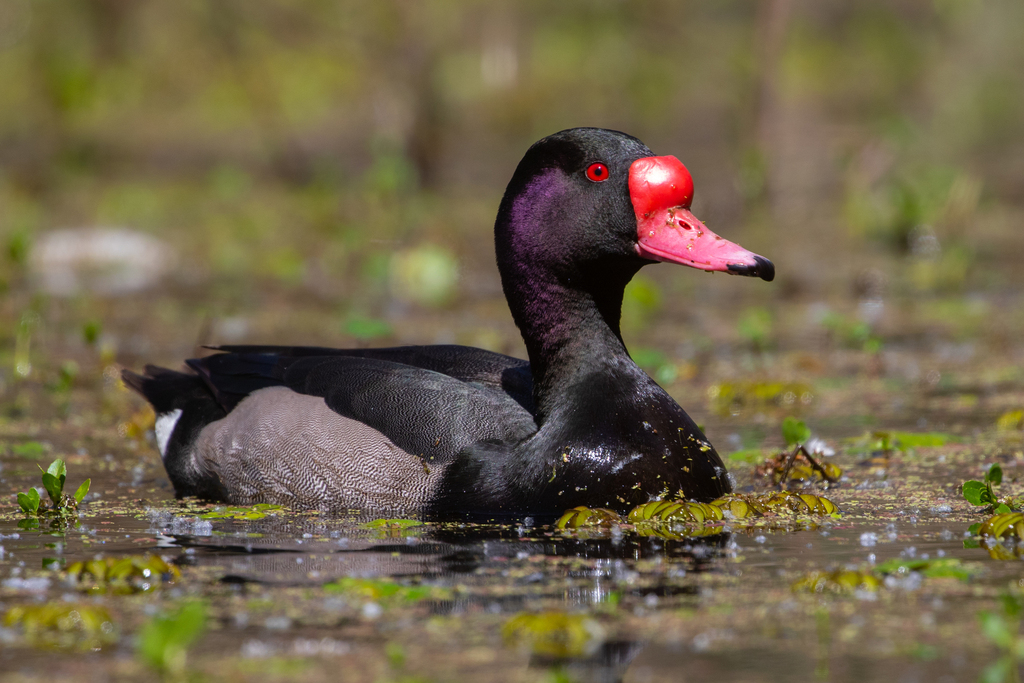
Rosy-billed Pochard
Photo © Johannes S.
Photo © Johannes S. — CC BY 4.0 — Source: iNaturalist photo #602507637Identification
The rosy-billed pochard is a striking duck with pronounced sexual dimorphism. Males are immediately recognizable by their purplish-black head, neck and breast, contrasting gray sides, and most distinctively, a bright red bill featuring a large rounded knob at the base. Male eyes are red, and they display white on the crissum (the area around the cloaca), with yellow-orange legs and feet. In flight, their mostly dark plumage contrasts sharply with white primaries and secondaries. Females are considerably duller, appearing brown overall with a bluish-gray bill tipped in black and yellow-orange to gray legs. The white crissum is the most noticeable feature on females. Young birds resemble females but have darker underparts. Adults measure about 22 inches (56 cm) in length with wingspans ranging from 72 to 84 cm, weighing 2.2-2.6 pounds.
The species name "peposaca" is a Guaraní transcription meaning "showy wings," referring to the broad white stripe visible only when wings are stretched in flight. Unlike many northern ducks, rosy-billed pochards lack the dull eclipse plumage characteristic of other Aythini tribe members. Males are slightly larger than females, though both sexes are similar in overall body size.
Range & Habitat
The rosy-billed pochard is endemic to South America, found in Argentina, central Chile, Paraguay, Uruguay, and southern Brazil. The species is partially migratory, with populations in southern Argentina moving northward during the austral winter, reaching Brazil and southern Bolivia. Occasionally, vagrants appear in the Falkland Islands. Birds nest within tall grasses in wetlands, primarily in central Argentine provinces including Córdoba, Santa Fe, Entre Ríos, and Buenos Aires, extending southward to Río Negro, as well as in shallow freshwater swamps, marshes, and small lakes.
Their movements are heavily associated with water conditions. Seasonal dry periods common in central Argentina force birds to migrate toward larger water areas in late summer, and by early fall, they must relocate again in search of adequate water and food sources. Population sizes notably increase during wet periods.
Behaviour & Diet
Rosy-billed pochards are highly sociable ducks that frequently congregate in flocks numbering thousands of individuals. Despite being classified as diving ducks, they feed more like dabbling ducks, using surface feeding, upending in shallow water, and occasional grazing on land, but they rarely dive. Their diet is dominated by seeds, particularly from knotgrass and barnyard grasses, supplemented with roots, sedges, aquatic plants, and other grasses. They occasionally consume animal products. This seed-dominated diet provides the carbohydrate-rich nutrition essential for thermoregulation across seasons, as seeds are high in energy and help the birds manage temperature stressors. Their generalist diet and lack of dependence on single food sources make them relatively adaptable to alternate food availability.
During breeding season, males and females form seasonal bonds, though these pairs are not monogamous and do not pair for life. A distinct spring courtship period features elaborate displays by both sexes, including exaggerated drinking activities, mock preenings, head bobbings, and neck extensions. Breeding generally occurs in October to November, either in single pairs or small groups.
Best Time & Places to See It
The best time to observe rosy-billed pochards is during the breeding season from October to November, when birds are concentrated in their nesting areas across central and southern Argentina. Look for them in wetlands in the provinces of Córdoba, Santa Fe, Entre Ríos, and Buenos Aires, extending to Río Negro. Northern Argentina and southern Brazil host wintering birds from the southern Argentine population.
Visit during wet periods when population sizes increase noticeably. Lakes, marshes, and shallow freshwater swamps are your most productive habitats. Since these ducks are highly gregarious, locating one flock often leads to observing hundreds or thousands of individuals.
Photography Tips
The rosy-billed pochard's striking sexual dimorphism makes for compelling comparative photography. Male birds with their bright red bills and purplish-black plumage are particularly photogenic, especially during breeding season when the bill's rounded knob increases in size and color intensity. Capture males in profile to emphasize the distinctive bill structure.
Photograph these ducks in flight to showcase the contrasting white primaries and secondaries against their dark plumage—a dramatic field mark. Patience is rewarded by their sociable nature; large flocks provide opportunities for dynamic composition and behavior documentation. Early morning light on the water enhances the subtle gray tones of males' sides and highlights the striking eye color. Avoid startling birds during takeoff, as their blunt-tipped wings require rapid wing-beats and they experience some difficulty becoming airborne.
Peixe National Park Lagoon
Brazil
+293 birds+4 mammals
Where the coastal plains of Rio Grande do Sul meet the Atlantic, Peixe National Park Lagoon sprawls across nearly 2,200 square kilometres of shallow waters, reed…
VIEW NATIONAL PARKSerra da Bocaina National Park
Brazil
+441 birds+5 mammals
Where the escarpment of the Serra da Bocaina rises sharply from the Atlantic coastal plain, tropical rainforest cloaks steep mountainsides that climb toward peaks exceeding 2,000…
VIEW NATIONAL PARKChiloé National Park
Dalcahue, Chile
+122 birds+6 mammals
Temperate rainforest cloaks the Chiloé archipelago's northwestern reaches, where granite ridges thrust through dense, moisture-laden canopy and freshwater streams carve ravines toward the Pacific. Across approximately…
VIEW NATIONAL PARKTorres del Paine National Park
Torres del Paine, Chile
+143 birds+10 mammals
Where granite spires pierce the Patagonian sky, Torres del Paine commands one of South America's most dramatic landscapes. Across 4,106 square kilometres of southern Chile, jagged…
VIEW NATIONAL PARKPatagonia National Park
Cochrane, Chile
+133 birds+8 mammals
Where the Andes meet the Patagonian steppe, vast grasslands and shrublands sweep across rolling terrain carved by ancient glaciation, their contours softened by distance and dramatic…
VIEW NATIONAL PARKParque Provincial Península de Magallanes
Argentina
+125 birds+4 mammals
Granite peaks and windswept steppe converge across this 415-square-kilometre peninsula jutting into the cold Atlantic waters of southern Patagonia, where the Magallanes landscape embodies the raw,…
VIEW NATIONAL PARKLos Glaciares National Park
Argentina
+121 birds+3 mammals
Where granite peaks and sprawling ice fields dominate the landscape, Los Glaciares National Park encompasses over ten thousand square kilometres of Patagonian wilderness in southern Argentina.…
VIEW NATIONAL PARKEl Palmar National Park
Distrito Sexto, Argentina
+244 birds+14 mammals
Across the Paraná River floodplain in northeastern Argentina, palms rise from wetland and grassland in a landscape shaped by water and time. El Palmar National Park…
VIEW NATIONAL PARKCampos del Tuyú National Park
Argentina
+169 birds+5 mammals
Subtropical forest graces the borderlands where Misiones Province meets Paraguay, a landscape shaped by the Paraná Plateau's weathered topography and the warm, humid climate of northeastern…
VIEW NATIONAL PARKRío Pilcomayo National Park
Argentina
+271 birds+13 mammals
Where the Río Pilcomayo cuts through northeastern Argentina's subtropical lowlands, a sprawling mosaic of wetlands, grasslands, and seasonally flooded forests creates one of South America's most…
VIEW NATIONAL PARKEl Rey National Park
Municipio de Las Lajitas, Argentina
+317 birds+4 mammals
Where the eastern slopes of the Andes descend into northwestern Argentina's subtropical transition zone, El Rey National Park unfolds across 841 square kilometers of dramatically varied…
VIEW NATIONAL PARKChaco National Park
Municipio de Presidencia de la Plaza, Argentina
+258 birds+7 mammals
Across the humid subtropical lowlands of northeastern Argentina, where the Paraná River basin feeds vast seasonal wetlands and gallery forests, Chaco National Park protects one of…
VIEW NATIONAL PARKNo community photos yet. Log in to add the first one.
No community observations of this species yet.