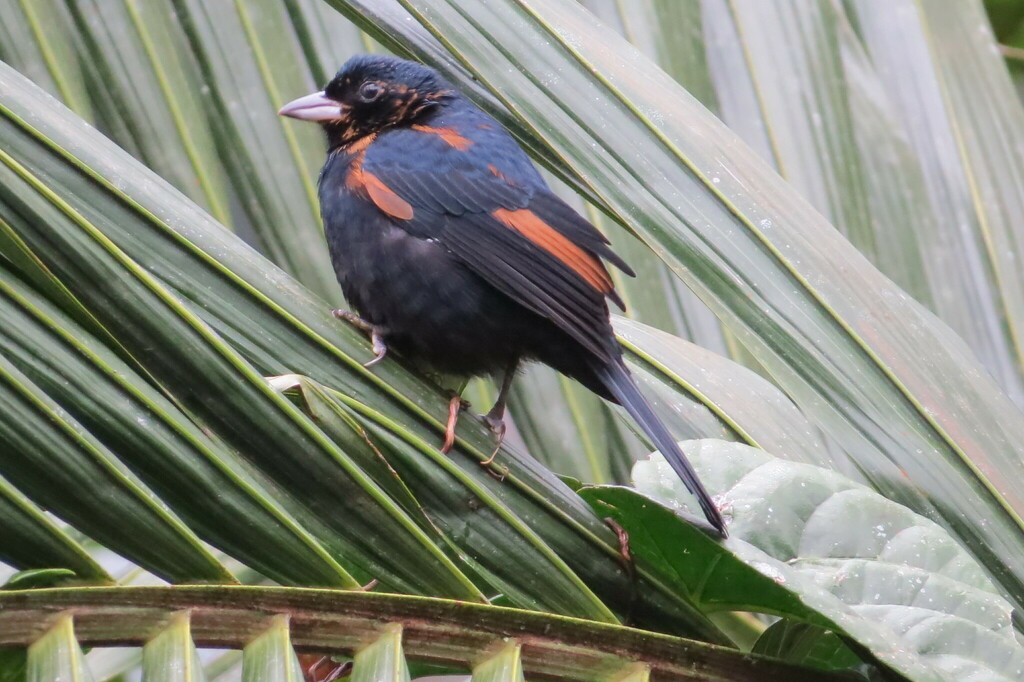
Ruby-crowned Tanager
Photo © Jonathan Lorencetti Ehlert
Photo © Jonathan Lorencetti Ehlert — CC BY-SA 4.0 — Source: iNaturalist photo #407066350Identification
The ruby-crowned tanager is a small passerine, measuring 16 centimetres in length and weighing between 26–33 grams. Sexual dimorphism is pronounced in this species. Males are striking birds with shining black plumage and a distinctive concealed red crest on the front of the head, which they rarely raise except when excited. In flight, males reveal white wingpits that are otherwise hidden. Females present a contrasting appearance, displaying light brown plumage with slight black streaking under the throat and noticeably darker wings. Both sexes share conical bills and black legs and feet, features typical of many tanager species.
Range & Habitat
The ruby-crowned tanager occupies a large range across southern South America, including most of southern Brazil, eastern Paraguay, and the Misiones Province of Argentina. This species inhabits subtropical and tropical moist environments, thriving in lowland forests, montane forests, and even heavily degraded former forest areas, demonstrating considerable adaptability to habitat disturbance.
Behaviour & Diet
Ruby-crowned tanagers are highly active foragers that employ diverse feeding strategies. They consume a varied diet of fruits, insects, and seeds, supplementing their natural food sources by pursuing swarms of army ants—a behavior shared with several other tropical bird species. These tanagers readily visit feeding stations stocked with fruit, making them accessible to observers with prepared resources.
Socially, ruby-crowned tanagers are flexible in their grouping patterns. While they typically live in pairs, they may also be encountered alone or in slightly larger flocks. Their active nature drives constant movement between fruiting trees as they search for food, making them engaging subjects for patient observers.
Best Time & Places to See It
Travellers seeking this species should focus on southern Brazil, eastern Paraguay, and the Misiones Province of Argentina, where the species maintains its large range. The ruby-crowned tanager's preference for fruit-bearing trees means that areas with abundant fruiting vegetation will offer the best viewing opportunities. Setting up fruit feeders can attract these birds reliably, allowing for closer observation and photography.
Photography Tips
Photographing male ruby-crowned tanagers offers striking compositional possibilities, as their glossy black plumage creates strong contrast and reflects light beautifully. The concealed red crest is rarely visible, but patient photographers may capture the moment it is raised during excitement. The white wingpits are only visible in flight, so anticipating takeoff moments will reward those seeking to document this diagnostic feature. Female birds, while less conspicuous, present subtle beauty in their brown and darker tones. Since these are active foragers constantly moving between trees, a fast shutter speed is essential. Position yourself near fruiting trees or established feeding stations early in the day when light is optimal and bird activity peaks.
Tijuca National Park
Brazil
+317 birds+13 mammals
Where the Atlantic forest rises steeply from Rio de Janeiro's urban edge, Tijuca National Park encompasses a landscape of dramatic granite peaks, cascading waterfalls, and closed-canopy…
VIEW NATIONAL PARKSerra do Cipó National Park
Brazil
+379 birds+5 mammals
Where granite escarpments rise above the Atlantic Forest transition zone in southeastern Brazil, Serra do Cipó National Park unfolds across a landscape of dramatic ridges, cascading…
VIEW NATIONAL PARKItatiaia National Park
Brazil
+519 birds+12 mammals
Where granite peaks pierce the Atlantic rainforest canopy in southeastern Brazil, Itatiaia National Park rises as one of the country's oldest and most ecologically vital protected…
VIEW NATIONAL PARKPeixe National Park Lagoon
Brazil
+293 birds+4 mammals
Where the coastal plains of Rio Grande do Sul meet the Atlantic, Peixe National Park Lagoon sprawls across nearly 2,200 square kilometres of shallow waters, reed…
VIEW NATIONAL PARKSuperagui National Park
Brazil
+246 birds+2 mammals
Where the Atlantic rainforest meets the subtropical coast of Paraná, Superagui National Park sprawls across more than 1,000 square kilometres of one of Brazil's most biodiverse…
VIEW NATIONAL PARKSaint-Hilaire/Lange National Park
Brazil
+225 birds
Subtropical Atlantic forests rise and fall across the plateaus of inland Paraná, where Saint-Hilaire/Lange National Park protects nearly 578 square kilometres of Brazil's most biodiverse woodland…
VIEW NATIONAL PARKSerra do Itajaí National Park
Brazil
+227 birds+2 mammals
Where the Atlantic rainforest rises steeply from the coastal plains of Santa Catarina, Serra do Itajaí National Park spreads across 1,136 square kilometres of montane wilderness…
VIEW NATIONAL PARKSerra da Bocaina National Park
Brazil
+441 birds+5 mammals
Where the escarpment of the Serra da Bocaina rises sharply from the Atlantic coastal plain, tropical rainforest cloaks steep mountainsides that climb toward peaks exceeding 2,000…
VIEW NATIONAL PARKIguaçu National Park
Brazil
+387 birds+17 mammals
Where the Paraná Plateau plunges toward the Atlantic watershed, six thousand square kilometers of subtropical rainforest cling to steep gorges and river valleys in this corner…
VIEW NATIONAL PARKIlha Grande National Park
Brazil
+233 birds
Across the subtropical plateaus and Atlantic forest remnants of southern Brazil, a vast protected landscape spanning nearly 4,600 square kilometers safeguards one of the continent's most…
VIEW NATIONAL PARKSão Joaquim National Park
Brazil
+222 birds+9 mammals
Where the southern Brazilian highlands rise above the Atlantic Forest, São Joaquim National Park protects nearly 1,000 square kilometers of montane terrain that shifts between temperate…
VIEW NATIONAL PARKSerra dos Órgãos National Park
Brazil
+446 birds+13 mammals
Granite peaks thrust skyward through the Atlantic Forest canopy in the mountains immediately north of Rio de Janeiro, their bare rock faces rising above a landscape…
VIEW NATIONAL PARKSerra do Gandarela National Park
Brazil
+333 birds+3 mammals
Where granite massifs rise through Atlantic Forest in southeastern Brazil's highlands, Serra do Gandarela National Park protects nearly 1,000 square kilometres of montane terrain that few…
VIEW NATIONAL PARKAraucárias National Park
Brazil
+231 birds+3 mammals
Where the southern Brazilian highlands rise into cool temperate forest, Araucárias National Park protects one of the Atlantic Forest's most distinctive ecosystems across 506 square kilometres…
VIEW NATIONAL PARKSerra Geral National Park
Brazil
+211 birds+2 mammals
Where basalt cliffs and sandstone escarpments rise above the subtropical forests of southern Brazil, Serra Geral National Park preserves one of the Atlantic region's most dramatic…
VIEW NATIONAL PARKCampos Gerais National Park
Brazil
+143 birds
Where rolling plateaus rise above the Atlantic forest escarpment in Paraná's interior, Campos Gerais National Park unfolds across 539 square kilometers of highland grassland and forest…
VIEW NATIONAL PARKIguazú National Park
Puerto Iguazú, Argentina
+346 birds+15 mammals
Where the Paraná Plateau plunges toward the Atlantic watershed, nearly 800 square kilometers of subtropical rainforest drape across Misiones Province in a landscape carved by millennia…
VIEW NATIONAL PARKNo community photos yet. Log in to add the first one.
No community observations of this species yet.