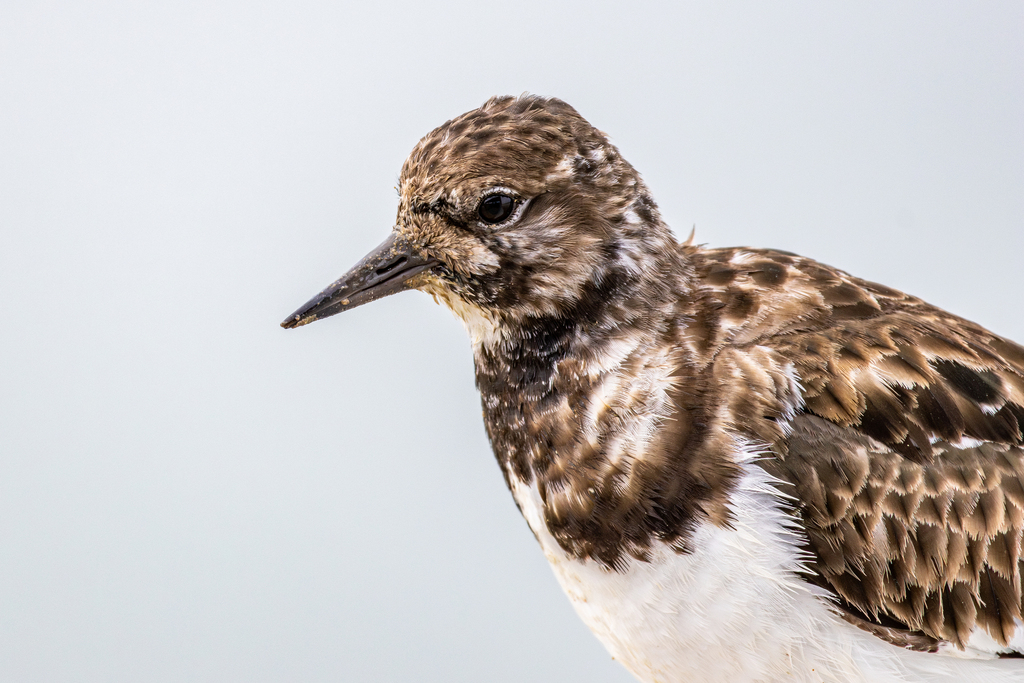
Ruddy Turnstone
Photo © Diego González Dopico
Photo © Diego González Dopico — CC BY 4.0 — Source: iNaturalist photo #470970089Identification
The Ruddy Turnstone is a fairly small and stocky wading bird, measuring 22–24 cm in length with a wingspan of 50–57 cm. Its most distinctive features include a dark, wedge-shaped bill that is slightly upturned, and characteristically short, bright orange legs. In all seasons, the plumage displays a striking harlequin-like pattern of brown, black and white that is instantly recognizable in the field.
Breeding plumage is particularly bold, with reddish-brown upper parts marked by black, a mainly white head with black streaks, and a predominantly black breast with white patches on the sides. In flight, look for a white wingbar, white patch near the wing base, and white lower back and rump. Non-breeding birds are considerably duller with grey-brown upperparts and dark heads, while juveniles show pale brown heads and scaly-looking feather fringes. The bird's staccato, rattling call is also useful for identification.
Range & Habitat
The Ruddy Turnstone is a highly migratory cosmopolitan species, breeding in northern latitudes across Eurasia and North America, usually within a few kilometres of the sea. Two subspecies are recognized: A. i. interpres breeds from western Alaska through Greenland and across northern Europe to northeast Siberia, while A. i. morinella breeds in northeast Alaska and Arctic Canada.
The species winters on coastlines almost worldwide. In the Americas, it ranges from Washington and Massachusetts southwards to the southern tip of South America. European wintering birds are found from Iceland and Norway southwards, while African populations extend throughout the continent to South Africa. Asian populations winter as far north as southern China and Japan, and the species also reaches Tasmania, New Zealand, and numerous Pacific islands. Some non-breeding birds remain year-round in wintering areas.
Behaviour & Diet
The Ruddy Turnstone has earned its name through its characteristic foraging technique of flipping over stones and other objects to expose hidden prey. Its diet is varied and opportunistic, including invertebrates, crustaceans, spiders, molluscs, and worms, with insects and larvae being particularly important during the breeding season. The birds employ six main foraging strategies: routing through seaweed piles, turning stones, digging in sand or mud, probing into substrate, and other specialized techniques to access prey items.
Though uncommon, turnstones have been observed preying on the eggs of gulls, terns, ducks, and even other turnstones, typically targeting undefended nests. They usually forage in flocks and will also consume carrion, fish, and plant material when available, making them remarkably adaptable feeders across their vast range.
Best Time & Places to See It
Ruddy Turnstones are present on coastlines throughout much of the world during winter months, making them accessible to travelers visiting temperate and tropical shores. Prime locations include western European coasts, the coasts of North and South America, African shores, and Asian coastal regions. The species is common in many wintering areas and can often be found in small flocks along rocky shores, sandy beaches, and estuaries.
Some non-breeding birds remain in wintering areas year-round, so the species can potentially be encountered in almost any season depending on your location. Coastal areas with exposed rocky shores and abundant invertebrate populations are particularly productive.
Photography Tips
The Ruddy Turnstone's striking harlequin plumage and active foraging behaviour make it an engaging photographic subject. Breeding birds in spring show the most dramatic coloration, with bold reds, blacks and whites that photograph beautifully in good light. The bird's habit of flipping stones and probing in shallow water provides excellent opportunities for capturing characteristic behaviour sequences.
Focus on capturing the bird's distinctive orange legs and wedge-shaped bill in detail, which are key identifying features. Early morning or late afternoon light will enhance the contrast of the plumage pattern. Patient observation of feeding flocks will reward you with dynamic action shots as birds busily work the shoreline, and the high contrast between the bird and typical coastal habitats generally makes exposure metering straightforward.
Delta de l’Ebre Natural Park
Parque del Centenario
Murchison Falls National Park
Queen Elizabeth National Park
Abel Tasman National Park
Acadia National Park
Addo Elephant National Park
Agulhas National Park
Alaska Maritime National Wildlife Refuge
Nothing matches these filters.