Ruffed Grouse
Photo © Meghan Cassidy
Photo © Meghan Cassidy — CC BY-SA 4.0 — Source: iNaturalist photo #629969295Identification
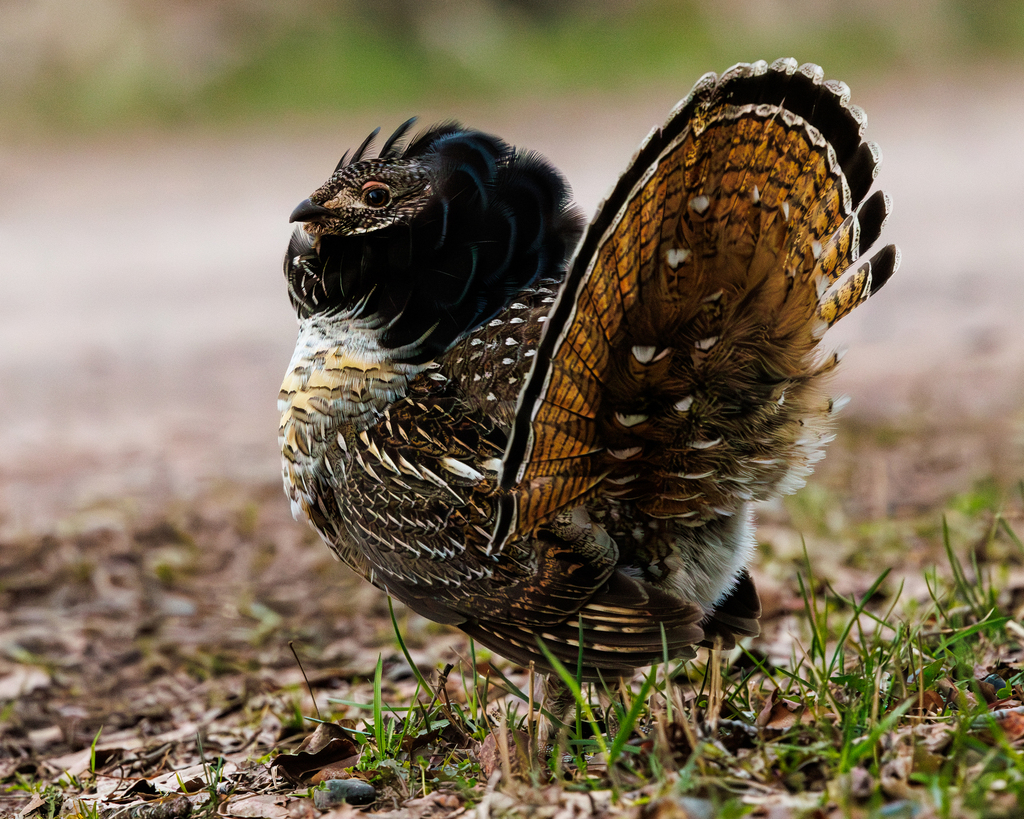
The ruffed grouse is a chunky, medium-sized woodland bird weighing 450–750 grams and measuring 40–50 centimetres in length. It features two distinct colour morphs—grey and brown—with considerable individual variation between them. Grey-morph birds display grey-brown heads, necks, and backs with light, barred breasts and white underparts, creating a variegated appearance. Brown-morph birds are uniformly darker with less conspicuous light plumage below, though their tails remain the same brownish-grey with regular barring and a distinctive broad black band near the end. Both sexes are similarly marked and sized, making field identification challenging. The most defining feature is the ruff—a distinctive collar of feathers on the sides of the neck present in both males and females—along with a crest atop the head that may lie flat or be raised. Subtle differences exist: females often display a broken subterminal tail band compared to males' typically unbroken bands, and rump feathers with multiple white dots indicate males, while single white dots suggest females.
Range & Habitat
The ruffed grouse is the most widely distributed game bird in North America, occurring in forests from the Appalachian Mountains across Canada to Alaska. The species is non-migratory and comprises 13 recognized subspecies distributed across this vast range. These birds are strongly associated with mixed woodlands, particularly those rich in aspen, where they spend most of their time on the ground.
Behaviour & Diet
Unlike other grouse species that rely on vocalizations, the ruffed grouse employs a remarkable nonvocal, acoustic courtship display known as drumming. This rapid wing-beating display creates a low-frequency sound that starts slowly and accelerates (thump ... thump ... thump..thump-thump-thump-thump), audible for a quarter-mile or more even in dense woodland. Males proclaim territory by drumming while standing on logs, stones, or soil mounds—using these surfaces as stages rather than striking them. When surprised, grouse may explode into flight with startlingly loud wing beats, or burrow into snow for winter warmth, erupting suddenly when disturbed.
Ruffed grouse are omnivorous ground and tree foragers, consuming buds, leaves, berries, seeds, and insects. Their dietary flexibility is key to their continental success; documented crops have yielded everything from salamanders in watercress to small snakes. The species exhibits cyclical population fluctuations—a "grouse cycle" that has puzzled scientists for decades and occurs independently of hunting pressure.
Best Time & Places to See It
Spring is the prime season for observing ruffed grouse, particularly during the drumming season when males establish territories with their distinctive acoustic displays. Mixed aspen woodlands throughout their range from the Appalachians across Canada to Alaska offer the best habitat. Early mornings provide optimal opportunities to hear drumming males, which can be detected from considerable distances in quiet conditions. The species' non-migratory nature means birds can be found year-round in suitable habitat, though winter observations may be more challenging as birds burrow into snow.
Photography Tips
Photographing ruffed grouse requires patience and stealth, as these birds spend most time quietly on the ground and are easily startled. During spring drumming season, locating an active male's drumming log allows for predictable positioning and repeated opportunities. Use telephoto lenses to maintain safe distance without disturbing the bird. Early morning light in forest environments can be challenging; bring appropriate equipment for low-light woodland photography. Explosive flight when birds are flushed provides dramatic action shots, but approach quietly to maximize opportunities before disturbance. Both morphs and the distinctive ruff and crest are key photographic features to capture. The bird's cryptic coloration demands careful exposure metering to preserve detail in both light and dark plumage areas.
Tombstone Territorial Park
Acadia National Park
Alaska Maritime National Wildlife Refuge
Algonquin Provincial Park
Banff National Park
Bear River Migratory Bird Refuge
Bic National Park
Cape Breton Highlands National Park
Crater Lake National Park
Nothing matches these filters.
No community photos yet. Log in to add the first one.
No community observations of this species yet.