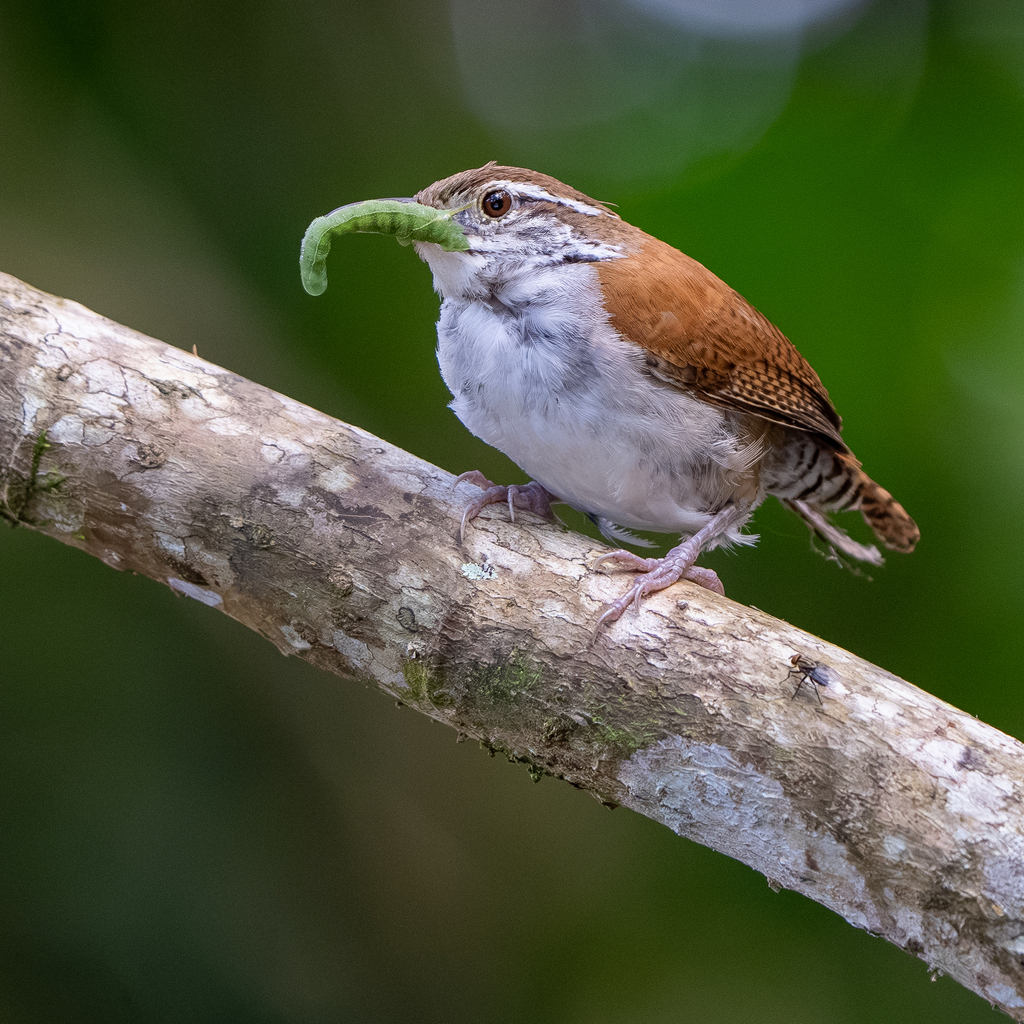
Rufous-and-white Wren
Photo © Anthony Batista
Photo © Anthony Batista — CC BY 4.0 — Source: iNaturalist photo #431436503Identification
The rufous-and-white wren is a small songbird measuring 14–15 cm in length and weighing just 22–25 g, making it a diminutive but distinctive member of the wren family. Adults display striking plumage: warm chestnut-brown upperparts with a darker crown, contrasting sharply with pure white underparts. The face is particularly distinctive, featuring a bold white supercilium, a brown eye-stripe, and black streaking on the cheeks. Look for black barring on the wings, tail, and lower belly, and warm brown flanking on the sides. Young birds appear duller overall with buff-tinged underparts. The Venezuelan subspecies T. r. minlosi shows a greyish tinge to both crown and underparts, providing a useful field mark for regional identification.
Range & Habitat
This resident species breeds from southwesternmost Mexico through Central America to northern Colombia and northwestern Venezuela, making it a wide-ranging inhabitant of the tropical Americas. The rufous-and-white wren favours lowlands and foothills from sea level up to 1,500 metres altitude, inhabiting dry forests and, in wetter regions, more open scrubby woodland. In Central America, it shows a preference for the Pacific side of the central mountain ranges, a geographical preference worth noting for travellers planning their itineraries.
Behaviour & Diet
This is a shy species, far more often heard than seen, which forages actively in low vegetation and on the ground, typically in pairs. The rufous-and-white wren's diet consists primarily of insects, spiders, and other invertebrates gleaned from its preferred low habitats. The species is particularly vocal, producing a distinctive sharp "chek" or explosive "tuck" call, and delivering a melodious song comprised of a memorable sequence of slow hooting whistles—weee, boo, boo, booo, boo, whit—sometimes delivered as a duet between paired birds. The second bird responds with a purring ou-ou-ou-oouu,u,u,u, creating an engaging acoustic display. Breeding pairs construct flask-shaped nests 2–3 metres high in trees or shrubs, where females alone incubate three or four greenish-blue eggs for approximately two weeks, with fledging occurring in a similar timeframe.
Best Time & Places to See It
The rufous-and-white wren's elusive nature rewards patient, attentive observers who listen carefully for its distinctive vocalizations as a guide to locating the bird. Its preference for low vegetation and ground-level foraging means scanning such habitats carefully will increase sighting success. Since the species is resident year-round throughout its range, any season offers opportunities, though the breeding season may provide more vocal activity and greater visibility as pairs defend territories and maintain contact through duetting.
Photography Tips
Photographing this shy wren requires patience and an understanding of its behaviour. Position yourself near suitable low scrubby habitat where the species forages, and remain still and quiet, listening for its characteristic calls. Early morning often yields more vocal activity. Since the bird typically remains in low vegetation and on the ground, keep your camera ready for sudden appearances at ground level. The striking facial pattern and contrasting plumage provide excellent photographic subjects when the bird is adequately lit, so seek dappled morning light filtering through scrubby growth for flattering portraits.
Manuel Antonio National Park
Quepos, Costa Rica
+426 birds+22 mammals
Where tropical rainforest descends steeply to a rocky Pacific coastline, Manuel Antonio National Park distills Central American biodiversity into one of Costa Rica's most compressed and…
VIEW NATIONAL PARKArenal Volcano National Park
Peñas Blancas, Costa Rica
+551 birds+21 mammals
Straddling the border between Alajuela and Guanacaste in northwestern Costa Rica, this national park rises dramatically around one of Central America's most active volcanic systems. The…
VIEW NATIONAL PARKSanta Rosa National Park
Santa Elena, Costa Rica
+359 birds+30 mammals
Where Pacific-facing slopes descend from volcanic uplands toward the Guanacaste lowlands, Santa Rosa National Park unfolds across a mosaic of tropical dry forest, gallery woodland, and…
VIEW NATIONAL PARKGuanacaste National Park
Santa Elena, Costa Rica
+461 birds+17 mammals
Where the Pacific slopes of northwestern Costa Rica rise toward the Continental Divide, dry tropical forest gives way to cloud-laden peaks and misty ridges—a landscape that…
VIEW NATIONAL PARKNatural el Cocuy National Park
Güicán, Colombia
+313 birds+3 mammals
Where the Andes rise to their highest peaks in Colombia's eastern cordillera, El Cocuy National Park sprawls across more than 6,600 square kilometers of some of…
VIEW NATIONAL PARKMorrocoy National Park
Municipio Silva
+290 birds
Where the Caribbean coast of northwestern Venezuela meets protected coastal waters, a mosaic of mangrove forests, sandy beaches, and coral reef systems defines Morrocoy National Park.…
VIEW NATIONAL PARKEl Tamá National Park
Toledo, Colombia
+435 birds
Where the Andes descend toward the Caribbean coastal lowlands of northern Colombia, El Tamá National Park sprawls across nearly 3,800 square kilometres of montane forest, cloud…
VIEW NATIONAL PARKNatural Sierra de la Macarena National Park
Vista Hermosa, Colombia
+566 birds+15 mammals
Across nearly 20,000 square kilometres of Colombia's Meta Department, the terrain rises from lowland savanna into Andean foothills through a mosaic of gallery forests, palm-fringed wetlands,…
VIEW NATIONAL PARKBaru Volcano National Park
Cerro Punta, Panama
+402 birds+6 mammals
Where the land rises sharply toward the Caribbean's western spine, Baru Volcano National Park sprawls across roughly 220 square kilometres of southwestern Panama, anchored by the…
VIEW NATIONAL PARKGeneral de División Omar Torrijos Herrera National Park
La Pintada, Panama
+401 birds+2 mammals
Across the highlands of central Panama, where the continental divide funnels moisture-laden trade winds into steep river valleys, the terrain rises and falls in a landscape…
VIEW NATIONAL PARKSoberanía National Park
Cristóbal, Panama
+495 birds+34 mammals
Rainforest and riverine woodland blanket the rolling terrain of this 714-square-kilometre national park in Colón Province, where the Caribbean watershed feeds a maze of streams and…
VIEW NATIONAL PARKChagres National Park
Caimitillo, Panama
+486 birds+19 mammals
Where the Chagres River carves through the humid tropics of central Panama, a vast montane and lowland forest sprawls across more than 2,300 square kilometers, anchoring…
VIEW NATIONAL PARKCarara National Park
Tárcoles, Costa Rica
+397 birds+19 mammals
Where the Pacific coastal plain meets transitional forest, Carara National Park straddles one of Central America's most dynamic ecological boundaries. The park's landscape encompasses lowland deciduous…
VIEW NATIONAL PARKPalo Verde National Park
Bagaces, Costa Rica
+318 birds+24 mammals
Dry forest spreads across Palo Verde's low-lying terrain in northwestern Guanacaste, where seasonal rivers and lagoons etch through deciduous woodland that sheds its canopy each winter.…
VIEW NATIONAL PARKRincón de la Vieja National Park
Liberia, Costa Rica
+451 birds+30 mammals
Where volcanic slopes rise abruptly from the Guanacaste lowlands, Rincón de la Vieja National Park sprawls across a landscape shaped by geothermal drama and seasonal extremes.…
VIEW NATIONAL PARKVolcán Tenorio National Park
Guatuso, Costa Rica
+480 birds+12 mammals
Where volcanic slopes rise through Costa Rica's northwestern borderlands, Volcán Tenorio National Park sprawls across terrain shaped by ancient lava flows and mineral-rich springs. The park's…
VIEW NATIONAL PARKMarino Las Baulas National Park
Santa Cruz, Costa Rica
+246 birds+9 mammals
Where the Pacific meets a mosaic of dry forest and mangrove estuary, this coastal national park protects one of Central America's most dynamic wildlife theatres. The…
VIEW NATIONAL PARKCurú National Wildlife Refuge
Paquera, Costa Rica
+249 birds+8 mammals
Where the Pacific coast of Puntarenas dissolves into dry deciduous forest and mangrove fringe, Curú Wildlife Sanctuary holds one of Costa Rica's most ecologically vital yet…
VIEW WILDLIFE SANCTUARYNo community photos yet. Log in to add the first one.
No community observations of this species yet.