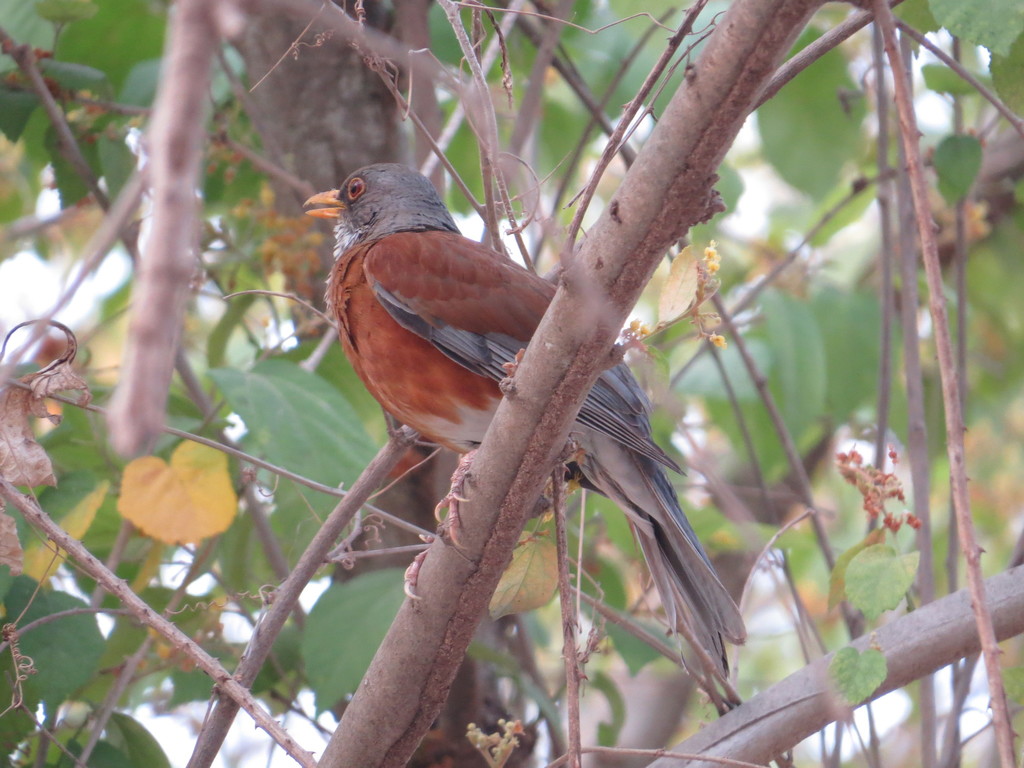
Rufous-backed Thrush
Photo © Gary Abner Garcia-Garcia
Photo © Gary Abner Garcia-Garcia — CC BY-SA 4.0 — Source: iNaturalist #45128009Identification
The rufous-backed thrush is a medium-sized songbird similar in size and shape to the American robin, measuring 21.5 to 25.5 cm in length with a wingspan of about 40 cm. Adults of the nominate subspecies have a distinctive pale gray head with black lores and a yellow eye-ring, contrasting with their dull chestnut back and gray mantle. The breast and flanks are warm orange-chestnut, while the throat, belly, and vent are white. A yellow bill completes the profile. Females are overall duller than males. Juveniles show buffy stipples on their upperparts and dark mottling on their underparts. Two other subspecies occur: T. r. interior has a duller, more maroon back, while the larger T. r. graysoni displays grayish-buff scapulars and mostly dull buff breast and flanks.
Range & Habitat
This thrush is endemic to Mexico, though it regularly wanders north as a casual visitor to the southwestern United States, particularly between October and April. The nominate subspecies inhabits western Mexico from Sonora south to Jalisco, occasionally reaching southeastern California, southern Arizona, south-central New Mexico, and far western Texas. T. r. interior occupies south-central Mexico from Jalisco to western Puebla and Oaxaca, while T. r. graysoni is found on the Tres Marías Islands and visits the mainland in Nayarit during the non-breeding season.
The species favors arid to semi-humid landscapes in tropical and subtropical zones, including deciduous and semi-deciduous forest, gallery forest, thorn forest, plantations, and gardens. It typically occurs from sea level to elevations of 1,500–2,500 m, depending on location. Interestingly, isolated populations exist in Mexico City and Oaxaca City, likely descended from escaped cage birds.
Behaviour & Diet
The rufous-backed thrush is non-migratory across its native range, though northern populations show seasonal wandering. It is primarily a frugivore, especially during the non-breeding season, foraging both on the ground and in trees and bushes. Winter birds often gather in flocks. The species has a rich vocal repertoire: its song is described as a leisurely, warbling phrase with 2–3 repetitions of certain motifs. Other calls include a plaintive, mellow whistle (cheeoo or teeeuu), hard clucking (chuk chuk chuk), and high thin notes in flight.
Breeding biology in the wild remains poorly known. Nests are shallow cups constructed from plant material and mud, lined with fine fibers, positioned in trees at approximately 6 m height. Clutches average 2.75 whitish eggs heavily marked with red-brown. Incubation lasts about 13 days, with fledging approximately 14 days post-hatch. Females handle nest-building and incubation; both parents feed chicks.
Best Time & Places to See It
In Mexico, the rufous-backed thrush is fairly common to common year-round throughout its range, making it accessible to travelers visiting suitable habitats. The mainland subspecies are reliable throughout their range, while T. r. graysoni is common on the Tres Marías Islands. Northern birders and travelers in the southwestern United States should watch for vagrants between October and April, particularly in Arizona, New Mexico, and California.
Seek this species in deciduous forests, gallery forests, gardens, and mixed plantations. Early morning often provides the best viewing opportunities, when birds are most vocal and active. In winter, check fruiting trees and feeding flocks for the best chance of observation.
Photography Tips
The rufous-backed thrush's warm chestnut-orange underparts and pale gray head make it visually distinctive against foliage. Photograph in early morning or late afternoon light to capture the rich coloration of the back and breast. The bird's ground-foraging behavior and time spent in trees at moderate heights make it relatively accessible for photography. During winter, flocking birds offer opportunities for group compositions, though individual bird portraiture will highlight the species' diagnostic field marks—particularly the yellow eye-ring and bill.
Garden and plantation habitats often provide better photographic opportunities than dense forest. The bird's non-migratory nature in most of its range means that consistent subjects may be found in suitable locations throughout the year. Patient observation will reward photographers with portraits of this handsome thrush in its preferred fruiting trees and feeding grounds.
Saguaro National Park
Rincon Valley, United States
+354 birds+40 mammals
Where the Sonoran Desert meets sky-island mountains, two geographically separated districts of Saguaro National Park sprawl across nearly two thousand square kilometers of Arizona's most iconic…
VIEW NATIONAL PARKParque Nacional Cerro de la Estrella
Mexico
+126 birds+4 mammals
Where volcanic peaks rise sharply above Mexico City's sprawling metropolis, Parque Nacional Cerro de la Estrella offers a rare glimpse of high-altitude terrain within one of…
VIEW NATIONAL PARKParque Nacional Benito Juárez
San Andrés Huayápam, Mexico
+128 birds+4 mammals
High in the Sierra Madre del Sur of Oaxaca, where cloud forest mingles with pine woodland and the terrain climbs steeply through ravines carved by mountain…
VIEW NATIONAL PARKParque Nacional Grutas de Cacahuamilpa
Pilcaya, Mexico
+97 birds+12 mammals
Where limestone ridges rise abruptly from the tropical deciduous forests of central Guerrero, the Grutas de Cacahuamilpa National Park shelters one of Mexico's most extensive cave…
VIEW NATIONAL PARKParque Nacional Isla Isabel
Santiago Ixcuintla, Mexico
+107 birds+2 mammals
A volcanic island sanctuary rises from the Pacific waters off Nayarit's coast, where three dormant cones define a landscape of sharp ridges, coastal cliffs, and sheltered…
VIEW NATIONAL PARKLaguna Atascosa National Wildlife Refuge
Cameron County, United States
+365 birds+19 mammals
Where coastal prairie meets shallow lagoon along the southernmost tip of Texas, Laguna Atascosa National Wildlife Sanctuary sprawls across a landscape sculpted by salt spray and…
VIEW WILDLIFE SANCTUARYSanta Ana National Wildlife Refuge
Hidalgo County, United States
+349 birds+12 mammals
Where the Rio Grande delta meets the semi-arid scrublands of South Texas, Santa Ana National Wildlife Sanctuary preserves a rare mosaic of wetland and thornforest habitat…
VIEW WILDLIFE SANCTUARYCabeza Prieta National Wildlife Refuge
United States
+155 birds+6 mammals
Across southwestern Arizona's harshest terrain, where the Colorado River marks the border with Mexico, lies a sanctuary shaped entirely by heat and aridity. Cabeza Prieta National…
VIEW WILDLIFE SANCTUARYNo community photos yet. Log in to add the first one.
No community observations of this species yet.