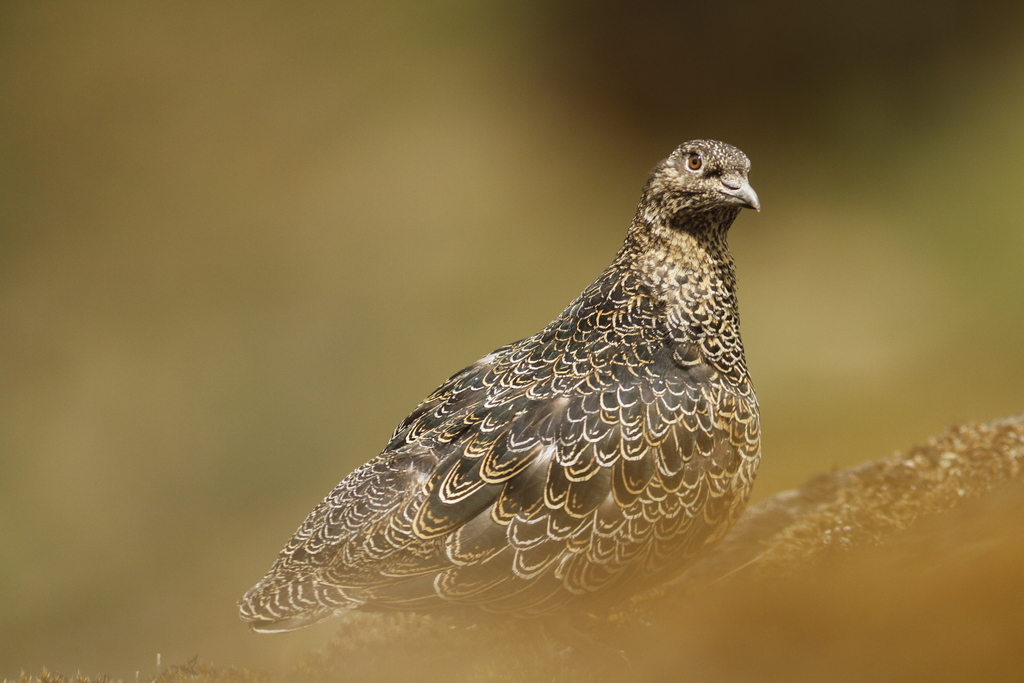
Rufous-bellied Seedsnipe
Photo © Julien Renoult
Photo © Julien Renoult — CC BY 4.0 — Source: iNaturalist photo #12409495Identification
The Rufous-bellied Seedsnipe is a small wader measuring 27–30 cm in length, weighing 280–400 g. Males and females are identical in plumage. The nominate subspecies displays intricate scalloped upperparts of rufous-brown and blackish tones, with unmarked pale pinkish-cinnamon underparts. Other subspecies show subtle variation: A. g. latrelillii has deeper rufous cinnamon on the vent and a scalloped breast, while A. g. simonsi sports a darker pinkish-cinnamon breast and paler, finer markings above. Juveniles resemble adults but with somewhat finer upperpart markings. In flight, this bird exhibits a characteristically fast, zigzag pattern.
Range & Habitat
The Rufous-bellied Seedsnipe is found across the Andes Mountains in Argentina, Bolivia, Chile, Ecuador, and Peru, with populations distributed across three subspecies. A. g. latrelillii occupies high volcanic terrain in north-central Ecuador, while A. g. simonsi ranges from central Peru through northern Chile, western Bolivia, and into northwestern Argentina. The nominate A. g. gayi inhabits north-central Chile and west-central Argentina south almost to Tierra del Fuego. This species is strictly alpine, typically occurring between 4,000–5,500 m elevation in the northern portion of its range, descending to 2,000 m further south and as low as 1,000 m in the extreme south. It favors boggy and moist areas in páramo and rocky landscapes, often reaching the snow line.
Behaviour & Diet
The Rufous-bellied Seedsnipe is essentially non-migratory, though southern populations likely descend to lower elevations during austral winter. It is a strong, agile flier. The species feeds primarily on plant matter, typically in moist terrain, though detailed dietary information remains scarce. Little is documented about its breeding biology, but it lays eggs during September through October in Chile, with breeding extending to December further north. Nests are simple shallow scrapes in the ground, typically containing four eggs. Vocalizations are distinctive and frequent: the bird calls both in flight and while running, producing a melodic 'gly-gly-gly' or 'cul-cul-cul' sound, often with several birds calling simultaneously.
Best Time & Places to See It
The breeding season from September to December offers the best opportunity to encounter this species, particularly in Chile where activity peaks in September and October. Look for it in alpine habitats across its range: the high volcanoes of Ecuador for the northern subspecies, the Andean highlands of Peru, Bolivia, and Argentina for others. The species is generally fairly common throughout most of its range, though it is less frequently encountered in Ecuador. Several protected areas within its distribution harbor populations. Early morning and late afternoon often yield the best sightings, when birds are most active in boggy meadows and rocky slopes near the snow line.
Photography Tips
Photographing the Rufous-bellied Seedsnipe requires patience and preparation for high-altitude conditions. The bird's cryptic coloration—pale cinnamon underparts and scalloped rufous-brown upperparts—provides excellent camouflage in alpine terrain, making detection challenging. Use binoculars first to locate birds before approaching with a camera. The species' habit of flying in fast zigzag patterns when flushed demands a fast shutter speed and continuous autofocus. Listen for its distinctive melodic calls to locate groups; several birds may vocalize together, aiding detection. The harsh mountain light at high elevation requires careful exposure management. Wide-angle shots capturing the alpine habitat alongside the bird often work better than tight portraits, given the species' small size and difficult terrain.
Full-day Birds of the desert
Nothing matches these filters.
Antisana National Park
Cerro Castillo National Park
Cotopaxi National Park
Huascarán National Park
Lauca National Park
Los Cardones National Park
Los Glaciares National Park
Parque Provincial Península de Magallanes
Patagonia National Park
Nothing matches these filters.
No community photos yet. Log in to add the first one.
No community observations of this species yet.