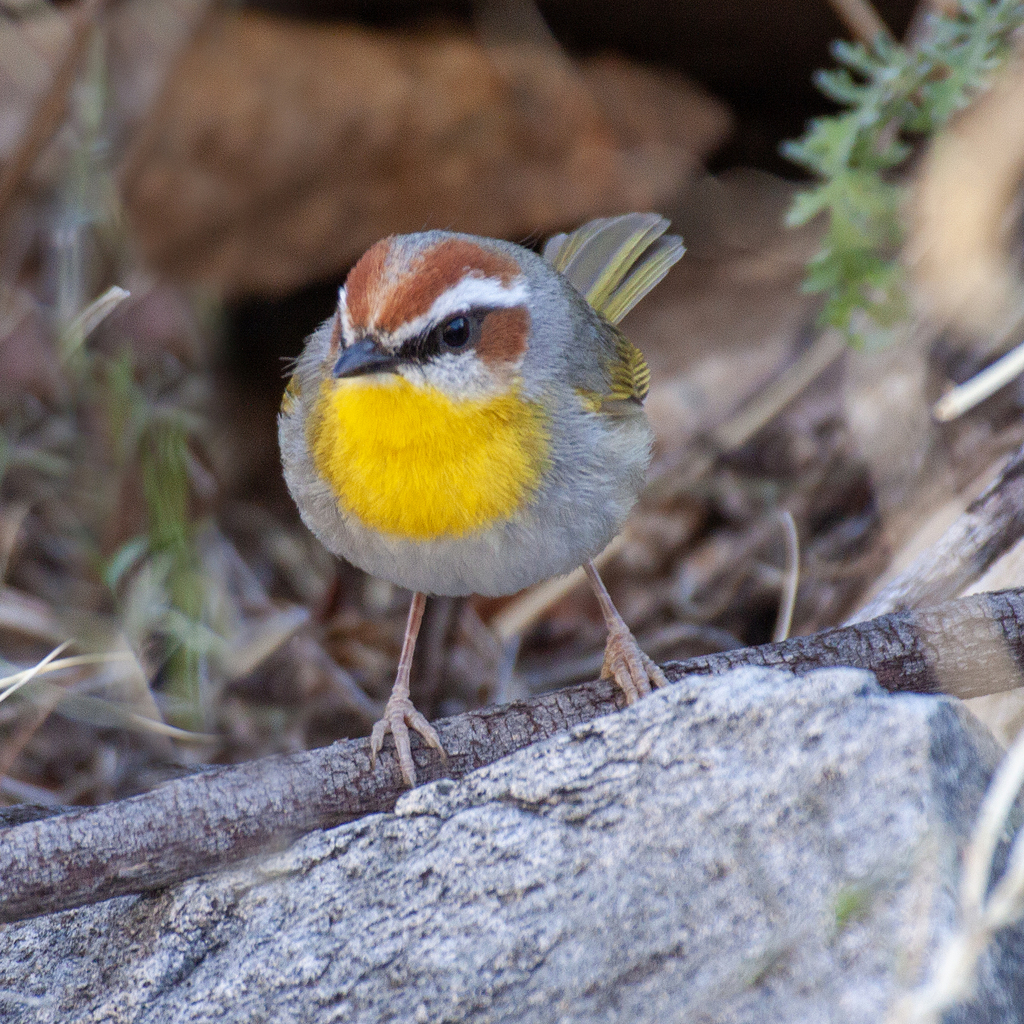
Rufous-capped Warbler
Photo © Dan Vickers
Photo © Dan Vickers — CC BY 4.0 — Source: iNaturalist #257991421Identification
The rufous-capped warbler is a small warbler, about 13 cm long, with distinctive plumage that is consistent between males and females. The nominate subspecies features a striking rufous crown and ear coverts framed by a long white supercilium, black lores, and a wide white streak running from the lores beneath the eye and ear coverts. The nape is grayish, upperparts olive-gray, and the wings and tail dusky gray with yellow-green edges. The throat and upper breast are lemon yellow, contrasting with a brownish-white lower breast and belly; flanks and undertail coverts show an olive-buff wash. Juveniles appear duller with an olive-brown head and warmer brown crown, and display two buff-tipped wing bars. All subspecies share a dark iris, blackish bill, and pinkish legs and feet.
Range & Habitat
The rufous-capped warbler inhabits a range extending through Mexico, Guatemala, and Belize, with five recognized subspecies occupying different regions from northwestern Mexico south through central and southern areas. Subspecies B. r. caudatus regularly visits southeastern Arizona and parts of Texas, occasionally breeding in the southwestern United States. The species prefers somewhat dry and open landscapes including scrublands, open woodlands, hedgerows, young secondary forest, shade coffee plantations, and forest edges, avoiding dense forest interiors. It occurs from sea level to 3,000 meters elevation overall, though between 450 and 2,150 meters south of Mexico.
Behaviour & Diet
The rufous-capped warbler is primarily a sedentary year-round resident, with only occasional vagrants reaching the southwestern United States. It feeds deliberately on insects and invertebrates gleaned from vegetation in lower to mid-level habitats, supplementing its diet with small numbers of berries, and sometimes joins mixed-species feeding flocks. Both males and females sing a fast-paced trill with repeated syllables in sections; the call is a hard tcheck that extends into harsh chatter when agitated. The breeding season spans at least April to July, with birds constructing distinctive domed cup nests with side entrances on the ground, hidden beneath rocks, logs, or vegetation and lined with soft plant fibers. Clutches contain two to four heavily marked white eggs with reddish spots and streaks.
Best Time & Places to See It
The rufous-capped warbler is common in Mexico and fairly common in Belize and Guatemala, making these countries ideal destinations for sightings. Within the United States, southeastern Arizona and the Big Bend area of Texas offer opportunities to observe visiting populations, particularly subspecies B. r. caudatus. The species' preference for scrubby habitats and second growth means these areas remain reliable and accessible for observation. Look for this warbler in open woodlands, hedgerows, and forest edges rather than dense forest interiors.
Photography Tips
The rufous-capped warbler's striking facial pattern—featuring the white supercilium and ear covert framing the rufous crown—makes for compelling photographs. The bird's deliberate foraging behavior in lower to mid-level vegetation offers good opportunities for patient photographers. Focus on capturing the distinctive head markings and the contrasting lemon-yellow throat and upper breast against the olive-gray upperparts. Early morning hours when birds are most active and vocalize frequently will provide the best chances for both location and photography, particularly in scrubby open woodlands and young secondary growth where the species is most active.
Saguaro National Park
Rincon Valley, United States
+354 birds+40 mammals
Where the Sonoran Desert meets sky-island mountains, two geographically separated districts of Saguaro National Park sprawl across nearly two thousand square kilometers of Arizona's most iconic…
VIEW NATIONAL PARKLagunas de Montebello National Park
Laguna de Montebello, Mexico
+360 birds+2 mammals
Where turquoise lagoons pierce the limestone plateau of southeastern Chiapas, the Lagunas de Montebello National Park unfolds across roughly 174 square kilometers of spectral water and…
VIEW NATIONAL PARKSierra de Tamaulipas
El Porvenir, Mexico
+98 birds+19 mammals
Where limestone peaks thrust skyward through dense subtropical forest, Mexico's northeastern frontier reveals one of the continent's most biodiverse mountain ranges. Canyons carved by perennial rivers…
VIEW NATURE RESERVEParque Nacional Benito Juárez
San Andrés Huayápam, Mexico
+128 birds+4 mammals
High in the Sierra Madre del Sur of Oaxaca, where cloud forest mingles with pine woodland and the terrain climbs steeply through ravines carved by mountain…
VIEW NATIONAL PARKParque Nacional Grutas de Cacahuamilpa
Pilcaya, Mexico
+97 birds+12 mammals
Where limestone ridges rise abruptly from the tropical deciduous forests of central Guerrero, the Grutas de Cacahuamilpa National Park shelters one of Mexico's most extensive cave…
VIEW NATIONAL PARKMontes Azules
Candelaria, Mexico
+395 birds+47 mammals
Where jungle-clad limestone plateaus plunge into canyon systems carved by the Usumacinta River, Mexico's most pristine rainforest reserve unfolds across the Lacandón region of Chiapas. Montes…
VIEW BIOSPHERE RESERVENo community photos yet. Log in to add the first one.
No community observations of this species yet.