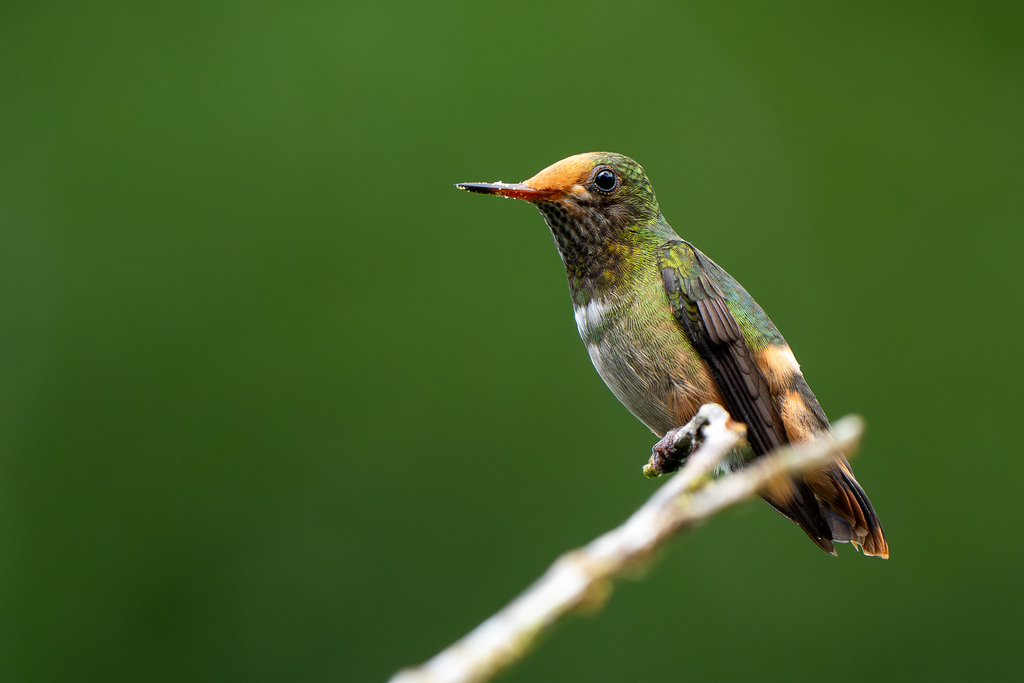
Rufous-crested Coquette
Photo © Anthony Batista
Photo © Anthony Batista — CC BY 4.0 — Source: iNaturalist photo #590291324Identification
The rufous-crested coquette is one of the tiniest hummingbirds, measuring just 6.4 to 7.0 cm in length with a wingspan of 4.0 to 4.5 cm and weighing around 2.8 grams. Males are unmistakable, sporting a striking rufous crest of slender, black-tipped feathers that extend dorsally from their rufous-coloured head. They display an iridescent green throat bordered by a vertical band of rufous feathers, with darker green feathers that end in pointed white tips. The tail is double-rounded and composed of brown, orange, and green feathers. Females lack the prominent crest and instead have rufous forehead feathers that fade into iridescent green plumage. Their throats are primarily white with scattered green feather clusters, and a rufous band extends from throat to forehead. Both sexes have light iridescent green backs and stomachs, a distinctive white band crossing the rump, and short orange bills with blackened points.
Range & Habitat
This species inhabits the Pacific and Caribbean mountainsides of Peru, Bolivia, Colombia, Ecuador, Panama, and Costa Rica, with at least one recorded observation in western Brazil. The rufous-crested coquette is primarily found between 500 and 1,900 metres above sea level, likely moving to higher altitudes during breeding season. It favours humid evergreen and semi-deciduous forests, particularly in clearings, forest openings, and roadsides where low-growing flowering plants are sparse. Despite being rare even within its native range, the species maintains stable populations and is listed as of least concern by the IUCN, partly because its preference for open areas and forest clearings makes it less vulnerable to deforestation than many other tropical bird species.
Behaviour & Diet
These diminutive hummingbirds forage primarily on nectar from flowering plants in humid forest ecosystems, showing a particular affinity for the small white flowers of Inga trees and blooms from Myrtaceae and Verbenaceae plants. They also catch small insects through hawking. Due to their tiny size, rufous-crested coquettes cannot compete successfully with larger hummingbird species for food and therefore forage over considerably larger distances than most hummingbirds, navigating ranges of up to 15 kilometres within their territories.
Males perform a distinctive courtship display involving lateral oscillating flights in front of perched females, prominently displaying their characteristic crests. In flight, the species exhibits a distinctive vertical pumping of the tail that gives them an insect-like appearance, often causing them to be mistaken for sphinx moths. Rufous-crested coquettes are generally silent birds, though they produce sharp "tsip" calls while foraging and soft chipping sounds, accompanied by the characteristic quiet humming produced by their rapid wingbeats.
Best Time & Places to See It
Finding the rufous-crested coquette requires patience and persistence, as this species is a rare sight even within its native range. Focus your search on humid evergreen forests between 500 and 1,900 metres elevation across the Pacific and Caribbean slopes of its range. Forest clearings, openings, and roadsides are your best locations, particularly areas with flowering Inga trees, Myrtaceae, and Verbenaceae plants. Look during daylight hours when the birds are actively foraging. The species likely moves to higher elevations during the breeding season, so adjust your search altitude accordingly if you're visiting during that period.
Photography Tips
Photographing the rufous-crested coquette presents significant challenges given its small size and rarity. Use a telephoto lens of at least 400mm to capture sufficient detail from a distance that won't disturb the bird. Focus on forest clearings and roadsides where light conditions are better than in dense forest understory. The males' vibrant rufous crest and iridescent green throat offer striking photographic subjects when properly lit; position yourself to catch the afternoon light illuminating these iridescent feathers. Be prepared to spend considerable time searching and waiting, as the bird's small size and habit of foraging over large distances make encounters unpredictable. Listen for the sharp "tsip" call or the characteristic humming of wingbeats to locate birds in flight.
Otishi National Park
Río Tambo, Peru
+108 birds
Where the Andes descend toward the Amazon basin, vast cloud forests cloak the ridges and valleys of Peru's Río Tambo watershed, and this is where Otishi…
VIEW NATIONAL PARKManu National Park
Manu, Peru
+892 birds+26 mammals
Across the eastern slopes of the Peruvian Andes, tropical rainforest descends into the Amazon basin with a complexity that few terrestrial ecosystems match. Manu National Park…
VIEW NATIONAL PARKTingo Maria National Park
Mariano Dámaso Beraún, Peru
+423 birds
Where the eastern slopes of the Peruvian Andes descend toward the Amazon basin, the landscape fractures into a maze of limestone ridges, humid gorges, and cloud-wrapped…
VIEW NATIONAL PARKGeneral de División Omar Torrijos Herrera National Park
La Pintada, Panama
+401 birds+2 mammals
Across the highlands of central Panama, where the continental divide funnels moisture-laden trade winds into steep river valleys, the terrain rises and falls in a landscape…
VIEW NATIONAL PARKSoberanía National Park
Cristóbal, Panama
+495 birds+34 mammals
Rainforest and riverine woodland blanket the rolling terrain of this 714-square-kilometre national park in Colón Province, where the Caribbean watershed feeds a maze of streams and…
VIEW NATIONAL PARKChagres National Park
Caimitillo, Panama
+486 birds+19 mammals
Where the Chagres River carves through the humid tropics of central Panama, a vast montane and lowland forest sprawls across more than 2,300 square kilometers, anchoring…
VIEW NATIONAL PARKDarién National Park
Tucutí, Panama
+534 birds+13 mammals
Where the spine of Central America crumbles into wetland and rainforest, Darién National Park sprawls across more than 20,000 square kilometres of some of the tropics'…
VIEW NATIONAL PARKNo community photos yet. Log in to add the first one.
No community observations of this species yet.