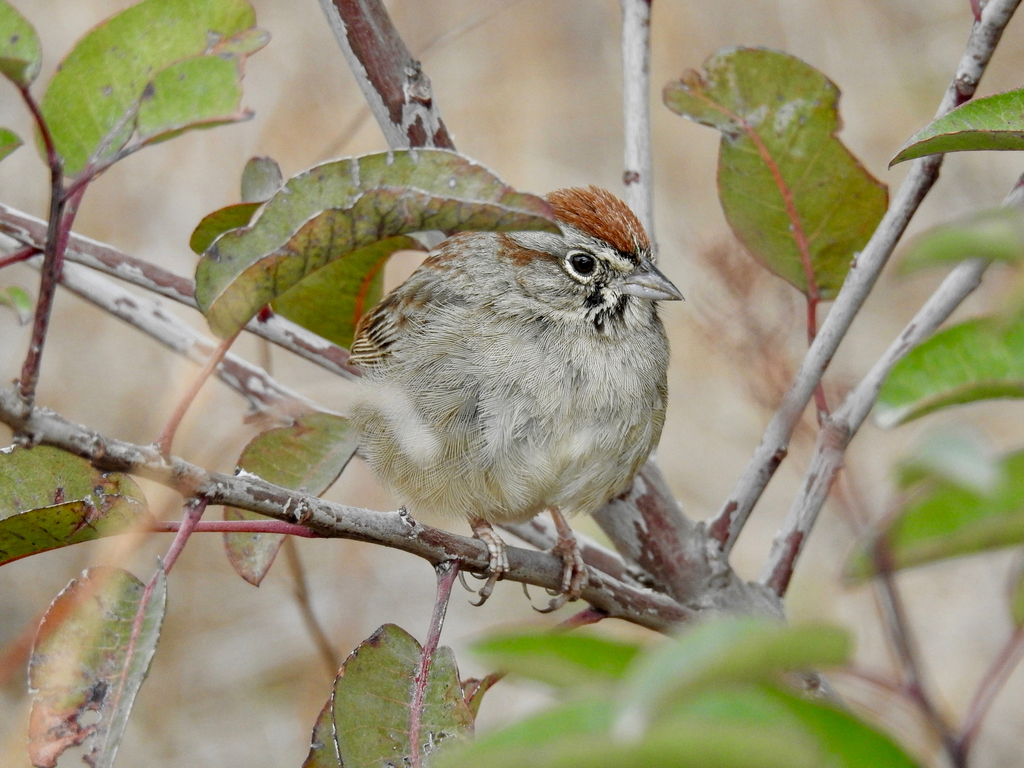
Rufous-crowned Sparrow
Photo © James M. Maley
Photo © James M. Maley — CC BY 4.0 — Source: iNaturalist #68664469Identification
The Rufous-crowned Sparrow is a small American sparrow with distinctive field marks that make it recognizable across its range. This bird features a rufous crown, gray face and supercilium, and characteristic brown or rufous streaks extending from each eye, paired with a thick black malar streak. The back is brown with darker streaks, while the underparts are gray. As a member of the genus Aimophila, this sparrow displays the family's typical traits: proportionally long bill and tail relative to body size, short rounded wings, and overall compact build. The species is occasionally called the rock sparrow, a reference to its preference for rocky slopes.
Range & Habitat
The Rufous-crowned Sparrow is primarily found across the Southwestern United States and much of the interior of Mexico, with its range extending south to the transverse mountain range and to the Pacific coast southwest of this range. The bird's distribution is notably patchy, with populations often isolated from one another across its vast territory. Twelve subspecies are generally recognized, though some authorities suggest up to eighteen, reflecting regional variation across this fragmented range. These sparrows are characteristic inhabitants of arid scrubland environments, particularly rocky slopes and similar terrain.
Behaviour & Diet
Rufous-crowned Sparrows are primarily granivorous, feeding on seeds during winter months and switching to insects during spring and summer breeding seasons. The birds are often strongly territorial, with males actively guarding their territory through song and visual displays. They are characteristically awkward fliers and prefer to move about by hopping along the ground. These sparrows are monogamous and breed during spring, constructing well-hidden, cup-shaped nests where females typically lay two to five eggs. Adults face predation from house cats and small raptors, while young birds are vulnerable to a range of mammalian and reptilian predators.
Best Time & Places to See It
Spring is the optimal season for observing Rufous-crowned Sparrows, as breeding males become more vocal and visible while defending territories. The species occurs across the Southwestern United States and interior Mexico, though birders should be prepared to search in suitable rocky scrubland habitat where populations are often scattered. The bird's preference for arid scrub and rocky slopes provides clues for locating it, as does listening for male song during the breeding season. Given the patchy distribution, consulting regional guides for specific localities within the general range will increase success.
Photography Tips
Photographers should focus on early morning hours when territorial males are most vocal and active. The species' preference for ground movement and short flights means positioning yourself at eye level near rocky scrub habitat will yield better photographic opportunities than attempting to capture birds in flight. The distinctive head pattern—with the rufous crown, gray supercilium, and black malar streak—provides excellent compositional potential when captured in good light. Patience is essential, as the bird's ground-hugging behavior and tendency to remain within dense scrub vegetation require careful stalking and positioning to achieve clear shots.
Big Bend National Park
Brewster County, United States
+345 birds+34 mammals
Where the Chisos Mountains rise abruptly from the Sonoran Desert floor, Big Bend National Park spans over 7,300 square kilometers of one of North America's most…
VIEW NATIONAL PARKSaguaro National Park
Rincon Valley, United States
+354 birds+40 mammals
Where the Sonoran Desert meets sky-island mountains, two geographically separated districts of Saguaro National Park sprawl across nearly two thousand square kilometers of Arizona's most iconic…
VIEW NATIONAL PARKLassen Volcanic National Park
Shasta County, United States
+239 birds+18 mammals
Volcanic peaks and geothermal upheaval have sculpted 545 square kilometers of Northern California into a landscape where fire and water engage in perpetual dialogue. Lassen Peak…
VIEW NATIONAL PARKPinnacles National Park
San Benito County, United States
+197 birds+33 mammals
Jagged volcanic spires thrust from chaparral-covered ridges across 222 square kilometers of central California's inner Coast Ranges, their pale stone crowns catching the afternoon light like…
VIEW NATIONAL PARKCarlsbad Caverns National Park
Eddy County, United States
+309 birds+18 mammals
Beneath the Chihuahuan Desert floor of southern New Mexico lies one of North America's most spectacular subterranean landscapes. Carlsbad Caverns National Park encompasses over 518 square…
VIEW NATIONAL PARKZion National Park
Washington County, United States
+244 birds+30 mammals
Towering sandstone cliffs in shades of crimson, rust, and cream rise abruptly from the Virgin River's winding canyon floor, their sculpted faces bearing witness to millions…
VIEW NATIONAL PARKYosemite National Park
Mariposa County, United States
+224 birds+28 mammals
Granite cliffs soar nearly a kilometer above the valley floor in this expanse of high Sierra wilderness, where glacial U-shaped valleys sculpt a landscape of dramatic…
VIEW NATIONAL PARKSequoia National Park
Tulare County, United States
+187 birds+27 mammals
Granite peaks rising above 3,600 meters dominate the southern Sierra Nevada, where Sequoia National Park sprawls across one of North America's most vertically compressed wilderness zones.…
VIEW NATIONAL PARKKings Canyon National Park
Fresno County, United States
+186 birds+20 mammals
Where granite peaks fracture the Sierra Nevada skyline and the Kings River has carved one of North America's most dramatic canyons, a landscape of extreme relief…
VIEW NATIONAL PARKEl Vizcaíno
Laguna San Ignacio, Mexico
+317 birds+29 mammals
Where the Baja California peninsula thins into a tapestry of salt lagoons and coastal desert, one of Mexico's most biodiverse reserves sprawls across half a million…
VIEW BIOSPHERE RESERVEParque Nacional Cerro de la Estrella
Mexico
+126 birds+4 mammals
Where volcanic peaks rise sharply above Mexico City's sprawling metropolis, Parque Nacional Cerro de la Estrella offers a rare glimpse of high-altitude terrain within one of…
VIEW NATIONAL PARKTutuaca
Tosanachi, Mexico
+147 birds+13 mammals
Where copper canyons plunge deeper than the Grand Canyon itself, Mexico's remote Sierra Madre Occidental unfolds in dramatic vertical relief. Tutuaca anchors this wilderness realm, a…
VIEW PROTECTED LANDSCAPEChannel Islands National Park
Santa Barbara County, United States
+330 birds+15 mammals
A chain of eight volcanic islands rises from the cold Pacific waters off the California coast, their rugged sea cliffs and windswept terrain shaped by millions…
VIEW NATIONAL PARKGrand Canyon National Park
United States
+277 birds+35 mammals
A mile-deep chasm of rust-red rock and purple shadow cuts through the high desert plateau of northern Arizona, revealing nearly two billion years of geological history…
VIEW NATIONAL PARKGuadalupe Mountains National Park
Culberson County, United States
+262 birds+14 mammals
Where fossil-laden limestone ridges thrust skyward above the Chihuahuan Desert floor, Guadalupe Mountains National Park reveals a landscape sculpted by ancient seas and relentless aridity. These…
VIEW NATIONAL PARKPetrified Forest National Park
Apache County, United States
+206 birds+23 mammals
Across the high desert plateau of northeastern Arizona, where the climate swings between scorching summer days and frost-laden winters, badlands of raw earth and timber-turned-to-stone dominate…
VIEW NATIONAL PARKWhite Sands National Park
Otero County, United States
+178 birds+6 mammals
Across the Tularosa Basin in south-central New Mexico sprawls an otherworldly landscape of gypsum dunes—the largest gypsum field on Earth and a stark desert playground shaped…
VIEW NATIONAL PARKBosque del Apache National Wildlife Refuge
Socorro County, United States
+345 birds+17 mammals
Where the Rio Grande emerges from its desert canyon in central New Mexico, a narrow ribbon of riparian woodland defies the arid landscape that surrounds it.…
VIEW WILDLIFE SANCTUARYWichita Mountains National Wildlife Refuge
Medicine Park, United States
+256 birds+17 mammals
Granite peaks rise abruptly from rolling prairie in southwestern Oklahoma, where the Wichita Mountains National Wildlife Refuge protects a rare collision of ecosystems. This sanctuary encompasses…
VIEW WILDLIFE SANCTUARYKofa National Wildlife Refuge
Yuma County, United States
+142 birds+10 mammals
Desert mountains rise in sculptured ridges across northwestern Arizona, where the Colorado River's distant influence fades into some of the most austere terrain in the American…
VIEW WILDLIFE SANCTUARYSacramento National Wildlife Refuge
Glenn County, United States
+247 birds+13 mammals
Across the flat expanse of Glenn County's Sacramento Valley, shallow pools and seasonal marshes create one of California's most vital wetland sanctuaries—a landscape shaped by water…
VIEW WILDLIFE SANCTUARYSan Luis National Wildlife Refuge
Merced County, United States
+219 birds+14 mammals
Across the floor of California's San Joaquin Valley, where semi-arid grasslands meet shallow seasonal wetlands, San Luis National Wildlife Sanctuary preserves a critical mosaic of habitats…
VIEW WILDLIFE SANCTUARYBitter Lake National Wildlife Refuge
Chaves County, United States
+284 birds+10 mammals
Across the high desert floor of southeastern New Mexico, where elevation and aridity shape every living thing, shallow alkaline lakes and marshes form an unexpected oasis…
VIEW WILDLIFE SANCTUARYNo community photos yet. Log in to add the first one.
No community observations of this species yet.