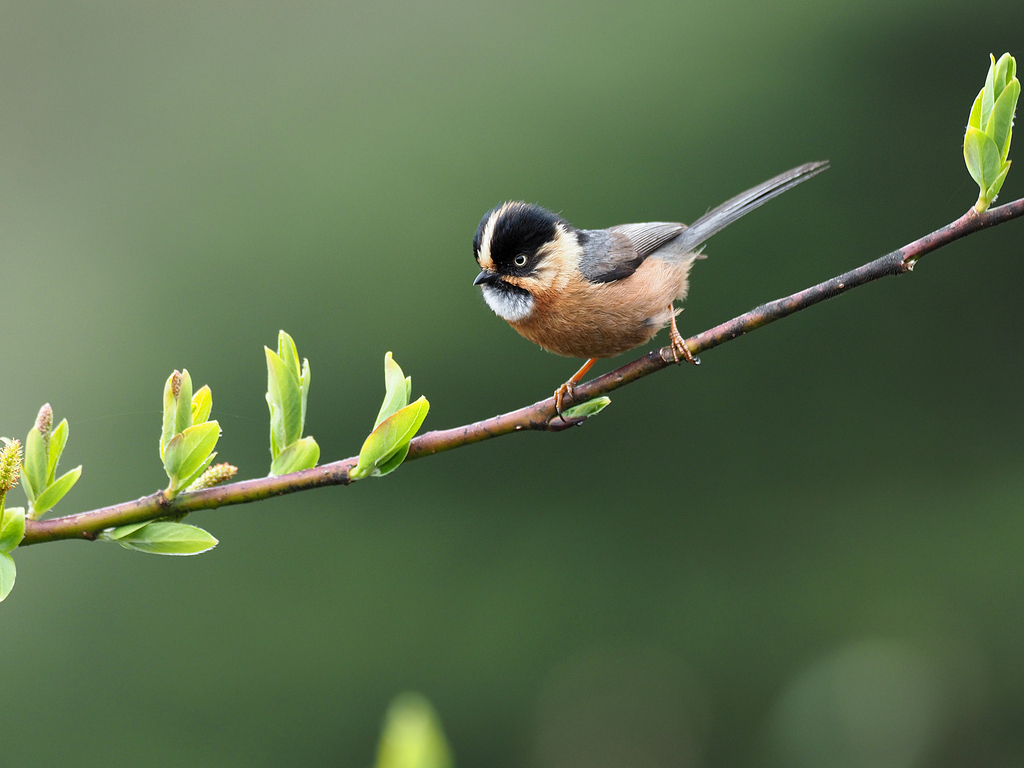
Rufous-fronted Bushtit
Photo © James Eaton
Photo © James Eaton — CC0 1.0 — Source: iNaturalist photo #395651052Identification
The Rufous-fronted Bushtit is a diminutive long-tailed passerine, measuring just 11–12 centimetres in length. It is instantly recognisable by its distinctive head pattern: a broad black mask contrasting sharply with a white forehead and white bib (speckled black in the centre). The head is predominantly buff, and the upperparts are soft grey. The breast and flanks display warm rufous colouration, whilst the belly is white. The subspecies A. i. sharpei, found in southwestern Myanmar, shows subtle but notable differences, including white rather than buff on the head, a dark breastband, and a buff belly rather than white.
Range & Habitat
This species is endemic to the eastern Himalayan region and mountains of East and Southeast Asia. Its range spans from Nepal and northern India through southeastern Tibet, across southern China (including Sichuan and Yunnan provinces), and into Myanmar, where it occurs sporadically. The bird inhabits boreal and temperate forests, typically in montane regions. Four subspecies are recognised across this range, each occupying distinct geographical populations from the Himalayas to Mount Victoria in southwestern Myanmar.
Behaviour & Diet
Like other members of the long-tailed tit family, the Rufous-fronted Bushtit is a small, active forager typically encountered in small flocks. These birds glean insects and other small food items from foliage whilst moving restlessly through the forest canopy and mid-storey. Their behaviour is characteristic of their family: acrobatic, social, and energetic, with frequent contact calls maintaining flock cohesion as they work through dense vegetation.
Best Time & Places to See It
The Rufous-fronted Bushtit favours montane boreal and temperate forests across its range. Birdwatchers and nature travellers visiting the Himalayan foothills, particularly in Nepal and northern India, or exploring the mountain forests of Sichuan and Yunnan in China, have the best prospects of encountering this species. Observers should listen for contact calls and watch for flocks moving through mid-storey vegetation in forest habitat.
Photography Tips
The small size, active behaviour, and preference for dense forest canopy make this species challenging to photograph. Position yourself quietly along forest edges or clearings where flocks may pass through more openly. Early morning hours often produce more active behaviour and better lighting conditions. A telephoto lens (400mm or greater) is essential, along with a fast shutter speed to freeze the bird's constant movement. Focus on capturing the striking head pattern and facial mask, which are the species' most distinctive and photogenic features.
Langtang National Park
Helambu, Nepal
+364 birds+14 mammals
Where the southern slopes of the Himalayan highlands descend toward the subtropical valleys of central Nepal, Langtang National Park sprawls across one of the subcontinent's most…
VIEW NATIONAL PARKSagarmatha National Park
Khumjung, Nepal
+219 birds+7 mammals
Soaring peaks and deep glacial valleys define this alpine wilderness in northeastern Nepal, where the terrain rises from forested foothills into a realm of high-altitude tundra…
VIEW NATIONAL PARKKhangchendzonga National Park
Sakkyong, India
+290 birds+1 mammals
Where the eastern Himalayas surge toward their crowning peaks, Khangchendzonga National Park embraces a landscape of almost overwhelming vertical drama. Rising from subtropical river valleys into…
VIEW NATIONAL PARKGiant Panda National Park
Mianyang, China
+447 birds+47 mammals
Where the eastern slopes of China's Sichuan plateau descend into cloud-wrapped valleys, one of Asia's most biodiverse landscapes unfolds across more than 350,000 square kilometres. This…
VIEW NATIONAL PARKJiuzhai Valley
Jiuzhaigou County, China
+226 birds+7 mammals
Where crystalline alpine streams cascade through limestone gorges and karst terrain rises in dramatic vertical walls, Jiuzhai Valley unfolds across nearly 1,300 square kilometers of southwestern…
VIEW NATURAL MONUMENTHuanglong Scenic and Historic Interest Area
Ngawa Tibetan and Qiang Autonomous Prefecture, China
+194 birds+7 mammals
Across the high plateau of northwestern Sichuan, a geological wonder unfolds where limestone terraces and mineral-rich springs have sculpted one of China's most distinctive natural monuments.…
VIEW NATURAL MONUMENTGaoligong Mountain National Nature Reserve
Nujiang Lisu Autonomous Prefecture, China
+443 birds+13 mammals
VIEW NATURE RESERVEBaima Snow Mountain National Nature Reserve
Diqing Tibetan Autonomous Prefecture, China
+204 birds+3 mammals
High-altitude ridges and steep-sided valleys define this reserve in northwestern Yunnan, where elevations surge from around 3,000 metres to peaks above 4,100 metres. The terrain supports…
VIEW NATURE RESERVENo community photos yet. Log in to add the first one.
No community observations of this species yet.