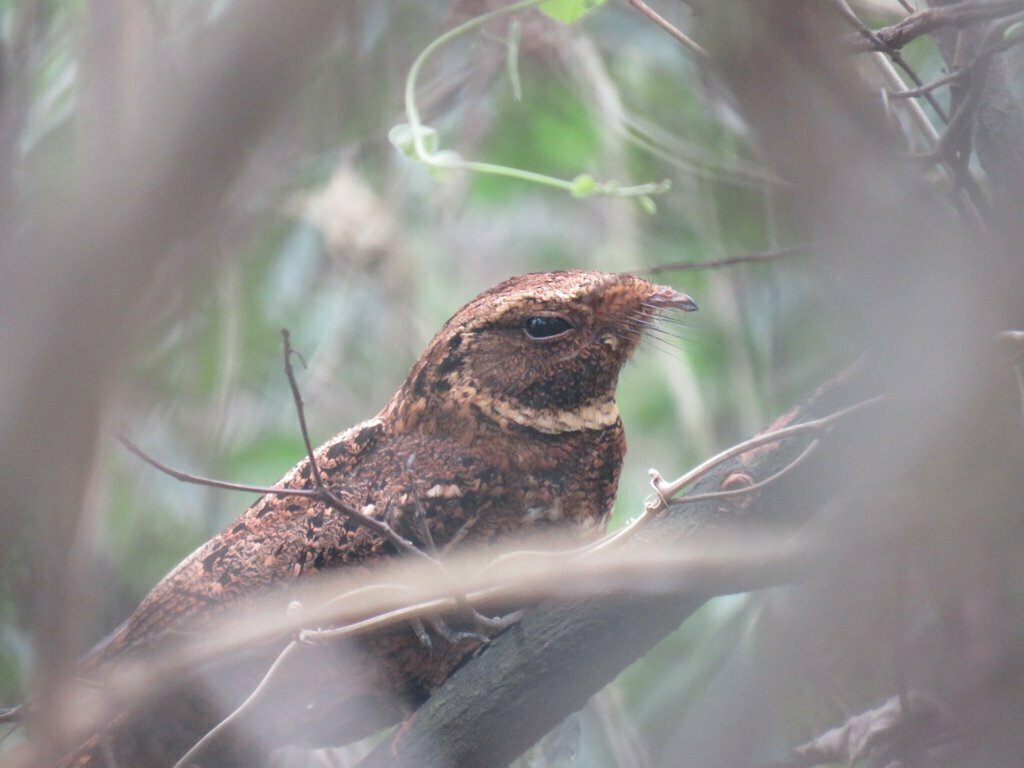
Rufous Nightjar
Photo © Diego Carús
Photo © Diego Carús — CC0 1.0 — Source: iNaturalist photo #444631797Identification
The Rufous Nightjar is a small nightjar, measuring 25 to 30 cm in length and weighing around 88 to 98 grams—roughly the size of a sparrow. Its plumage is almost entirely reddish-brown, giving the species its common name. Look for a distinctive buff-coloured collar on the sides and back of the neck, and a white band beneath the throat. The upperparts feature dark brown streaks, while the wings are spotted and barred with dark brown. Unlike many nightjar species, this bird's wings lack white patches. The underparts are speckled with dark brown and white. Males display white spots on the outer three pairs of tail feathers, while females show pale buff tips instead. The various subspecies differ in color intensity and the extent of spotting, with A. r. saltarius being notably grayer than its relatives.
Range & Habitat
The Rufous Nightjar has a highly discontinuous distribution across Central and South America, occurring in Argentina, Bolivia, Brazil, Colombia, Costa Rica, Ecuador, Guyana, Panama, Paraguay, Peru, Saint Lucia, Suriname, Trinidad and Tobago, and Venezuela. Different subspecies occupy distinct regions: minimus ranges from southern Costa Rica eastward along Caribbean coasts; rufus inhabits discontinuous areas of eastern Venezuela, Guyana, Suriname, and central Brazil; otiosus is endemic to Saint Lucia; rutilus occupies southeastern Bolivia, central Brazil, Paraguay, and northeastern Argentina; and saltarius is found in southern Bolivia and northwestern Argentina.
The species inhabits diverse landscapes ranging from dry scrublands to primary and secondary forests. It adapts to habitats varying from the arid Gran Chaco to the humid Amazon basin. The Saint Lucia population favours dry scrub environments, while other subspecies are more generalist in their habitat requirements.
Behaviour & Diet
The Rufous Nightjar is most active during crepuscular hours—at dawn and dusk—when it actively hunts for insects. During daylight hours, it roosts either on low perches or on the ground beneath thick vegetation, relying on camouflage to avoid detection. The bird forages by making sallies from low perches such as branches or fenceposts to snatch insects from the air. Its diet consists primarily of insects, though detailed dietary information remains limited.
During breeding season, the Rufous Nightjar follows the nightjar pattern of minimal nest construction, laying a clutch of one or two eggs directly on bare ground. The nest site is typically concealed within low vegetation. The female undertakes daytime incubation duties. The bird's distinctive vocalization consists of energetic, rhythmic calls—described variously as "chuck-wick-wick-WEEoo" or similar staccato patterns—typically delivered from a perch anywhere up to 20 metres above ground.
Best Time & Places to See It
To observe Rufous Nightjars, visit during the early morning or late evening hours when these crepuscular birds are most active. The species' broad range offers multiple opportunities: birders in Central America might explore southern Costa Rica and Panama, while South American travellers could seek them in the Amazon basin, the Guyana Shield, or the Atlantic Forest regions of Brazil. Saint Lucia offers a more localized option for those wishing to encounter the endemic subspecies. The bird's preference for roosting in low vegetation on or near the ground makes finding them challenging during daylight hours, but patient observers listening for their distinctive calls at dawn and dusk may be rewarded with sightings.
Photography Tips
Photographing Rufous Nightjars presents particular challenges owing to their cryptic habits and crepuscular activity. Plan to shoot during the golden hours of early dawn or late dusk when sufficient light remains. Since the bird roosts on or near the ground in dense vegetation, approach slowly and carefully to avoid flushing it from cover. The reddish-brown plumage can be difficult to expose correctly; aim to preserve detail in both highlights and shadows. Listen for their distinctive calls to locate birds, then position yourself quietly before they become active. A telephoto lens will allow you to maintain distance, reducing disturbance. Patient, repeated visits to suitable habitat will increase your chances of successful encounters.
Emas National Park
Brazil
+333 birds+23 mammals
Across the high plateaux of central Brazil, where the cerrado grasslands roll toward distant horizons under an immense sky, Emas National Park anchors one of South…
VIEW NATIONAL PARKSerra do Cipó National Park
Brazil
+379 birds+5 mammals
Where granite escarpments rise above the Atlantic Forest transition zone in southeastern Brazil, Serra do Cipó National Park unfolds across a landscape of dramatic ridges, cascading…
VIEW NATIONAL PARKCorcovado National Park
Puerto Jiménez, Costa Rica
+444 birds+48 mammals
Where the Osa Peninsula juts into the Pacific, rainforest descends almost to the tide line, and Corcovado National Park protects one of Central America's most intact…
VIEW NATIONAL PARKPiedras Blancas National Park
Golfito, Costa Rica
+386 birds+24 mammals
Where the Golfo Dulce meets the southwestern Pacific coast of Costa Rica, Piedras Blancas National Park protects a dramatic transition zone where lowland rainforest descends toward…
VIEW NATIONAL PARKItatiaia National Park
Brazil
+519 birds+12 mammals
Where granite peaks pierce the Atlantic rainforest canopy in southeastern Brazil, Itatiaia National Park rises as one of the country's oldest and most ecologically vital protected…
VIEW NATIONAL PARKViruá National Park
Brazil
+389 birds+6 mammals
Across the northern frontier of Roraima, where the forest canopy rises from ancient Amazonian lowlands, Viruá National Park protects nearly 3,700 square kilometres of terra firme…
VIEW NATIONAL PARKChapada dos Guimarães National Park
Brazil
+450 birds+1 mammals
Where weathered sandstone plateaus rise above the cerrado grasslands of central Brazil, Chapada dos Guimarães National Park protects 624 square kilometres of ecological transition zone that…
VIEW NATIONAL PARKChapada dos Veadeiros National Park
Brazil
+324 birds+6 mammals
Where granite plateaus rise above the cerrado savanna in central Brazil, Chapada dos Veadeiros National Park unfolds across 6,665 square kilometres of some of the world's…
VIEW NATIONAL PARKPantanal Matogrossense National Park
Brazil
+322 birds+17 mammals
Where the flooded forests of central Brazil meet vast seasonally inundated grasslands, Pantanal Matogrossense National Park sprawls across nearly 2,900 square kilometers of one of the…
VIEW NATIONAL PARKChapada Diamantina National Park
Brazil
+346 birds+5 mammals
Where granite peaks and sandstone cliffs rise abruptly from the Brazilian interior, Chapada Diamantina National Park sprawls across 4,215 square kilometers of some of Brazil's most…
VIEW NATIONAL PARKSerra do Gandarela National Park
Brazil
+333 birds+3 mammals
Where granite massifs rise through Atlantic Forest in southeastern Brazil's highlands, Serra do Gandarela National Park protects nearly 1,000 square kilometres of montane terrain that few…
VIEW NATIONAL PARKSerra do Divisor National Park
Brazil
+448 birds+10 mammals
Where the western Amazon meets the Andes foothills, Serra do Divisor National Park sprawls across one of South America's most biodiverse and least accessible frontiers. Spanning…
VIEW NATIONAL PARKCoiba National Park
Montijo, Panama
+260 birds+10 mammals
An archipelago of volcanic and sedimentary islands rises from the Pacific waters off Panama's southwestern coast, its densest rainforest canopy unbroken for millennia. Coiba National Park…
VIEW NATIONAL PARKGeneral de División Omar Torrijos Herrera National Park
La Pintada, Panama
+401 birds+2 mammals
Across the highlands of central Panama, where the continental divide funnels moisture-laden trade winds into steep river valleys, the terrain rises and falls in a landscape…
VIEW NATIONAL PARKSoberanía National Park
Cristóbal, Panama
+495 birds+34 mammals
Rainforest and riverine woodland blanket the rolling terrain of this 714-square-kilometre national park in Colón Province, where the Caribbean watershed feeds a maze of streams and…
VIEW NATIONAL PARKChagres National Park
Caimitillo, Panama
+486 birds+19 mammals
Where the Chagres River carves through the humid tropics of central Panama, a vast montane and lowland forest sprawls across more than 2,300 square kilometers, anchoring…
VIEW NATIONAL PARKDarién National Park
Tucutí, Panama
+534 birds+13 mammals
Where the spine of Central America crumbles into wetland and rainforest, Darién National Park sprawls across more than 20,000 square kilometres of some of the tropics'…
VIEW NATIONAL PARKIguazú National Park
Puerto Iguazú, Argentina
+346 birds+15 mammals
Where the Paraná Plateau plunges toward the Atlantic watershed, nearly 800 square kilometers of subtropical rainforest drape across Misiones Province in a landscape carved by millennia…
VIEW NATIONAL PARKEl Rey National Park
Municipio de Las Lajitas, Argentina
+317 birds+4 mammals
Where the eastern slopes of the Andes descend into northwestern Argentina's subtropical transition zone, El Rey National Park unfolds across 841 square kilometers of dramatically varied…
VIEW NATIONAL PARKCalilegua National Park
Municipio de Calilegua, Argentina
+288 birds+8 mammals
Where the eastern Andean slopes plunge into northwestern Argentina's humid subtropics, nearly 2,645 square kilometers of steep terrain and luxuriant forest compose one of South America's…
VIEW NATIONAL PARKBaritú National Park
Argentina
+81 birds+2 mammals
Where the eastern slopes of the Serranías del Hornocal descend into cloud forest and subtropical ravines, Baritú National Park protects one of northwestern Argentina's most biodiverse…
VIEW NATIONAL PARKParque Provincial Pampa del Indio
Laguna Limpia, Argentina
+231 birds+4 mammals
Across the flat horizons of Chaco Province, where the Paraná River system spills into vast wetlands and grasslands, Parque Provincial Pampa del Indio protects one of…
VIEW NATURE RESERVEChaco National Park
Municipio de Presidencia de la Plaza, Argentina
+258 birds+7 mammals
Across the humid subtropical lowlands of northeastern Argentina, where the Paraná River basin feeds vast seasonal wetlands and gallery forests, Chaco National Park protects one of…
VIEW NATIONAL PARKNo community photos yet. Log in to add the first one.
No community observations of this species yet.