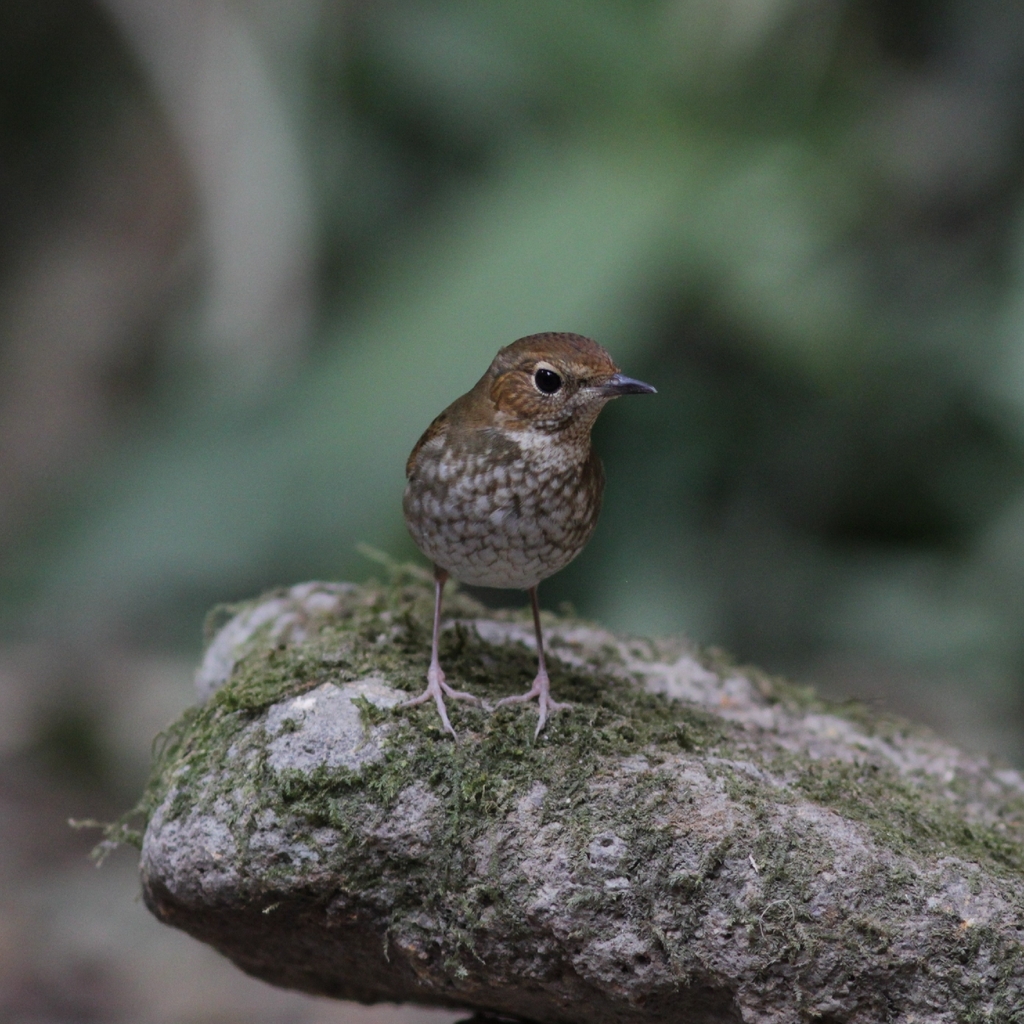
Rufous-tailed Robin
Photo © Jacob She
Photo © Jacob She — CC BY 4.0 — Source: iNaturalist #336472416Identification
The rufous-tailed robin is a small passerine comparable in size to the European robin, measuring 14 cm (5.5 in) in length. Its most distinctive feature is the bright rufous rump and tail, which contrasts sharply with its plain greyish-brown upperparts. The underparts are grey to white, with circular pale markings on a heavily mottled throat and breast. Look for the characteristic whitish eye-ring, pronounced buffish cheek stripe, and buff flanks. The lower mandible is slightly upturned, and legs are pinkish-grey. Sexes are generally similar, though females may be marginally paler. Juveniles are tinged with ochre and show dark edges to their upper plumage. At first glance, this species can be confused with American Catharus thrushes such as the veery or hermit thrush.
Range & Habitat
This migratory insectivore breeds across the taiga of northeastern Asia, from southern Siberia and the Sea of Okhotsk south to southern China and Mongolia. It winters in Southeast Asia and southern China, with populations moving through Hong Kong, Thailand, Laos, and Vietnam. The species is a rare vagrant to Western Europe, with occasional records from the British Isles, Poland, and Denmark. It favours coniferous woodlands and damp broad-leafed forests with fallen trees and thick undergrowth, particularly spruce and fir mixed with willow, alder, birch, poplar, and bird cherry. While primarily a lowland species, it occasionally occurs at altitudes up to 1,200 m (4,000 ft).
Behaviour & Diet
This elusive bird is terrestrial and difficult to locate, spending considerable periods concealed among branches and undergrowth. It feeds primarily on ants, beetles, spiders, and other invertebrates, often flicking its tail in a characteristic manner. The male sings both day and night during the breeding season, producing loud cascading trills that start at a high pitch and drop lower, resembling a horse's neigh. Alarm calls include sharp whistles, while a jangling "chok-chok" indicates parents attending to young. Breeding occurs in June or July, with cup-shaped nests typically placed in tree holes or stumps near the ground, constructed from dead leaves, grasses, and moss. Clutches of five or six pale blue or blueish-grey eggs, irregularly blotched with brown, are typical. Migration south begins in late August from Russia and a few weeks later from Korea, with northward movement resuming in spring.
Best Time & Places to See It
For birdwatchers and photographers, the breeding season (June–July) in northeastern Asia offers the best opportunity to observe this species in its taiga habitat. During migration periods, late August through November provides chances to encounter the species in transitional zones. Winter observations are possible in Southeast Asia, particularly in Thailand, Laos, Vietnam, and around Hong Kong from November onwards. However, this bird's elusive nature and preference for dense undergrowth make it challenging to locate even within its regular range.
Photography Tips
Photographing the rufous-tailed robin requires patience and fieldcraft. Its cryptic plumage and tendency to remain stationary among dense vegetation demand high shutter speeds and fast lenses to capture clear images in shadowy woodland conditions. Focus on the distinctive rufous tail and rump, which provide the clearest identification features in photographs. Early morning sessions, when the male is most vocal, may help locate birds by sound, allowing you to position yourself for photography. During breeding season, the characteristic tail-flicking behaviour provides a useful indicator of the bird's presence and can frame dynamic shots. Use neutral backgrounds when possible to emphasize the bird's subtle but elegant plumage details.
Khao Yai National Park
Prachantakham District, Thailand
+377 birds+46 mammals
Evergreen dipterocarp forest blankets the rolling terrain of this national park in eastern Thailand, where limestone hills rise abruptly from the forest floor and seasonal streams…
VIEW NATIONAL PARKSt. Paul Island
Saint Paul, United States
+255 birds+8 mammals
Windswept tundra rolls across this remote Pribilof island, where volcanic basalt cliffs plunge into the Bering Sea and fog rolls in thick enough to erase the…
VIEW PROTECTED LANDSCAPENalychevo National Park
Nalychevo, Russia
+30 birds+5 mammals
Where volcanic peaks pierce the mist of Russia's far northeast, a primordial landscape of steaming geothermal springs and pristine river valleys unfolds across the Kamchatka Peninsula.…
VIEW NATIONAL PARKNortheast China Tiger and Leopard National Park
Mu Dan Jiang Shi, China
+202 birds+19 mammals
Across the temperate forests of northeastern China, where winters grip the landscape in subzero silence and summers remain cool and brief, the Mudanjiang region supports a…
VIEW NATIONAL PARKWuyishan National Park
Yanshan County, China
+141 birds+2 mammals
Where subtropical monsoon rains sustain a perpetually humid landscape, Wuyishan National Park rises from Fujian's eastern plateau as a realm of forested ridges, cascading streams, and…
VIEW NATIONAL PARKPoyang Lake National Nature Reserve
Shangrao, China
+270 birds+7 mammals
Where the Yangtze River's massive floodplain spreads across central China, Poyang Lake National Nature Reserve encompasses one of the continent's most dynamic and water-rich wetland systems.…
VIEW NATURE RESERVEAlaska Maritime National Wildlife Refuge
Alaska, United States
+391 birds+58 mammals
Where the North Pacific collides with Alaska's rugged coastline, a sprawling archipelago of islands, rocky outcrops, and coastal headlands forms one of North America's most remote…
VIEW WILDLIFE SANCTUARYNo community photos yet. Log in to add the first one.
No community observations of this species yet.