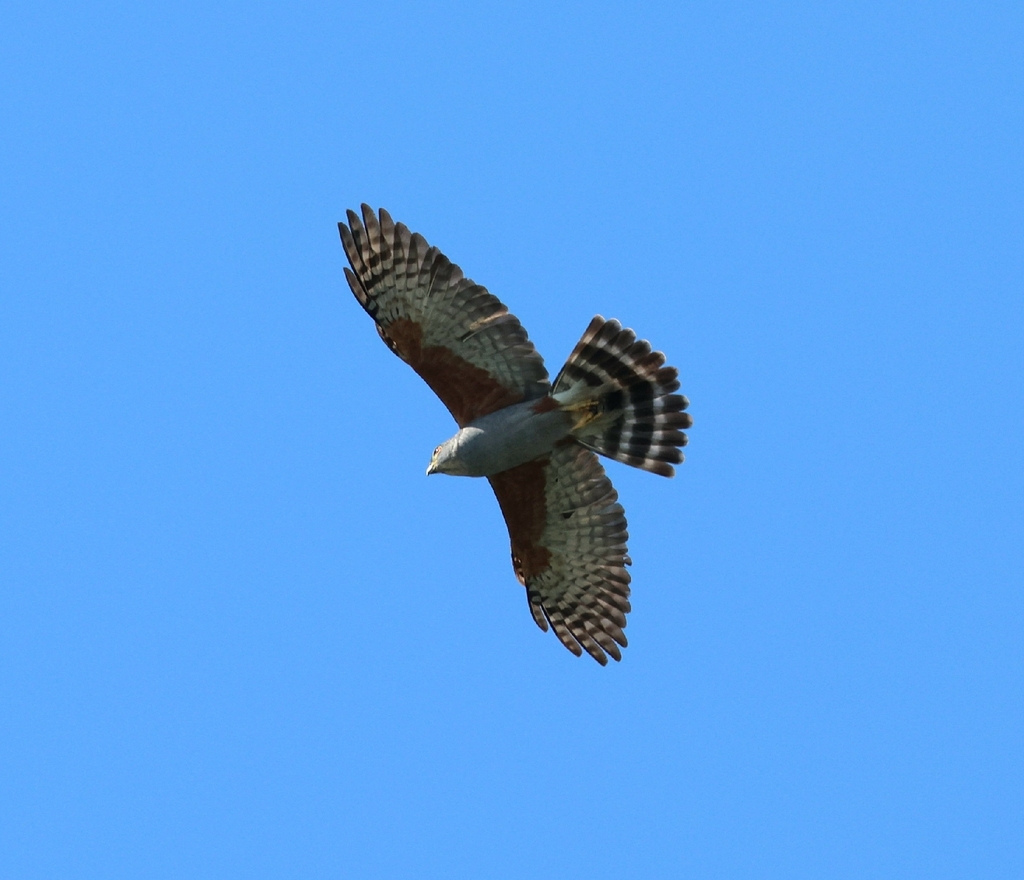
Rufous-thighed Kite
Photo © Miguel
Photo © Miguel — CC BY-SA 4.0 — Source: iNaturalist #330165258Identification
The Rufous-thighed Kite is a small raptor measuring 29 to 35 cm in length with a wingspan of 60 to 70 cm. Adults are unmistakable in their slate-gray head and upperparts, with chestnut thighs that give the species its English name. The tail is slate gray with three paler bars and white-tipped feathers. Look for the whitish throat with a dark central streak, gray breast fading to white at the undertail coverts, and a distinctive red or orange eye with a lemon-yellow cere and yellow to orange legs. Females are slightly larger than males. Immature birds are notably different, with dark brown upperparts, streaked head sides, and whitish underparts with darker streaking on the breast and belly.
Range & Habitat
The Rufous-thighed Kite breeds in southern Brazil, northern Argentina, and Paraguay, then migrates north during the non-breeding season into Amazonian Brazil, Bolivia, Guyana, and Suriname. Vagrants have been recorded in French Guiana and Venezuela, with an unevaluated report from Colombia. The species is primarily a lowland rainforest dweller, favoring primary forest but readily adapting to aged secondary forest with closed canopy. It has even been spotted in forest patches within urban areas, such as São Paulo.
Behaviour & Diet
As an austral migrant, the Rufous-thighed Kite moves seasonally from its southern breeding grounds northward into Amazonia, sometimes traveling in loose flocks of up to 30 individuals. It hunts within the forest canopy, typically in the middle to upper layers, perching quietly before seizing prey from branches rather than catching it in mid-air. Its diet consists predominantly of insects—particularly cicadas and orthoptera—with smaller numbers of lizards, birds, amphibians, and small mammals. The species opportunistically follows army ant swarms and monkey troops to capture flushed prey.
Breeding occurs from October to February during the austral late spring and summer. Nests are simple stick platforms placed in tree forks or on horizontal branches, containing one or two eggs. Fledglings leave the nest about four weeks after hatching. High-pitched begging calls and three-note adult vocalizations are the main sounds recorded for this species.
Best Time & Places to See It
The Rufous-thighed Kite is most regularly encountered in Amazonian Brazil, Bolivia, Guyana, and Suriname during the non-breeding season when populations move north. For breeding birds, southern Brazil, Paraguay, and northern Argentina are your best destinations during October to February. The species' preference for closed-canopy lowland rainforest means patient observation in primary and mature secondary forests offers the best chances of encounter. Early morning hours when raptors are most active improve your odds.
Photography Tips
Photographing this small, forest-dwelling raptor requires patience and a keen eye. Look for it perched quietly in the canopy midstory, where it surveys branches for prey. Its contrasting slate-gray and chestnut plumage photographs well in dappled forest light, though the closed-canopy habitat presents challenges. A zoom lens of at least 400mm is essential. Position yourself where you have clear sight lines through the forest, and listen for its distinctive vocalizations—the disyllabic "chee-weet" calls may alert you to nearby birds. Early morning light is ideal for capturing the rich rufous tones of its thighs and the distinctive eye color.
Tijuca National Park
Brazil
+317 birds+13 mammals
Where the Atlantic forest rises steeply from Rio de Janeiro's urban edge, Tijuca National Park encompasses a landscape of dramatic granite peaks, cascading waterfalls, and closed-canopy…
VIEW NATIONAL PARKSerra do Cipó National Park
Brazil
+379 birds+5 mammals
Where granite escarpments rise above the Atlantic Forest transition zone in southeastern Brazil, Serra do Cipó National Park unfolds across a landscape of dramatic ridges, cascading…
VIEW NATIONAL PARKItatiaia National Park
Brazil
+519 birds+12 mammals
Where granite peaks pierce the Atlantic rainforest canopy in southeastern Brazil, Itatiaia National Park rises as one of the country's oldest and most ecologically vital protected…
VIEW NATIONAL PARKSerra do Itajaí National Park
Brazil
+227 birds+2 mammals
Where the Atlantic rainforest rises steeply from the coastal plains of Santa Catarina, Serra do Itajaí National Park spreads across 1,136 square kilometres of montane wilderness…
VIEW NATIONAL PARKSerra da Bocaina National Park
Brazil
+441 birds+5 mammals
Where the escarpment of the Serra da Bocaina rises sharply from the Atlantic coastal plain, tropical rainforest cloaks steep mountainsides that climb toward peaks exceeding 2,000…
VIEW NATIONAL PARKViruá National Park
Brazil
+389 birds+6 mammals
Across the northern frontier of Roraima, where the forest canopy rises from ancient Amazonian lowlands, Viruá National Park protects nearly 3,700 square kilometres of terra firme…
VIEW NATIONAL PARKIguaçu National Park
Brazil
+387 birds+17 mammals
Where the Paraná Plateau plunges toward the Atlantic watershed, six thousand square kilometers of subtropical rainforest cling to steep gorges and river valleys in this corner…
VIEW NATIONAL PARKPau Brasil National Park
Brazil
+211 birds
Tropical Atlantic forest cloaks the rolling terrain of northeastern Bahia, where Pau Brasil National Park protects nearly 390 square kilometers of one of Brazil's most biodiverse…
VIEW NATIONAL PARKSerra dos Órgãos National Park
Brazil
+446 birds+13 mammals
Granite peaks thrust skyward through the Atlantic Forest canopy in the mountains immediately north of Rio de Janeiro, their bare rock faces rising above a landscape…
VIEW NATIONAL PARKChapada dos Guimarães National Park
Brazil
+450 birds+1 mammals
Where weathered sandstone plateaus rise above the cerrado grasslands of central Brazil, Chapada dos Guimarães National Park protects 624 square kilometres of ecological transition zone that…
VIEW NATIONAL PARKPantanal Matogrossense National Park
Brazil
+322 birds+17 mammals
Where the flooded forests of central Brazil meet vast seasonally inundated grasslands, Pantanal Matogrossense National Park sprawls across nearly 2,900 square kilometers of one of the…
VIEW NATIONAL PARKChapada Diamantina National Park
Brazil
+346 birds+5 mammals
Where granite peaks and sandstone cliffs rise abruptly from the Brazilian interior, Chapada Diamantina National Park sprawls across 4,215 square kilometers of some of Brazil's most…
VIEW NATIONAL PARKSerra do Gandarela National Park
Brazil
+333 birds+3 mammals
Where granite massifs rise through Atlantic Forest in southeastern Brazil's highlands, Serra do Gandarela National Park protects nearly 1,000 square kilometres of montane terrain that few…
VIEW NATIONAL PARKBrasília National Park
Plano Piloto, Brazil
+338 birds+15 mammals
Cerrado grassland and scattered woodland sweep across the central Brazilian plateau where this national park sprawls across more than a thousand square kilometres of the Federal…
VIEW NATIONAL PARKAraucárias National Park
Brazil
+231 birds+3 mammals
Where the southern Brazilian highlands rise into cool temperate forest, Araucárias National Park protects one of the Atlantic Forest's most distinctive ecosystems across 506 square kilometres…
VIEW NATIONAL PARKSerra Geral National Park
Brazil
+211 birds+2 mammals
Where basalt cliffs and sandstone escarpments rise above the subtropical forests of southern Brazil, Serra Geral National Park preserves one of the Atlantic region's most dramatic…
VIEW NATIONAL PARKJaú National Park
Brazil
+354 birds+3 mammals
Vast floodplain forests and blackwater rivers define this remote corner of western Amazonas, where the Rio Negro and its tributaries have carved an intricate mosaic of…
VIEW NATIONAL PARKAnavilhanas National Park
Brazil
+468 birds+8 mammals
Across the Rio Negro in central Amazonas, an archipelago of over a thousand islands rises from the world's largest rainforest river system, creating a labyrinth of…
VIEW NATIONAL PARKIguazú National Park
Puerto Iguazú, Argentina
+346 birds+15 mammals
Where the Paraná Plateau plunges toward the Atlantic watershed, nearly 800 square kilometers of subtropical rainforest drape across Misiones Province in a landscape carved by millennia…
VIEW NATIONAL PARKEl Rey National Park
Municipio de Las Lajitas, Argentina
+317 birds+4 mammals
Where the eastern slopes of the Andes descend into northwestern Argentina's subtropical transition zone, El Rey National Park unfolds across 841 square kilometers of dramatically varied…
VIEW NATIONAL PARKCalilegua National Park
Municipio de Calilegua, Argentina
+288 birds+8 mammals
Where the eastern Andean slopes plunge into northwestern Argentina's humid subtropics, nearly 2,645 square kilometers of steep terrain and luxuriant forest compose one of South America's…
VIEW NATIONAL PARKNo community photos yet. Log in to add the first one.
No community observations of this species yet.