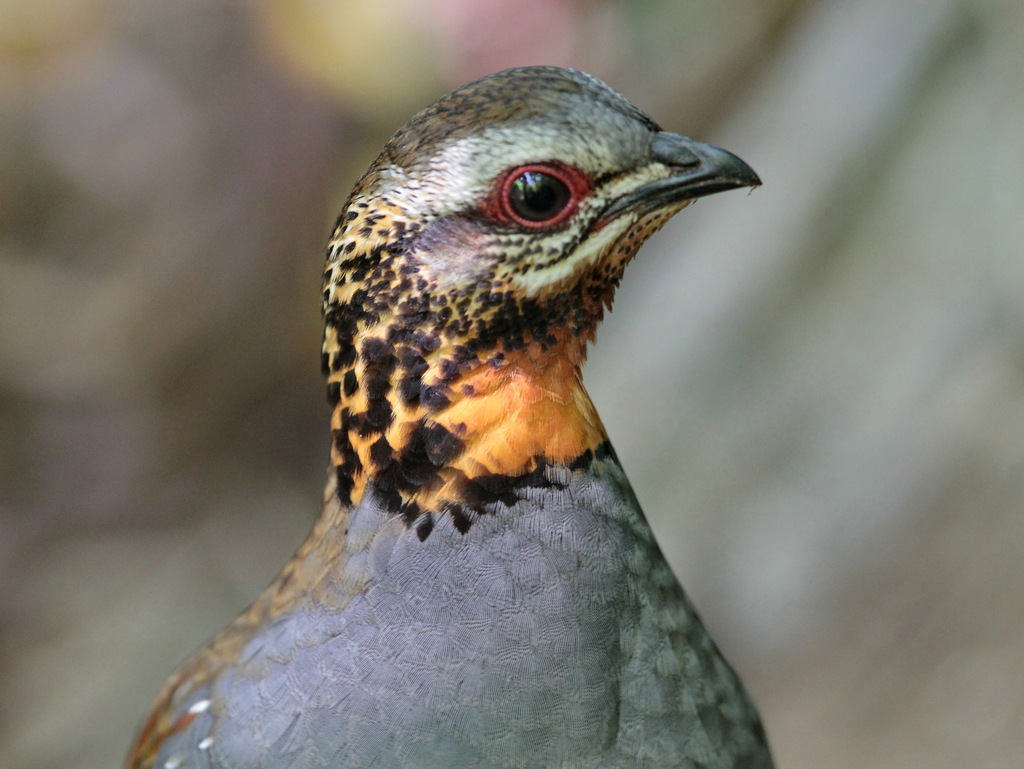
Rufous-throated Partridge
Photo © Ian Dugdale
Photo © Ian Dugdale — CC BY 4.0 — Source: iNaturalist #303354892Identification
The Rufous-throated Partridge is a small galliform measuring 26–29 cm in length, with males weighing 325–430 g and females 261–386 g. Both sexes share distinctive plumage featuring a grey forehead, olive-brown crown and nape with black mottling, and conspicuous whitish supercilia and moustachial curves. The most striking feature is the orange-rufous throat and neck-sides, finely speckled with black. The breast and flanks are blue-grey, while the belly transitions from blue-grey to whitish in the centre, with a buffy-brown vent. The mantle, back and rump are olive-brown with banded scapulars and wing coverts showing chestnut, black and greyish patterns. The beak is dusky-brown to blackish, and the legs are pinkish or crimson. Females are similar to males, though juveniles appear duller below with brown and black vermiculations on the crown and flanks.
Range & Habitat
This species occurs across a broad swath of montane Asia, found in Bangladesh, Bhutan, China, India, Laos, Myanmar, Nepal, Thailand, and Vietnam. It inhabits montane forests primarily between 1,800 and 3,000 metres elevation. The bird shows a particular preference for oak forests containing laurels and rhododendrons, making it a characteristic inhabitant of the eastern Himalayan and Southeast Asian highlands. Six recognized subspecies occupy different portions of this range, from northeastern India and the Himalayan region eastward through Myanmar and Thailand to Vietnam.
Behaviour & Diet
The Rufous-throated Partridge is a social bird, typically foraging in small groups of five to ten individuals. It feeds on seeds, plant shoots, berries, insects and snails, gleaning these foods from the forest floor and undergrowth. When disturbed, birds either run or fly, occasionally perching on branches in a behaviour reminiscent of thrushes. At roost, coveys huddle together in trees, similar to the habits of babblers, providing communal warmth and protection.
Breeding extends from April to July in India and February to May in China. Males construct simple scrapes in bamboo, forest undergrowth, or along water courses, which are lined with grass. Clutches comprise three to five white eggs. Vocally, the species produces a distinctive rising series of hu-hu whistles, with paired birds engaging in duets where the partner responds with kew-kew-kew calls.
Best Time & Places to See It
The Rufous-throated Partridge is best encountered during the breeding season (April–July in India, February–May in China) when birds are more vocal and active. Target montane oak and rhododendron forests between 1,800 and 3,000 metres elevation across the eastern Himalayas and Southeast Asian highlands. Early morning visits to forest edges and open understory areas offer the best opportunities, as birds feed during these hours. The species is found across multiple countries, offering birdwatchers flexibility in planning visits to suitable elevations and forest types throughout its considerable range.
Photography Tips
Photographing this partridge presents both challenges and rewards. The species' small size and preference for dense forest undergrowth demand patience and careful stalking. Focus on capturing the distinctive orange-rufous throat and neck-sides that distinguish it from related species. Early morning light filtering through the canopy can illuminate the subtle blue-grey breast colouration beautifully. Since birds sometimes perch on branches when flushed, position yourself where you can exploit this behaviour. Working quietly along forest trails and listening for their distinctive hu-hu whistles will help locate birds before attempting photography. Wide-angle lenses may be necessary given the dense vegetation typical of their montane forest habitat.
Khangchendzonga National Park
Sakkyong, India
+290 birds+1 mammals
Where the eastern Himalayas surge toward their crowning peaks, Khangchendzonga National Park embraces a landscape of almost overwhelming vertical drama. Rising from subtropical river valleys into…
VIEW NATIONAL PARKGaoligong Mountain National Nature Reserve
Nujiang Lisu Autonomous Prefecture, China
+443 birds+13 mammals
VIEW NATURE RESERVENo community photos yet. Log in to add the first one.
No community observations of this species yet.