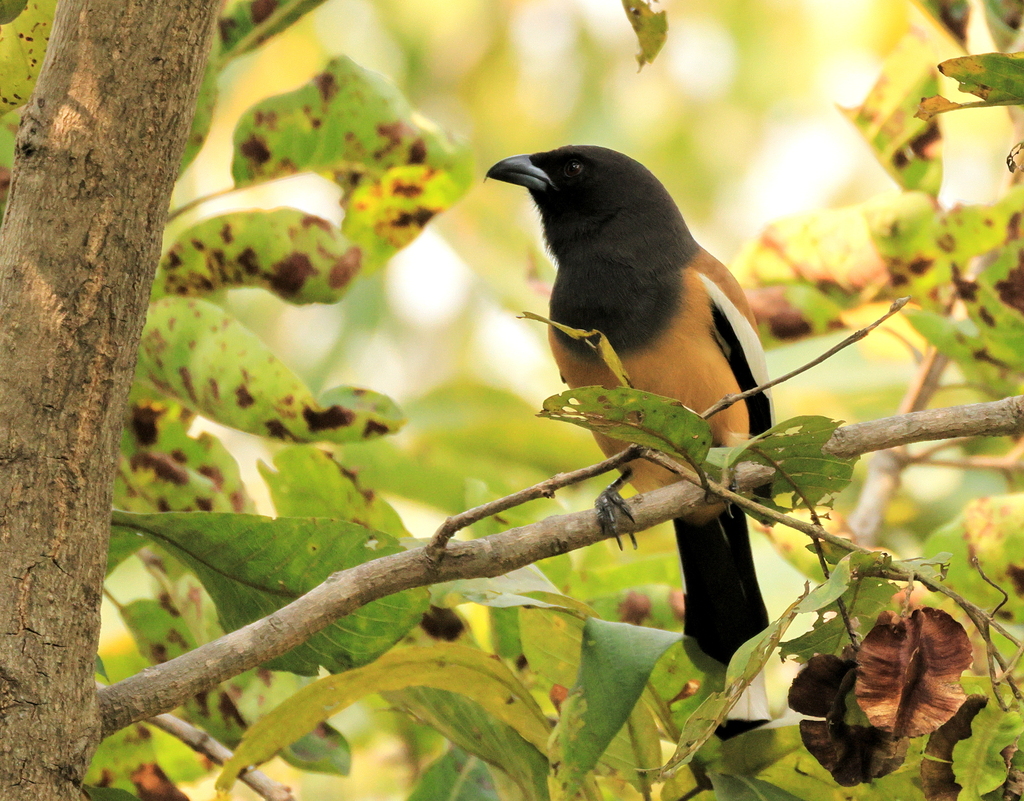
Rufous Treepie
Photo © Darren Obbard
Photo © Darren Obbard — CC BY 4.0 — Source: iNaturalist photo #624497052Identification
The rufous treepie is a distinctive and unmistakable member of the crow family. Its most striking feature is the contrast between its cinnamon-rufous body and jet-black head, combined with a long, bluish-grey tail tipped in black. The wings display a prominent white patch on the coverts, while the primaries remain black. The underparts and lower back are warm tawny to orange-brown in colour. The bird has a stout, hooked bill and black legs and feet. The sexes are alike in plumage, making identification straightforward even for novice birdwatchers.
Geographic variation across its range has led to the recognition of several subspecies, with plumage tones varying from paler desert forms to brighter populations in the Eastern Ghats and smaller birds in the Western Ghats. The most reliable confusion risk is with the grey treepie, which lacks the bright rufous mantle that defines this species.
Range & Habitat
The rufous treepie has a large and widespread range across the Indian subcontinent and adjoining Southeast Asia, including Pakistan, India, Bangladesh, Myanmar, Laos, and Thailand. This adaptable bird is remarkably versatile in its habitat preferences, occurring commonly in open scrub, agricultural areas, deciduous forests, and urban gardens. In mountainous regions such as the Garhwal Himalayas, populations undertake seasonal elevational migrations in response to changing conditions.
Behaviour & Diet
The rufous treepie is highly conspicuous thanks to its loud, musical calls. Its most characteristic vocalisation is a distinctive "bob-o-link" or "ko-tree" call, which has inspired several local names including "kotri," "Handi Chancha," and "taka chor" (meaning "coin thief"). The bird possesses a diverse repertoire of calls that facilitate social communication across open habitats.
Like other corvids, this species is an adaptable omnivore with opportunistic feeding habits. It forages agilely through branches for invertebrates, small reptiles, bird eggs and nestlings, seeds, and fruits—notably including toxic fruits that mammals avoid. It feeds on nectar from Bombax ceiba flowers and forages for palm weevil grubs, making it beneficial to agricultural interests. Rufous treepies often join mixed-species feeding flocks with drongos and babblers, and they engage in a remarkable cleaning symbiosis with sambar deer, picking ectoparasites from the animals' coats. Like all corvids, they cache food for later consumption.
Best Time & Places to See It
The rufous treepie is a year-round resident across most of its range, though elevational migrants in the Himalayas move seasonally. The breeding season runs from April to June across India, with activity peaking in April and May in Bengal. During breeding season, birds are particularly vocal and active as they build shallow nests in trees and bushes. Your best opportunities come in open scrub, agricultural gardens, and parkland habitats from Pakistan and the Indian subcontinent through to Thailand and Laos.
Photography Tips
The rufous treepie's conspicuous nature and loud vocalizations make it relatively approachable for photographers. The striking contrast between the black head and rufous body provides excellent compositional opportunities. Look for birds perched openly in scrub or gardens, or watch for movement in the canopy where they forage acrobatically through branches. Early morning during the breeding season is ideal, when territorial calling makes birds easier to locate. Position yourself to capture both the distinctive white wing patch and the long, graduated tail in profile.
Langtang National Park
Helambu, Nepal
+364 birds+14 mammals
Where the southern slopes of the Himalayan highlands descend toward the subtropical valleys of central Nepal, Langtang National Park sprawls across one of the subcontinent's most…
VIEW NATIONAL PARKOrang National Park
Rangagarapathar, India
+298 birds+1 mammals
Where the Brahmaputra's floodplains meet the foothills of Assam, Orang National Park unfolds across a mosaic of riverine grasslands, forests and wetlands that pulse with the…
VIEW NATIONAL PARKRanthambhore National Park
Sawai Madhopur, India
+294 birds+20 mammals
Granite ridges and ravines carved through the Aravalli Range frame this protected landscape in eastern Rajasthan, where deciduous forest mingles with open scrubland and seasonal water…
VIEW NATIONAL PARKEravikulam National Park
Devikulam, India
+192 birds+7 mammals
High in the Western Ghats of Kerala, where monsoon mists cling to slopes that rise above 2,000 metres, Eravikulam National Park preserves one of South India's…
VIEW NATIONAL PARKKhao Yai National Park
Prachantakham District, Thailand
+377 birds+46 mammals
Evergreen dipterocarp forest blankets the rolling terrain of this national park in eastern Thailand, where limestone hills rise abruptly from the forest floor and seasonal streams…
VIEW NATIONAL PARKKhao Laem National Park
Sangkhla Buri District, Thailand
+197 birds
Where the Vajiralongkorn Reservoir sprawls across the forested valleys of Kanchanaburi's northern borderlands, Khao Laem National Park protects a landscape where limestone ridges rise dramatically from…
VIEW NATIONAL PARKKanha Tiger Reserve
Kanha Kisli F.V., India
+321 birds+23 mammals
Where sal forests give way to emerald meadows and crystalline streams carve through ancient valleys, one of India's finest wilderness reserves unfolds across the Maikal Range.…
VIEW NATIONAL PARKTadoba National Park
Palasgaon Singru, India
+270 birds+20 mammals
Where sal forests meet open grasslands and rocky outcrops rise from red laterite soil, central India's landscape unfolds in raw, untamed beauty. Ancient teak woodlands and…
VIEW NATIONAL PARKBandhavgarh National Park
Garhpuri, India
+285 birds+17 mammals
Where granite ridges rise dramatically above sal and bamboo forests, one of India's most pristine tiger reserves unfolds across the Vindhyan plateau. Ancient rock formations tower…
VIEW NATIONAL PARKPanna National Park
Badgadi Kalan, India
+271 birds+17 mammals
Where granite gorges slice through central India's Vindhyan plateau, a landscape of stark beauty unfolds across nearly six hundred square kilometers. The Ken River carves through…
VIEW NATIONAL PARKKaziranga National Park
Kohora, India
+422 birds+26 mammals
Dawn breaks over the floodplains of the Brahmaputra, where tall grasslands stretch endlessly beneath monsoon-heavy skies. This sprawling wilderness of northeastern Assam is a mosaic of…
VIEW NATIONAL PARKKeoladeo National Park
Shreenagar Rural, India
+326 birds+14 mammals
Where shallow wetlands shimmer beneath vast Rajasthani skies, one of Asia's finest bird sanctuaries pulses with extraordinary life. This former maharaja's hunting reserve, now spanning 29…
VIEW NATIONAL PARKPeriyar National Park
Mlappara, India
+232 birds+4 mammals
Dawn breaks over mist-shrouded ridges where the Western Ghats tumble toward Kerala's spice-scented lowlands. Here, ancient tropical forests envelope a glittering artificial lake, creating a mosaic…
VIEW NATIONAL PARKPampadum Shola National Park
Vattavada, India
+258 birds+14 mammals
Where misty shola forests cling to the high plateaus of the Nilgiri Mountains, ancient evergreen remnants create a world apart. This 2,316-hectare reserve protects one of…
VIEW NATIONAL PARKBandipur National Park
Hirehalli, India
+302 birds+19 mammals
Where the Western Ghats descend into the Deccan plateau, ancient deciduous forests blanket a landscape carved by the Nugu River. Bandipur unfolds across 880 square kilometres…
VIEW NATIONAL PARKNagarahole Tiger Reserve
Nalkeri Forest, India
+323 birds+23 mammals
Where granite escarpments rise above dense deciduous forests and the Kabini River carves through pristine wilderness, one of India's most biodiverse landscapes unfolds across the Western…
VIEW NATIONAL PARKGir National Park
Asundrali, India
+258 birds+13 mammals
Dry deciduous forests cloak the rolling hills of western Gujarat where the Gir landscape rises as a final sanctuary for one of the world's rarest felids:…
VIEW NATIONAL PARKNo community photos yet. Log in to add the first one.
No community observations of this species yet.