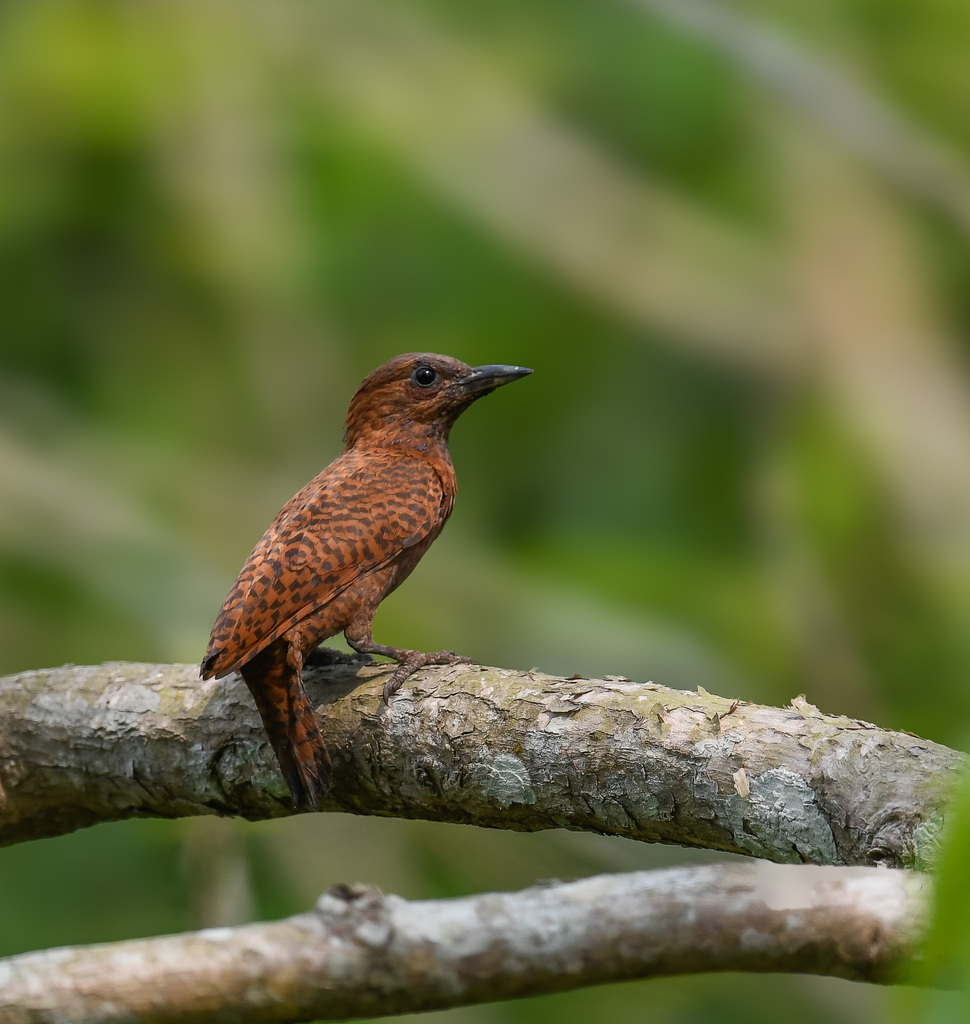
Rufous Woodpecker
Photo © Rejoice Gassah
Photo © Rejoice Gassah — CC BY 4.0 — Source: iNaturalist photo #547315802Identification
The Rufous Woodpecker is a medium-sized woodpecker, approximately 25 cm long, with distinctive dark brown plumage marked by black barring on the wings and tail. The head appears noticeably paler than the body, while the underparts are darker. A key field mark is the short, slightly curved black bill—narrower at the nostrils—and a short rufous tail with narrow black bars (though some subspecies show the reverse pattern). Males display red-tipped feathers under the eyes and on the malar region, while females and juveniles lack these red markings. A weak but erectile crest is present on all birds. In the field, individuals often appear soiled and may smell distinctly of ant secretions, a telltale sign of their specialized foraging habits.
Range & Habitat
The Rufous Woodpecker is native to South and Southeast Asia, with a distribution spanning from the western Himalayas through peninsular India, Sri Lanka, and across Southeast Asia to Java and Borneo. Approximately ten recognized subspecies occur throughout this range, each showing subtle plumage and size variations. The species inhabits scrub, evergreen, and deciduous forests across plains and lower hills, typically below 3000 m elevation. Remarkably adaptable, these woodpeckers persist even in modified landscapes, including areas where natural swamp forests have been converted to oil palm plantations.
Behaviour & Diet
Rufous Woodpeckers forage in pairs, specializing in small insects—particularly ants and termites—gleaned from tree nests, fallen logs, dung heaps, and ant hills. They feed on ants of the genera Crematogaster and Oecophylla, and have been observed taking nectar from Bombax and Erythrina flowers, as well as sap from banana fronds. Most remarkable is their unique nesting behaviour: they excavate nest cavities within the carton nests of acrobat ants (Crematogaster), with both sexes participating in excavation. Two white, thin-shelled eggs are laid during the pre-Monsoon dry season (February to June), with an incubation period of 12–14 days. Both parents feed the young. Vocally, they produce a distinctive sharp nasal three-note call (keenk-keenk-keenk), a long wicka, and a characteristic drumming pattern that begins rapidly then slows in tempo, particularly frequent from March to April.
Best Time & Places to See It
Drumming activity peaks during the pre-breeding season, particularly March to April in Nepal and around winter in southern India, making these periods ideal for locating birds by sound. The breeding season (February to June) offers opportunities to observe nesting behaviour and both adults caring for young. Their adaptability means they can be found in various forest types across their range, though pair-based foraging makes them relatively predictable when searching ant-laden trees and logs. Early morning often yields better sightings, as this is when foraging activity is most active.
Photography Tips
The Rufous Woodpecker's small size and pair-based foraging behaviour reward patience and strategic positioning near known ant nests and dead wood. The short bill and overall dark coloration require careful exposure metering to retain detail in shadows. Males are particularly photogenic when displaying their red head markings in good light. Capture drumming sequences with fast shutter speeds (at least 1/1000 sec), and look for behavioural moments such as the distinctive head-swaying display between paired birds. The bird's characteristic odour and the visible coating of ant secretions on feathers can actually enhance field identification in photographs—these details are worth documenting as they confirm the species' remarkable ecology.
Kanha Tiger Reserve
Minneriya National Park
Bako National Park
Bandhavgarh National Park
Bandipur National Park
Banke National Park
Bardiya National Park
Chitwan National Park
Doi Inthanon National Park
Nothing matches these filters.
No community photos yet. Log in to add the first one.
No community observations of this species yet.