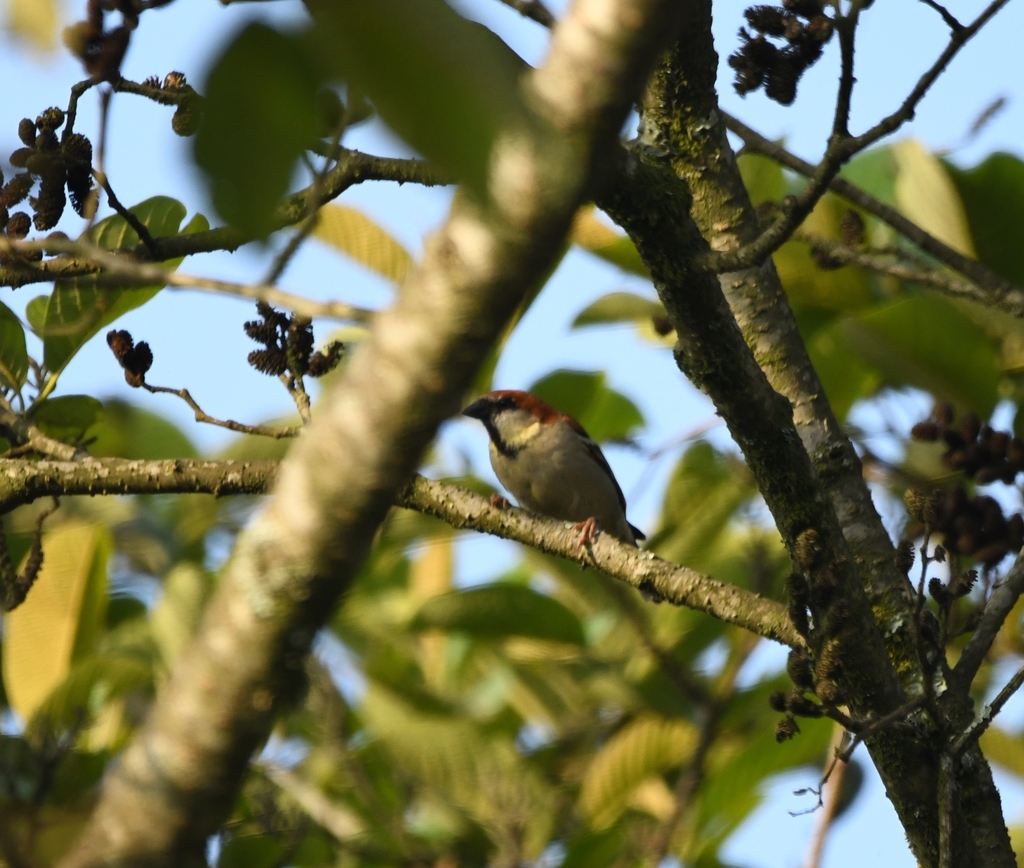
Russet Sparrow
Photo © Surabhi Srivastava
Photo © Surabhi Srivastava — CC BY 4.0 — Source: iNaturalist #120662575Identification
The russet sparrow is a compact, chunky bird measuring 14 to 15 cm in length, with the thick, powerful bill typical of seed-eating sparrows. Its most distinctive feature is its warm rufous plumage overall, with grey underparts. Sexual dimorphism is evident, with plumage patterns in both males and females resembling those of their counterparts in the house sparrow. The breeding male has a black bill, while non-breeding males show a horn-coloured bill, and females display a yellowish bill with a dark tip. The bird's chestnut-coloured iris adds character to its warm-toned face.
Three subspecies are widely recognized, differing chiefly in the intensity of yellow on their underparts. The subspecies cinnamomeus, found in the Himalayas, tends to be larger than rutilans (from Japan, Korea, Taiwan, and China) and intensior (from southwest China and parts of India, Burma, Laos, and Vietnam), with a noticeable size gradient from west to east within the Himalayan population.
Range & Habitat
The russet sparrow is distributed across eastern Asia, with three recognized subspecies occupying distinct ranges. The nominate subspecies cinnamomeus breeds from northern Arunachal Pradesh through the northwestern Himalayas to Nuristan in Afghanistan. Subspecies rutilans inhabits Japan, Korea, Taiwan, and central and southeastern China, while intensior ranges across southwest China, parts of India, Burma, Laos, and Vietnam. In the southern portions of its range, the russet sparrow prefers higher altitudes, whereas in the north it breeds by the sea.
This species is notably the typical sparrow of human habitations in towns where house sparrows and tree sparrows are absent. In the Himalayas, it is usually associated with terrace cultivation and light woodland. Its cultural significance is considerable—the bird is known well enough in the Himalayas to have received distinct names in some languages and has even been depicted in Japanese art.
Behaviour & Diet
The russet sparrow feeds primarily on the seeds of herbs and grains, supplemented by berries and insects, particularly during the breeding season. This diet makes it a minor agricultural pest in some areas, though it also serves as a predator of insect pests. During the non-breeding season, the bird forms flocks, though it infrequently associates with other bird species. In parts of its range, populations migrate, at least to lower altitudes during harsh seasons.
Breeding birds are not notably social, as their nests are dispersed rather than colonial. The male selects the nest site—typically a tree cavity or a hole in a cliff or building—before attracting a mate and uses it for courtship display. The typical clutch contains five or six whitish eggs, with both sexes sharing incubation and chick-feeding duties. Outside the breeding season, the russet sparrow is vocal, producing sweet and musical chirps that form a pleasing song when strung together.
Best Time & Places to See It
The russet sparrow is best observed in its core Himalayan range, particularly in areas of terrace cultivation and light woodland where it is a familiar resident. In the Himalayas, the species is present year-round, though some populations exhibit altitudinal migration. For those visiting eastern Asian regions, the subspecies rutilans can be found in Japan and China, while intensior populations inhabit southwestern China and parts of Southeast Asia.
The species is most active and vocal during the breeding season, when males are particularly engaged in courtship displays. Towns and villages where house sparrows and tree sparrows are rare or absent are reliable locations for encountering this charming species, making it accessible to travellers exploring human-inhabited areas throughout its range.
Photography Tips
The russet sparrow's warm rufous and grey plumage photographs beautifully in soft morning or late afternoon light, which enhances the rich tones of its upperparts. The bird's small size and tendency to frequent trees and built structures means a longer lens (300mm or more) is advisable for detailed shots. Look for perching birds in light woodland and around cultivated terraces, where they offer relatively accessible photo opportunities.
The striking bill coloration varies by sex and breeding status, making it a worthwhile detail to capture for field documentation. During the breeding season, watch for males at their nest sites, where they perform courtship displays—these behavioural moments provide engaging compositional opportunities. Early morning visits to favourite feeding and roosting areas offer the best light and activity for productive photography sessions.
Langtang National Park
Helambu, Nepal
+364 birds+14 mammals
Where the southern slopes of the Himalayan highlands descend toward the subtropical valleys of central Nepal, Langtang National Park sprawls across one of the subcontinent's most…
VIEW NATIONAL PARKGangotri National Park
Bhatwari, India
+119 birds+1 mammals
Where the Bhagirathi River carves through the western Himalayas in northern Uttarakhand, Gangotri National Park rises across steep alpine terrain that defines the boundary between temperate…
VIEW NATIONAL PARKSagarmatha National Park
Khumjung, Nepal
+219 birds+7 mammals
Soaring peaks and deep glacial valleys define this alpine wilderness in northeastern Nepal, where the terrain rises from forested foothills into a realm of high-altitude tundra…
VIEW NATIONAL PARKKhangchendzonga National Park
Sakkyong, India
+290 birds+1 mammals
Where the eastern Himalayas surge toward their crowning peaks, Khangchendzonga National Park embraces a landscape of almost overwhelming vertical drama. Rising from subtropical river valleys into…
VIEW NATIONAL PARKWulingyuan
Jundiping, China
+97 birds+3 mammals
Sandstone peaks erupting from forested valleys define this sprawling 993-square-kilometre national park in Hunan Province, where vertical cliffs rise dramatically above lush subtropical woodland. The landscape—a…
VIEW NATURAL MONUMENTGiant Panda National Park
Mianyang, China
+447 birds+47 mammals
Where the eastern slopes of China's Sichuan plateau descend into cloud-wrapped valleys, one of Asia's most biodiverse landscapes unfolds across more than 350,000 square kilometres. This…
VIEW NATIONAL PARKMount Nanling Forest Park
Ruyang Forest Farm, China
+179 birds+3 mammals
Granite ridges and weathered peaks rise through a canopy of subtropical montane forest where Ruyang Forest Farm anchors one of southern China's most biodiverse landscapes. Across…
VIEW FOREST & JUNGLEJiuzhai Valley
Jiuzhaigou County, China
+226 birds+7 mammals
Where crystalline alpine streams cascade through limestone gorges and karst terrain rises in dramatic vertical walls, Jiuzhai Valley unfolds across nearly 1,300 square kilometers of southwestern…
VIEW NATURAL MONUMENTHuanglong Scenic and Historic Interest Area
Ngawa Tibetan and Qiang Autonomous Prefecture, China
+194 birds+7 mammals
Across the high plateau of northwestern Sichuan, a geological wonder unfolds where limestone terraces and mineral-rich springs have sculpted one of China's most distinctive natural monuments.…
VIEW NATURAL MONUMENTNanda Devi National Park
Garpak, India
+218 birds+5 mammals
Where the Himalayas surge into their most dramatic alpine amphitheater, a wilderness of raw geological power unfolds across 624 square kilometers of pristine terrain. Nanda Devi,…
VIEW NATIONAL PARKValley of Flowers National Park
Ghangaria, India
+117 birds+1 mammals
Where alpine meadows explode with color each monsoon season, the Himalayan slopes of Uttarakhand rise to create one of Earth's most extraordinary floral displays. Perched between…
VIEW NATIONAL PARKWolong National Nature Reserve
Wenchuan County, China
+333 birds+17 mammals
Where the Qingyi River cuts through the eastern flanks of the Minshan Range, a temperate montane forest cloaks steep valleys in dense canopy that thins dramatically…
VIEW NATURE RESERVEPoyang Lake National Nature Reserve
Shangrao, China
+270 birds+7 mammals
Where the Yangtze River's massive floodplain spreads across central China, Poyang Lake National Nature Reserve encompasses one of the continent's most dynamic and water-rich wetland systems.…
VIEW NATURE RESERVECaohai National Nature Reserve
Bijie, China
+93 birds
At roughly 1,900 metres elevation on Guizhou's high plateau, Caohai sprawls across a temperate landscape shaped by pronounced seasonal extremes. Winters here are dry and cool,…
VIEW NATURE RESERVEQinghai Lake National Nature Reserve
Hainan Tibetan Autonomous Prefecture, China
+243 birds+11 mammals
At 3,200 metres above sea level on the Tibetan plateau, where winter temperatures plunge far below freezing and snow blankets the landscape for half the year,…
VIEW NATURE RESERVEGaoligong Mountain National Nature Reserve
Nujiang Lisu Autonomous Prefecture, China
+443 birds+13 mammals
VIEW NATURE RESERVEBaima Snow Mountain National Nature Reserve
Diqing Tibetan Autonomous Prefecture, China
+204 birds+3 mammals
High-altitude ridges and steep-sided valleys define this reserve in northwestern Yunnan, where elevations surge from around 3,000 metres to peaks above 4,100 metres. The terrain supports…
VIEW NATURE RESERVENo community photos yet. Log in to add the first one.
No community observations of this species yet.