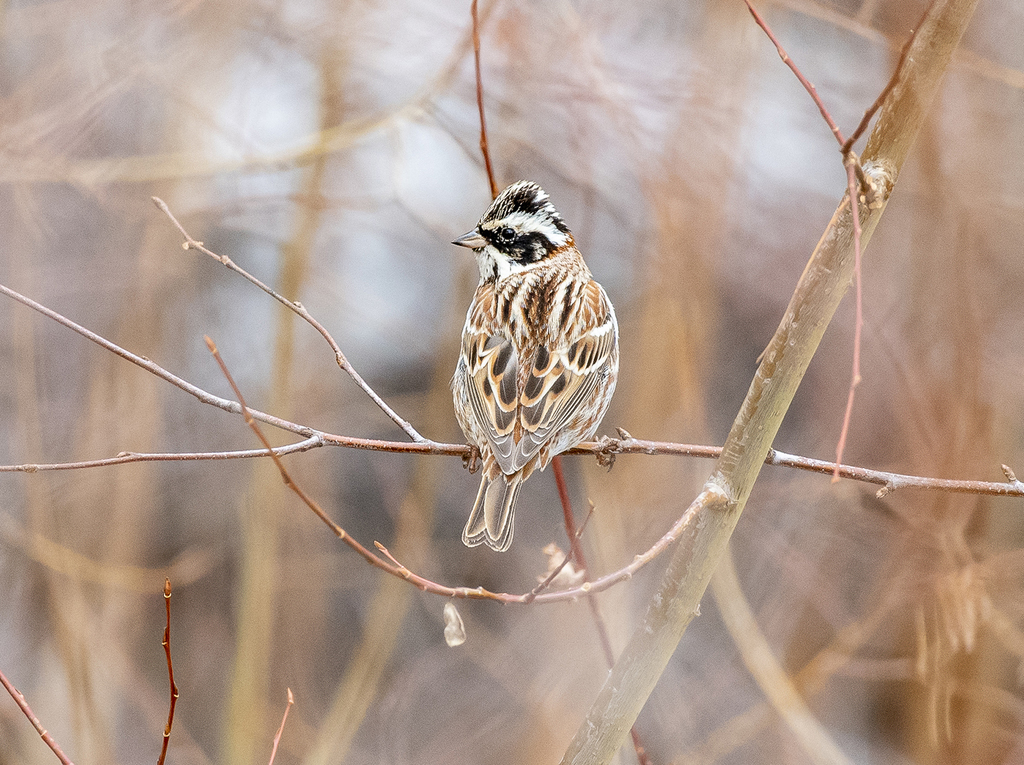
Rustic Bunting
Photo © Griha Hasanov
Photo © Griha Hasanov — CC BY 4.0 — Source: iNaturalist photo #118923392Identification
The rustic bunting is a small passerine comparable in size to a reed bunting. Males in breeding plumage are distinctive: a black head with a bold white throat and supercilium contrasts sharply with a reddish breast band. Both sexes display white underparts with characteristic reddish flank streaks, pink legs, and a pink lower mandible—useful field marks that separate them from related species.
Females are more subdued, with a heavily streaked brown back and brown face marked by a whitish supercilium. They closely resemble female reed buntings but are distinguished by their reddish flank streaks, chestnut nape, and notably pink (rather than grey) lower mandible.
Range & Habitat
The rustic bunting breeds across the northern Palearctic in wet coniferous woodland, with two recognized subspecies: E. r. rustica occupies the taiga from Scandinavia to Siberia, while E. r. latifascia is found in far eastern Siberia from Yakutsk to Kamchatka. This is a migratory species that winters in south-east Asia, Japan, Korea, and eastern China, though individuals occasionally wander to western Europe as rare vagrants.
Behaviour & Diet
Rustic buntings breed in wet coniferous woodlands, where females construct nests in bushes or on the ground. Clutches typically contain four to six eggs. The species is primarily granivorous, feeding on seeds throughout much of the year, but switches to insects when provisioning young during the breeding season—a dietary shift common to many buntings.
Best Time & Places to See It
This species is most reliably encountered in its breeding range during the breeding season and in its south-east Asian, Japanese, Korean, and eastern Chinese wintering grounds during winter months. Breeders should focus on wet coniferous woodlands in the northern Palearctic. Western European observers should remain alert during migration periods, when rare vagrants occasionally appear.
Photography Tips
The striking head pattern of breeding males—black crown, white supercilium, and white throat—provides excellent photographic subjects in good light. Females are more cryptic but can be approached in breeding habitat when they visit the nest. The species' small size and preference for coniferous woodlands mean that patient staking out of known breeding sites or winter flocks offers the best chance for prolonged observation and photography. Look for the diagnostic pink lower mandible and reddish flank streaks as confirming field marks in your images.
Alaska Maritime National Wildlife Refuge
Baikal National Park
Duinen van Texel National Park
Gorkhi-Terelj National Park
Hustai National Park
Land of the Leopard National Park
Lemmenjoki National Park
Los Alcornocales Natural Park
Muddus / Muttos National Park
Nothing matches these filters.
No community photos yet. Log in to add the first one.
No community observations of this species yet.