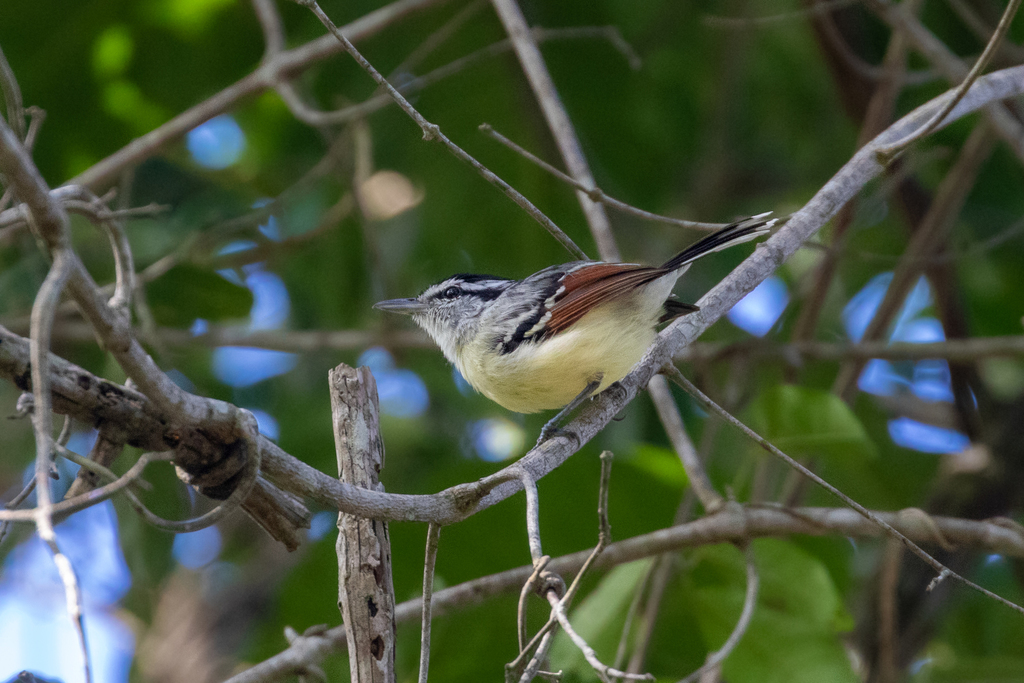
Rusty-winged Antwren
Photo © Thibaud Aronson
Photo © Thibaud Aronson — CC BY-SA 4.0 — Source: iNaturalist photo #113207772Identification
The rusty-winged antwren is a small bird, measuring 10 to 12.5 cm in length and weighing approximately 10 to 12.5 g. Sexual dimorphism is striking. Males of the nominate subspecies display a black crown and nape, a prominent white supercilium, a black eye-stripe, and black-and-white striped ear coverts. Their upperparts are ashy gray with scattered black spots and a distinctive black patch between the scapulars. The wing coverts are black with white tips, while flight feathers are blackish with dark cinnamon-red outer webs. The tail is black with white tips, increasingly white toward the outer feathers. Females are more colorful, with a rich chestnut-rufous crown, buffy-chestnut supercilium, and brownish olive-gray upperparts. Both sexes share a dark gray to brownish iris, black maxilla, light gray mandible with darker tip, and gray to olive-gray legs. Subspecies exiguus is smaller, with males showing nearly pure black upperparts and deep amber flight-feather edges.
Range & Habitat
The rusty-winged antwren occurs across nine countries: Panama, Colombia, Ecuador, Peru, Bolivia, Venezuela, Guyana, Suriname, and Brazil. Its range is disjunct, split between two subspecies. Subspecies exiguus occupies eastern Panama into northwestern Colombia, with an isolated population in western Ecuador. The nominate subspecies frater ranges from Colombia's Eastern Andes through the Amazon basin to northeastern Brazil, with a separate coastal population in Paraíba, Pernambuco, and Alagoas. This species favors the interior and edges of lowland and foothill evergreen forest, including terra firme and gallery forest, typically staying in the mid-storey to subcanopy where dense vine tangles provide shelter. Elevation ranges from below 200 m in western Ecuador to 1,500 m in Brazil, Venezuela, and the Guianas.
Behaviour & Diet
The rusty-winged antwren is a year-round resident throughout its range. It feeds primarily on insects and spiders, foraging singly, in pairs, or in family groups, and frequently joins mixed-species feeding flocks. Feeding occurs between 8 and 30 m above ground, though lower in stunted forest on sandy soil. The bird forages methodically, gleaning prey from leaves, stems, and vines by reaching or lunging from a perch, and occasionally making short sallies to glean from leaf undersides. Its distinctive song is a stuttered series beginning with 8–10 accelerating, melodious overslurred notes that shift into an unmelodious, decelerating raspy rattle of 15–20 notes. Common calls include a descending rattled series of overslurred notes and a short scolding note with tonal variation across its range. Breeding biology remains undocumented.
Best Time & Places to See It
Year-round presence makes the rusty-winged antwren accessible throughout the year across its range. The best approach is to visit humid lowland and foothill forests in active birding regions within Bolivia, Brazil, Colombia, Ecuador, Guyana, Peru, Suriname, or Venezuela. Early morning hours often yield the most activity and auditory detection via its distinctive song. Mixed-species feeding flocks passing through its territory provide excellent opportunities for observation, as the species readily joins these assemblies. In foothill regions of Colombia, Ecuador, and Peru, where elevations favor concentrations of forest-interior species, the antwren is more reliably found than in extensive lowland areas.
Photography Tips
This small, active antwren demands patience and a fast shutter speed due to its quick, methodical movements through dense vine tangles. Position yourself along mixed-species feeding flocks, which provide the most predictable viewing opportunities. Early morning light is ideal for capturing the striking plumage differences between males and females. The species' preference for the mid-storey to subcanopy (8–30 m high) can challenge ground-based photographers; elevated hides or canopy platforms offer significant advantages. Telephoto lenses (500mm or greater) are essential given the bird's small size and distance from typical observation points. Listen for its distinctive stuttering song to locate individuals, then wait quietly for the bird to move into gaps in the vine tangles where clean shots are possible. The male's bold black-and-white markings and the female's warm rufous tones both photograph well in diffuse morning light.
Yasuní National Park
Aguarico, Ecuador
+601 birds+43 mammals
Where the western Amazon basin converges with Ecuador's Orellana Province, lowland rainforest reaches toward the horizon in an unbroken canopy of staggering botanical density. Yasuní National…
VIEW NATIONAL PARKSumaco Napo-Galeras National Park
Loreto, Ecuador
+563 birds+4 mammals
Where Ecuador's Amazon transitions into cloud forest, a massive shield volcano rises from the emerald lowlands of Orellana Province, anchoring one of the continent's most biodiverse…
VIEW NATIONAL PARKMorrocoy National Park
Municipio Silva
+290 birds
Where the Caribbean coast of northwestern Venezuela meets protected coastal waters, a mosaic of mangrove forests, sandy beaches, and coral reef systems defines Morrocoy National Park.…
VIEW NATIONAL PARKNatural Sierra de la Macarena National Park
Vista Hermosa, Colombia
+566 birds+15 mammals
Across nearly 20,000 square kilometres of Colombia's Meta Department, the terrain rises from lowland savanna into Andean foothills through a mosaic of gallery forests, palm-fringed wetlands,…
VIEW NATIONAL PARKViruá National Park
Brazil
+389 birds+6 mammals
Across the northern frontier of Roraima, where the forest canopy rises from ancient Amazonian lowlands, Viruá National Park protects nearly 3,700 square kilometres of terra firme…
VIEW NATIONAL PARKCampos Amazónicos National Park
Amazonas, Brazil
+434 birds+7 mammals
Sprawling across the southwestern Amazon basin in Amazonas state, this 27,263-square-kilometre national park encompasses some of the region's most pristine lowland rainforest, where terra firme forest…
VIEW NATIONAL PARKBahuaja Sonene National Park
San Pedro de Putina Punco, Peru
+602 birds+8 mammals
Where the Madre de Dios and Heath rivers converge in southeastern Peru rises one of South America's most biodiverse wilderness regions: a vast protected realm of…
VIEW NATIONAL PARKCordillera Azul National Park
Pampa Hermosa, Peru
+322 birds+1 mammals
Where the eastern Andes descend into the western Amazon basin, Cordillera Azul National Park sprawls across nearly 38,000 square kilometres of some of Peru's most pristine…
VIEW NATIONAL PARKDarién National Park
Tucutí, Panama
+534 birds+13 mammals
Where the spine of Central America crumbles into wetland and rainforest, Darién National Park sprawls across more than 20,000 square kilometres of some of the tropics'…
VIEW NATIONAL PARKNo community photos yet. Log in to add the first one.
No community observations of this species yet.