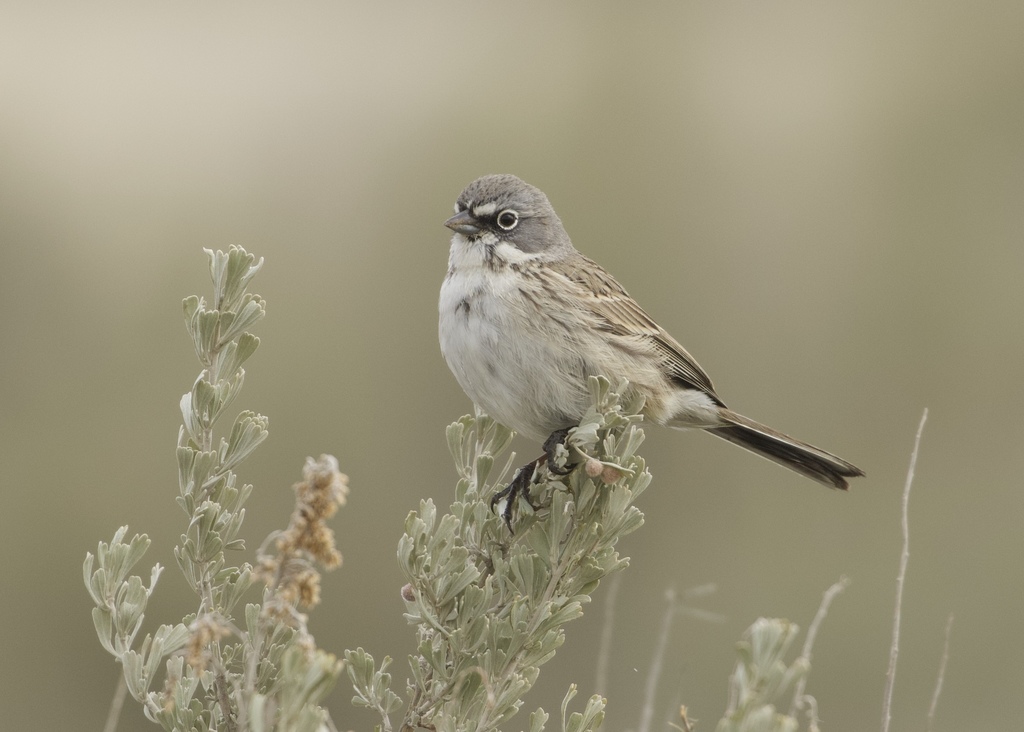
Sagebrush Sparrow
Photo © RJ Baltierra
Photo © RJ Baltierra — CC BY 4.0 — Source: iNaturalist photo #64581189Identification
The Sagebrush Sparrow is a small songbird, measuring 12 to 15 cm in length and weighing 15 to 22 grams, with males slightly larger than females. Both sexes share identical plumage: a pale to medium gray head and nape, dusky gray lores contrasted by a white to buff-white patch above, and a distinctive white eye-ring. A white streak runs below the ear coverts, sometimes accompanied by a thin black stripe. The back and rump display brownish tones with fuscous streaking, while the tail is brownish black with white outer webs on the outermost feathers.
The wings feature grayish-brown lesser coverts and dark brown median and greater coverts with whitish to pale rufous tips forming two visible wing bars when folded. Flight feathers are blackish brown with pale rufous edges. The throat and underparts are mostly white, occasionally with a small black spot on the breast center, and pale buff flanks with brown streaks. Key field marks include the hazel-brown iris, charcoal-gray upper mandible, pale gray-blue lower mandible, and dark grayish-brown legs and feet.
Range & Habitat
The Sagebrush Sparrow has a somewhat disjunct distribution across the mountain western United States extending south into northern Mexico. One population inhabits west-central Washington, while another occurs in northeastern Wyoming. The main contiguous range spans from western Oregon, southeastern and southwestern Idaho, and western and central Wyoming southward through eastern California, Nevada, and western Colorado to Arizona, northwestern and southern New Mexico, and far western Texas. The range continues into Mexico in northeastern Baja California Norte, central and western Sonora, and much of Chihuahua. Vagrant records have been documented along the west coast and further east in Montana, Colorado, Kansas, Oklahoma, and Nebraska, with rare records in Kentucky and Nova Scotia.
In breeding habitat, the species shows a strong association with big sagebrush (Artemisia tridentata), though it is not restricted to pure stands. It occurs in mixed shrubland including bitterbrush, saltbush, greasewood, and other shrubs. During migration and winter, it favors similar sagebrush-dominated habitats but also uses arid grasslands, scrublands with cactus, and areas with yucca or mesquite and inkweed.
Behaviour & Diet
The Sagebrush Sparrow is almost entirely migratory, breeding in the northern portions of its range from east-central California, southern Nevada, northeastern Arizona, and northwestern New Mexico. It vacates these areas after breeding season, except for small year-round populations in western and southeastern Nevada and southwestern Utah, and winters across the southern portions of its range into northern Mexico. During the breeding season, it feeds on adult and larval insects, spiders, seeds, small fruits, and plant parts, switching primarily to seeds during non-breeding months. The species forages mostly on the ground beneath or near shrubs, though it occasionally gleans above ground in vegetation, hopping or walking as it searches for food.
Sagebrush Sparrows typically occur in pairs during breeding season and form small flocks in winter, sometimes joining other sparrow species. Many pairs form during winter rather than on the breeding grounds. Males sing throughout the breeding season, producing a series of short musical buzzes on different frequencies. Breeding occurs between April and August with latitudinal variation, and most pairs raise two broods per season. Females construct open-cup nests from twigs and coarse grass, lined with fine grass, feathers, and hair, typically placed in shrubs but sometimes in bunchgrass or directly on the ground. Clutches average 3.3 eggs (range 1–4), which are pale blue or bluish white with brown to red-brown markings. Incubation lasts 10 to 16 days, with fledging occurring nine to ten days after hatching.
Best Time & Places to See It
The best time to observe Sagebrush Sparrows is during the breeding season from April through August, when males are actively singing and pairs are more conspicuous in their territories. The most reliable locations are the large contiguous breeding ranges in Nevada, eastern California, Oregon, Idaho, Wyoming, Colorado, Arizona, and New Mexico. In winter, search the southern portions of the range extending into Sonora and Chihuahua, Mexico, where the species congregates in small flocks within sagebrush scrubland. Early morning is optimal for locating singing males during breeding season.
Photography Tips
Photograph Sagebrush Sparrows during early morning or late afternoon when light is warm and males are most vocal and active. Position yourself downwind of singing birds to approach closely while remaining undetected. The species' small size and preference for foraging on the ground beneath shrubs requires patience and careful positioning—use low angles to capture the bird against desert sky or backlit sage. Focus on the distinctive white eye-ring, pale head, and wing bars, which are key field marks. Capture birds in flight to highlight the white outer tail feathers. Since they often perch briefly on sagebrush while singing, these moments offer excellent opportunities for sharp, well-framed shots. Winter flocking behavior provides opportunities for photographing multiple individuals, though lighting conditions may be harsher at that season.
Big Bend National Park
Brewster County, United States
+345 birds+34 mammals
Where the Chisos Mountains rise abruptly from the Sonoran Desert floor, Big Bend National Park spans over 7,300 square kilometers of one of North America's most…
VIEW NATIONAL PARKCanyonlands National Park
Wayne County, United States
+186 birds+15 mammals
Where the Colorado River has carved an intricate labyrinth through the high desert plateau of southeastern Utah, Canyonlands National Park sprawls across nearly 3,030 square kilometres…
VIEW NATIONAL PARKSaguaro National Park
Rincon Valley, United States
+354 birds+40 mammals
Where the Sonoran Desert meets sky-island mountains, two geographically separated districts of Saguaro National Park sprawl across nearly two thousand square kilometers of Arizona's most iconic…
VIEW NATIONAL PARKJoshua Tree National Park
Riverside County, United States
+221 birds+23 mammals
Across 5,610 square kilometers of Riverside County's high desert, a landscape of geological drama unfolds where granite monoliths pierce through bajadas of creosote scrub and Joshua…
VIEW NATIONAL PARKGreat Basin National Park
White Pine County, United States
+170 birds+19 mammals
Where the Great Basin's high desert plateaus rise above 10,000 feet, ancient bristlecone pines endure on moonscape ridges of limestone and quartzite, creating one of North…
VIEW NATIONAL PARKCarlsbad Caverns National Park
Eddy County, United States
+309 birds+18 mammals
Beneath the Chihuahuan Desert floor of southern New Mexico lies one of North America's most spectacular subterranean landscapes. Carlsbad Caverns National Park encompasses over 518 square…
VIEW NATIONAL PARKArches National Park
Grand County, United States
+185 birds+20 mammals
Where rust-red sandstone fins rise abruptly from high desert scrubland, Arches National Park spans 548 square kilometers of one of North America's most sculptural landscapes. The…
VIEW NATIONAL PARKZion National Park
Washington County, United States
+244 birds+30 mammals
Towering sandstone cliffs in shades of crimson, rust, and cream rise abruptly from the Virgin River's winding canyon floor, their sculpted faces bearing witness to millions…
VIEW NATIONAL PARKMesa Verde National Park
Montezuma County, United States
+166 birds+10 mammals
Across the high desert plateau of southwestern Colorado, where sandstone mesas rise abruptly from piñon-juniper scrubland, Mesa Verde National Park preserves one of North America's most…
VIEW NATIONAL PARKGreat Sand Dunes National Park
Saguache County, United States
+193 birds+14 mammals
Where the Colorado high plains collide with one of North America's most extraordinary geological anomalies, nearly 600 square kilometres of windswept sand rise abruptly from the…
VIEW NATIONAL PARKCapitol Reef National Park
Garfield County, United States
+196 birds+22 mammals
Wrinkled ridges of crimson and gold sandstone rise from the floor of south-central Utah, their weathered faces carved by the Fremont River into one of the…
VIEW NATIONAL PARKGrand Teton National Park
Teton County, United States
+247 birds+38 mammals
Where the Teton Range tears skyward in a dramatic escarpment above the Snake River valley, nearly 2,550 square kilometers of montane wilderness unfolds across Teton County,…
VIEW NATIONAL PARKYellowstone National Park
Park County, United States
+253 birds+43 mammals
Across nearly 11,400 square kilometres of the Rocky Mountain plateau, geothermal fury and pristine wilderness converge in one of Earth's most dynamic landscapes. Hot springs, geysers…
VIEW NATIONAL PARKBlack Canyon of the Gunnison National Park
Montrose County, United States
+169 birds+13 mammals
Where the Gunnison River has carved one of North America's steepest and most dramatic canyons, ancient metamorphic rock walls plunge nearly 2,000 feet in places, creating…
VIEW NATIONAL PARKRocky Mountain National Park
Larimer County, United States
+259 birds+33 mammals
Where granite peaks rise above 12,000 feet and alpine tundra gives way to subalpine forest, Rocky Mountain National Park spans the Continental Divide across nearly 1,600…
VIEW NATIONAL PARKDeath Valley National Park
Inyo County, United States
+339 birds+25 mammals
Across nearly 3.5 million acres of southeastern California's Inyo County, vast salt flats meet sculpted badlands and alluvial fans in a landscape so extreme it defines…
VIEW NATIONAL PARKBryce Canyon National Park
Tropic, United States
+202 birds+20 mammals
Hoodoos rise like a forest of stone pillars from an amphitheater carved into Utah's high plateau, where the Paunsaugunt elevates the landscape to over 9,000 feet…
VIEW NATIONAL PARKGrand Canyon National Park
United States
+277 birds+35 mammals
A mile-deep chasm of rust-red rock and purple shadow cuts through the high desert plateau of northern Arizona, revealing nearly two billion years of geological history…
VIEW NATIONAL PARKGuadalupe Mountains National Park
Culberson County, United States
+262 birds+14 mammals
Where fossil-laden limestone ridges thrust skyward above the Chihuahuan Desert floor, Guadalupe Mountains National Park reveals a landscape sculpted by ancient seas and relentless aridity. These…
VIEW NATIONAL PARKPetrified Forest National Park
Apache County, United States
+206 birds+23 mammals
Across the high desert plateau of northeastern Arizona, where the climate swings between scorching summer days and frost-laden winters, badlands of raw earth and timber-turned-to-stone dominate…
VIEW NATIONAL PARKWhite Sands National Park
Otero County, United States
+178 birds+6 mammals
Across the Tularosa Basin in south-central New Mexico sprawls an otherworldly landscape of gypsum dunes—the largest gypsum field on Earth and a stark desert playground shaped…
VIEW NATIONAL PARKBosque del Apache National Wildlife Refuge
Socorro County, United States
+345 birds+17 mammals
Where the Rio Grande emerges from its desert canyon in central New Mexico, a narrow ribbon of riparian woodland defies the arid landscape that surrounds it.…
VIEW WILDLIFE SANCTUARYCabeza Prieta National Wildlife Refuge
United States
+155 birds+6 mammals
Across southwestern Arizona's harshest terrain, where the Colorado River marks the border with Mexico, lies a sanctuary shaped entirely by heat and aridity. Cabeza Prieta National…
VIEW WILDLIFE SANCTUARYKofa National Wildlife Refuge
Yuma County, United States
+142 birds+10 mammals
Desert mountains rise in sculptured ridges across northwestern Arizona, where the Colorado River's distant influence fades into some of the most austere terrain in the American…
VIEW WILDLIFE SANCTUARYHavasu National Wildlife Refuge
Lake Havasu City, United States
+291 birds+8 mammals
Where the Colorado River widens into a vast reservoir in the Sonoran Desert, Havasu National Wildlife Sanctuary protects one of the most critical wetland ecosystems in…
VIEW WILDLIFE SANCTUARYImperial National Wildlife Refuge
La Paz County, United States
+222 birds+4 mammals
Where the Colorado River carves through the Sonoran Desert in southwestern Arizona, Imperial National Wildlife Sanctuary unfolds across a landscape shaped by water and aridity. The…
VIEW WILDLIFE SANCTUARYMalheur National Wildlife Refuge
Harney County, United States
+309 birds+24 mammals
Across the high desert plateau of southeastern Oregon, where sagebrush scrubland stretches toward distant ridgelines under an enormous sky, lies a sanctuary shaped by water in…
VIEW WILDLIFE SANCTUARYKlamath Marsh National Wildlife Refuge
Klamath County, United States
+219 birds+7 mammals
Where the volcanic plateau of south-central Oregon slopes into a broad, shallow basin lies one of the Pacific Northwest's most underappreciated wetland sanctuaries. Klamath Marsh National…
VIEW WILDLIFE SANCTUARYTule Lake National Wildlife Refuge
Siskiyou County, United States
+255 birds+9 mammals
Across the high volcanic plateau of northeastern California, where summer heat scorches the alkali flats and winter winds sweep unobstructed through open water and marsh, Tule…
VIEW WILDLIFE SANCTUARYBear River Migratory Bird Refuge
Box Elder County, United States
+254 birds+9 mammals
Where the Bear River winds through the semi-arid basin country of northwestern Utah, a sprawling wildlife sanctuary transforms the high desert into a haven for migratory…
VIEW WILDLIFE SANCTUARYSeedskadee National Wildlife Refuge
Sweetwater County, United States
+209 birds+8 mammals
Where the Green River carves through the high-desert basin of southwestern Wyoming, Seedskadee National Wildlife Sanctuary preserves one of the West's most vital riparian corridors. The…
VIEW WILDLIFE SANCTUARYNational Elk Refuge
Jackson, United States
+230 birds+27 mammals
Where the sagebrush flats of northwestern Wyoming rise toward the Gros Ventre Mountains, winter transforms the landscape into a realm of survival and spectacle. The National…
VIEW WILDLIFE SANCTUARYRed Rock Lakes National Wildlife Refuge
Beaverhead County, United States
+216 birds+10 mammals
Where the Greater Yellowstone ecosystem's northern reaches meet the high plateaus of southwestern Montana, a network of glacial lakes and wetlands sustains one of the continent's…
VIEW WILDLIFE SANCTUARYBitter Lake National Wildlife Refuge
Chaves County, United States
+284 birds+10 mammals
Across the high desert floor of southeastern New Mexico, where elevation and aridity shape every living thing, shallow alkaline lakes and marshes form an unexpected oasis…
VIEW WILDLIFE SANCTUARYNo community photos yet. Log in to add the first one.
No community observations of this species yet.