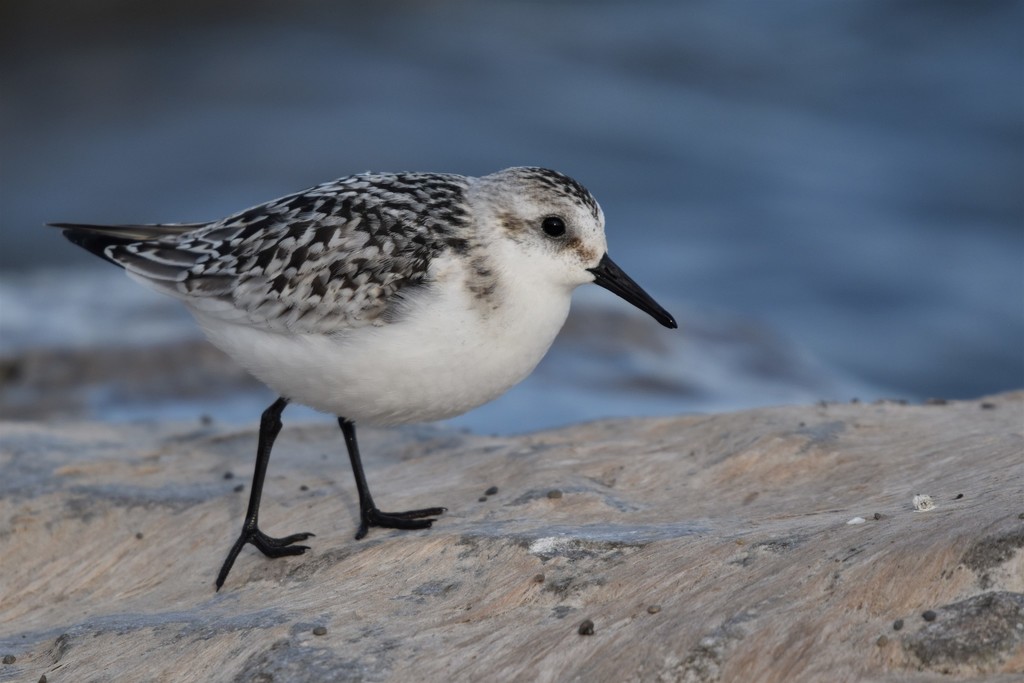
Sanderling
Photo © Braden J. Judson
Photo © Braden J. Judson — CC0 1.0 — Source: iNaturalist photo #97401552Identification
The sanderling is a small, plump sandpiper measuring 18–20 cm in length, weighing between 40–100 g. In winter plumage, it appears strikingly pale and almost white, marked only by a dark shoulder patch—a feature reflected in its scientific name, alba, Latin for "white." As spring approaches, breeding birds develop a distinctive brick-red face and throat. Juveniles are more boldly patterned, spangled in black and white with considerably more contrast than adults.
The sanderling is stouter than many other small sandpipers and possesses a thick bill. A reliable identification feature is its lack of a hind toe, unique among its relatives. In flight, it displays a strong white wingbar. Its behaviour is equally distinctive: the bird runs along sandy beaches with a characteristic "bicycling" action of its legs, frequently stopping to pick at small food items. With good views, these features should prevent confusion with dunlins, red knots, or various stint species.
Range & Habitat
The sanderling is a circumpolar Arctic breeder found among the world's most extreme northern breeding birds. It nests only on the coldest tundra, north of the 5°C July isotherm. In North America, it breeds throughout the Canadian Arctic Archipelago, Nunavut, and Greenland; in Eurasia, it breeds in Spitsbergen, the Taymyr Peninsula, and the New Siberian Islands. In Europe, Svalbard represents its southernmost breeding locality, supporting only a handful of breeding pairs. Breeding habitat consists of coastal tundra, typically on dry stony areas near wet ground, at elevations between 60 and 800 metres above sea level.
The sanderling is a long-distance migrant, travelling between 3,000 and 10,000 km from breeding grounds to wintering sites. It has a nearly cosmopolitan winter distribution across the world's marine coasts, wintering south to South America, western and southern Europe, Africa, and Australia. During migration and winter, it is most commonly found on coastal sandy beaches, but also frequents tidal sand flats, mudflats, and the shores of lakes and rivers, occasionally appearing on rocky shores. The species is highly gregarious in winter, sometimes forming large flocks.
Behaviour & Diet
Sanderlings are specialist feeders on small invertebrates buried in sand within the upper intertidal zone. They employ a characteristic hunting technique, plunging their bills—which can penetrate only 2–3 cm—randomly into sand as waves wash over the beach. This strategy targets crustaceans that burrow rapidly when exposed to air but become vulnerable near the surface as the tide swirls around them. On wintering grounds, the diet consists of small crabs and other small invertebrates. Notably, during spring migration through Delaware Bay, sanderlings consume large numbers of horseshoe crab eggs. On breeding grounds, birds shift their diet to insects and some plant material.
During the breeding season, sanderlings become territorial, with males aggressively defending their territories. Pairs arrive on their High Arctic breeding grounds at the end of May or in early June, laying 3–4 eggs in a ground scrape from mid-June to mid-July. Most adults depart breeding grounds in July and early August, while juveniles leave in late August and September. Northward migration begins in March at the southern end of the winter range, with birds that travel farther arriving later and departing sooner.
Best Time & Places to See It
Winter and migration periods offer the best opportunities to observe sanderlings, as they occur on coasts worldwide during these seasons. Look for them on sandy beaches and coastal mudflats where they often congregate in flocks. During spring migration—March onwards—large numbers can be encountered at staging areas along migration routes, particularly in regions supporting critical feeding opportunities. The Delaware Bay area is notable as a crucial spring stopover for birds migrating north from South America.
Those seeking to observe breeding birds must venture to the High Arctic during late May through mid-July. Accessible breeding locations include Svalbard and parts of northern Canada and Greenland, though breeding populations remain small and dispersed across remote tundra landscapes. The species' gregarious winter behaviour means that productive coastal sites often reward patient observation with sightings of multiple individuals or small flocks.
Photography Tips
Photograph sanderlings during winter to capture their distinctive pale, almost-white plumage contrasted against darker shoulder patches—a striking feature that defines the species visually. The bird's characteristic behaviour provides excellent photographic opportunities: capture its distinctive "bicycling" leg action as it runs along the beach, or freeze the moment it stops to probe the sand with its thick bill. Early morning and late afternoon light enhance the contrast of winter plumage against sandy backgrounds.
For breeding plumage photography, plan expeditions to accessible Arctic locations during the brief breeding season (late May through July). The brick-red face and throat of breeding birds offer vibrant colour contrasts. The strong white wingbar visible in flight provides another compelling photographic subject. patience is essential—sanderlings frequently pause while feeding, offering sharp shooting opportunities. Capture them in their natural beach habitat, with waves and surf providing dynamic compositional elements that emphasise their specialised ecological role.
Mabamba Swamp
Murchison Falls National Park
Queen Elizabeth National Park
Acadia National Park
Addo Elephant National Park
Agulhas National Park
Alaska Maritime National Wildlife Refuge
Algonquin Provincial Park
Alligator River National Wildlife Refuge
Nothing matches these filters.
No community photos yet. Log in to add the first one.
No community observations of this species yet.