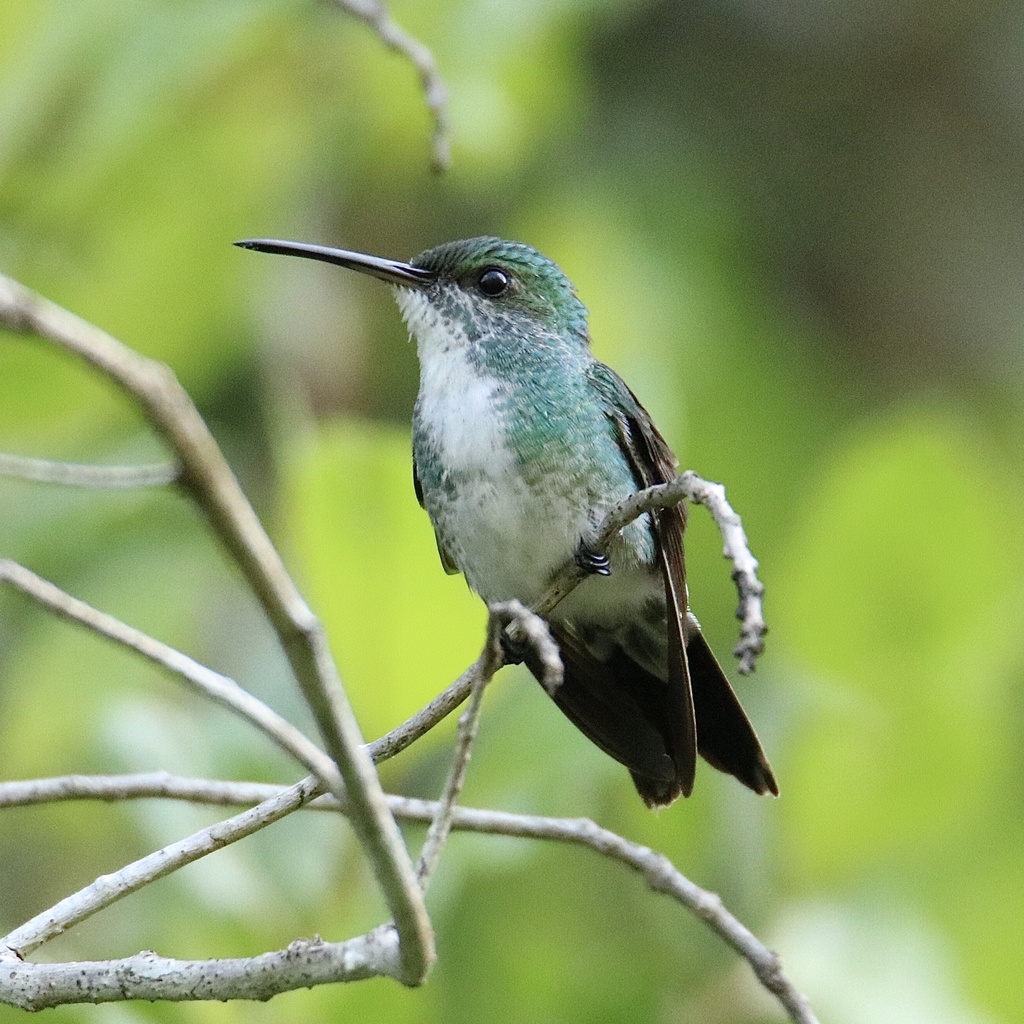
Sapphire-throated Hummingbird
Photo © Aitor
Photo © Aitor — CC BY 4.0 — Source: iNaturalist #37347647Identification
The sapphire-throated hummingbird is a compact, metallic-green hummingbird measuring just 9 cm (3.5 inches) in length. Its most distinctive feature is a deeply forked tail tipped with black, which sets it apart from similarly sized and colored species. Males are particularly striking, displaying shiny metallic-green plumage overall with a broad, glistening violet-blue throat patch and dark tail and wings. Females are more subdued in appearance, with white underparts extending from throat to vent and distinctive green spots adorning the sides of the breast.
The three subspecies show subtle variations in throat coloration: the nominate subspecies has a darker blue patch, Chrysuronia coeruleogularis conifis displays a more turquoise tone, and Chrysuronia coeruleogularis coelina exhibits a lighter blue. This species can be confused with its congeners, the sapphire-bellied hummingbird—which has more extensive blue coloration on its underparts—and the shining-green hummingbird, which lacks significant blue plumage entirely.
Range & Habitat
The sapphire-throated hummingbird is found across a substantial range spanning Panama, Colombia, and more recently Costa Rica, with a total distribution area of approximately 88,900 square kilometers. The three subspecies occupy different regions: the nominate subspecies inhabits Pacific western Panama from Chiriquí to the Canal Zone, Chrysuronia coeruleogularis confinis occupies the Caribbean slope of eastern Panama and northwestern Colombia, and Chrysuronia coeruleogularis coelina is found in northern Colombia from north Chocó through Ciénaga Grande de Santa Marta. A significant range expansion was documented in 2008 when a male was discovered in Costa Rica some 35 kilometers north of the Panamanian border, suggesting the species is gradually dispersing northward.
These hummingbirds favor coastal forests, secondary forests, and scrubby clearings, preferring light forests and forest edges over dense woodland. They occasionally use mangrove patches and have demonstrated adaptability to modified habitats, including protected areas like Tayrona National Natural Park in Colombia. They typically remain at elevations up to 100 meters above mean sea level.
Behaviour & Diet
Unlike northern hummingbird species that undertake extensive migrations, the sapphire-throated hummingbird does not migrate dramatically due to its Central and South American range. However, local altitude dispersal may occur in response to habitat changes. These are solitary birds that neither live nor migrate in flocks, maintaining independent territories year-round.
Best Time & Places to See It
The sapphire-throated hummingbird's lack of major seasonal migration means it can be encountered throughout the year within its range. Visitors should focus on coastal forest regions, secondary growth areas, and scrubby clearings in Panama and Colombia, with increasing chances of sightings in Costa Rica. Protected areas such as Tayrona National Natural Park in Colombia provide reliable viewing opportunities within suitable habitat.
Photography Tips
The species' small size and rapid wing-beats demand fast shutter speeds and careful tracking. The male's brilliant violet-blue throat provides striking contrast against its metallic-green body and offers excellent subject matter when the bird is perched. The distinctly forked tail is a key identifying feature worth capturing. Forest edge and scrubby habitat photography offers better lighting conditions than dense forest interiors, where these birds often forage. Early morning light will best showcase the iridescent throat patch and metallic plumage that make this species so visually distinctive.
Corcovado National Park
Puerto Jiménez, Costa Rica
+444 birds+48 mammals
Where the Osa Peninsula juts into the Pacific, rainforest descends almost to the tide line, and Corcovado National Park protects one of Central America's most intact…
VIEW NATIONAL PARKPiedras Blancas National Park
Golfito, Costa Rica
+386 birds+24 mammals
Where the Golfo Dulce meets the southwestern Pacific coast of Costa Rica, Piedras Blancas National Park protects a dramatic transition zone where lowland rainforest descends toward…
VIEW NATIONAL PARKCoiba National Park
Montijo, Panama
+260 birds+10 mammals
An archipelago of volcanic and sedimentary islands rises from the Pacific waters off Panama's southwestern coast, its densest rainforest canopy unbroken for millennia. Coiba National Park…
VIEW NATIONAL PARKSarigua National Park
Parita, Panama
+56 birds+1 mammals
Across the Parita lowlands of Herrera Province, mangrove forests and tidal mudflats define a landscape shaped entirely by water—where brackish estuaries meet the Pacific and the…
VIEW NATIONAL PARKGeneral de División Omar Torrijos Herrera National Park
La Pintada, Panama
+401 birds+2 mammals
Across the highlands of central Panama, where the continental divide funnels moisture-laden trade winds into steep river valleys, the terrain rises and falls in a landscape…
VIEW NATIONAL PARKSoberanía National Park
Cristóbal, Panama
+495 birds+34 mammals
Rainforest and riverine woodland blanket the rolling terrain of this 714-square-kilometre national park in Colón Province, where the Caribbean watershed feeds a maze of streams and…
VIEW NATIONAL PARKChagres National Park
Caimitillo, Panama
+486 birds+19 mammals
Where the Chagres River carves through the humid tropics of central Panama, a vast montane and lowland forest sprawls across more than 2,300 square kilometers, anchoring…
VIEW NATIONAL PARKDarién National Park
Tucutí, Panama
+534 birds+13 mammals
Where the spine of Central America crumbles into wetland and rainforest, Darién National Park sprawls across more than 20,000 square kilometres of some of the tropics'…
VIEW NATIONAL PARKPortobelo National Park
Portobelo, Panama
+366 birds+9 mammals
Where the Caribbean's turquoise waters meet the Darién's verdant shore, Portobelo National Park sprawls across 570 square kilometers of coastal forest, mangrove wetland, and coral-fringed islands…
VIEW NATIONAL PARKNo community photos yet. Log in to add the first one.
No community observations of this species yet.