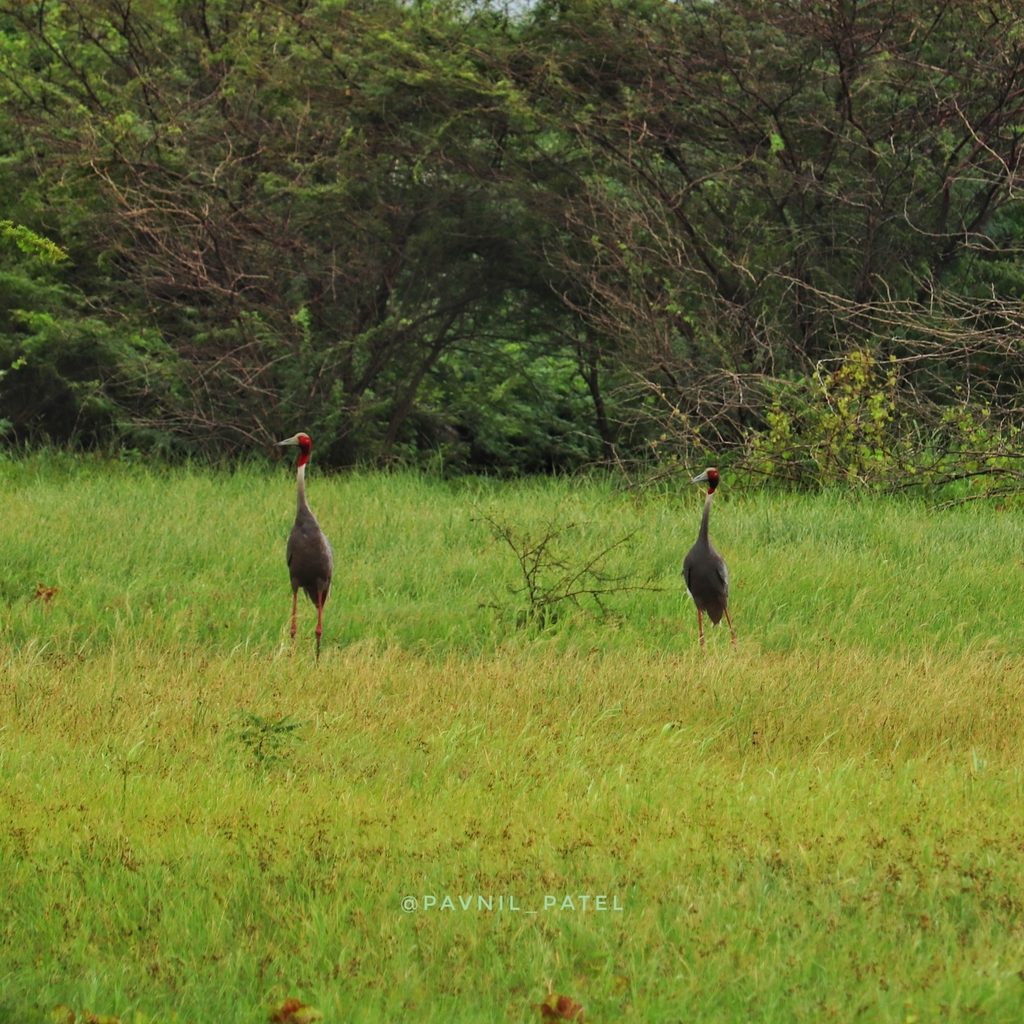
Sarus Crane
Photo © Pavnil Patel
Photo © Pavnil Patel — CC BY 4.0 — Source: iNaturalist #90136071Identification
The sarus crane is the tallest of all flying birds, standing at heights up to 1.8 metres (5 ft 11 in). It is easily distinguished from other cranes in its region by its overall grey plumage contrasted with a striking bare red head and upper neck. The Indian population (A. a. antigone) is distinguished by a white collar below the bare head and upper neck, and white tertiary flight feathers. The Southeast Asian population (A. a. sharpii) lacks this white collar and white wing feathers. The Australian population (A. a. gilliae) resembles the Southeast Asian birds but is distinguished by a larger grey patch of ear coverts.
Range & Habitat
The sarus crane is a large nonmigratory crane found across the Indian subcontinent, Southeast Asia, and northern Australia. It inhabits open wetlands in South Asia, seasonally flooded Dipterocarpus forests in Southeast Asia, and Eucalyptus-dominated woodlands and grasslands in Australia. The species has been extirpated from many parts of its former range, but the largest known population occurs in northern India's Uttar Pradesh, where it thrives in agricultural lands, flooded paddy fields, and the extensive network of canals that benefit the species.
In Australia, the species was first noticed in 1966 and is regarded as a relatively recent immigrant, though genetic evidence suggests the continent was colonized during the Late Pleistocene, some 35,000 years ago. A population that formerly existed in the Philippines is now extinct.
Behaviour & Diet
Sarus cranes forage on marshes and shallow wetlands for roots, tubers, insects, crustaceans, and small vertebrate prey. Like other cranes, they form long-lasting pair bonds and maintain territories where they perform elaborate territorial and courtship displays. These displays include loud trumpeting calls, dramatic leaps, and dance-like movements. In Indian culture, sarus cranes are revered as symbols of marital fidelity, believed to mate for life and even to starve themselves upon losing their partners.
During the breeding season, which coincides with the wet season, pairs build an enormous nest "island"—a circular platform of reeds and grasses nearly two metres in diameter, constructed high enough to remain above the surrounding shallow water.
Best Time & Places to See It
The breeding season, during the wet season, is the best time to observe sarus cranes as they are most active and conspicuous. Northern India, particularly Uttar Pradesh, offers the most reliable opportunities to see the species, as this region supports the largest known population. The cranes' close association with human agricultural lands and favourable local attitudes make them relatively accessible in this stronghold. In Southeast Asia and Australia, they inhabit seasonally flooded forests and grasslands, though they are less numerous than in India.
Photography Tips
The sarus crane's striking red head and upper neck against grey plumage creates excellent photographic contrast, particularly in good light. The bird's impressive height and conspicuous nature in open wetlands make it relatively approachable compared to more secretive species. Photographing the elaborate courtship displays—including leaps and dance-like movements—requires patience and positioning near territories during breeding season. Early morning light on wetlands is ideal for capturing the crane's distinctive silhouette and the vibrant colour of its bare head and neck.
Ranthambhore National Park
Sawai Madhopur, India
+294 birds+20 mammals
Granite ridges and ravines carved through the Aravalli Range frame this protected landscape in eastern Rajasthan, where deciduous forest mingles with open scrubland and seasonal water…
VIEW NATIONAL PARKHerberton Range National Park
Australia
+115 birds+10 mammals
Rainforest-clad ridges and rocky outcrops define this 324-square-kilometre reserve in far north Queensland, where the mountainous terrain of the Herberton Range rises through layered eucalypt woodland…
VIEW NATIONAL PARKKakadu National Park
Kakadu, Australia
+273 birds+46 mammals
Kakadu National Park is Australia’s largest national park and one of the world’s most remarkable protected areas, covering nearly 20,000 square kilometres in the tropical north…
VIEW NATIONAL PARKDaintree National Park
Dedin, Australia
+362 birds+37 mammals
Daintree National Park is one of the world’s oldest and most biologically diverse tropical rainforests, protecting an extraordinary landscape where ancient forests meet the Great Barrier…
VIEW NATIONAL PARKRinyirru National Park
Lakefield, Australia
+258 birds+7 mammals
Where the savanna grasslands of far north Queensland meet seasonal wetlands and eucalypt woodlands, Rinyirru National Park sprawls across more than 12,500 square kilometres of rugged,…
VIEW NATIONAL PARKKanha Tiger Reserve
Kanha Kisli F.V., India
+321 birds+23 mammals
Where sal forests give way to emerald meadows and crystalline streams carve through ancient valleys, one of India's finest wilderness reserves unfolds across the Maikal Range.…
VIEW NATIONAL PARKTadoba National Park
Palasgaon Singru, India
+270 birds+20 mammals
Where sal forests meet open grasslands and rocky outcrops rise from red laterite soil, central India's landscape unfolds in raw, untamed beauty. Ancient teak woodlands and…
VIEW NATIONAL PARKBandhavgarh National Park
Garhpuri, India
+285 birds+17 mammals
Where granite ridges rise dramatically above sal and bamboo forests, one of India's most pristine tiger reserves unfolds across the Vindhyan plateau. Ancient rock formations tower…
VIEW NATIONAL PARKPanna National Park
Badgadi Kalan, India
+271 birds+17 mammals
Where granite gorges slice through central India's Vindhyan plateau, a landscape of stark beauty unfolds across nearly six hundred square kilometers. The Ken River carves through…
VIEW NATIONAL PARKKeoladeo National Park
Shreenagar Rural, India
+326 birds+14 mammals
Where shallow wetlands shimmer beneath vast Rajasthani skies, one of Asia's finest bird sanctuaries pulses with extraordinary life. This former maharaja's hunting reserve, now spanning 29…
VIEW NATIONAL PARKNo community photos yet. Log in to add the first one.
No community observations of this species yet.